



TIP122 Pinout Guide: Features, Functions, and Practical Usage
The TIP122 pinout is a Darlington power transistor. A Darlington power transistor means that a transistor pair is in one box. Importantly, the main reason for placing the two transistors together is to increase the final gain. The TIP122 transistor works similarly to a typical transistor containing a Darlington pair.
The TIP122 is a common purpose transistor in the electronics market because of its distinct features. For instance, some of these features are its extraordinary current gain ability and a huge collector current valued at 5A. The design of this transistor is unique to perform functions such as power switching and amplification purposes.
In this article, we discuss the Tip 122 transistor, its use, and how to connect it in circuits safely.
Tip122 Transistor Pin Configuration.
Below is a table that describes each pin.
| Pin no. | Pin name | Description |
| 1 | Base | This pin works by switching the transistor on or off. Also, the base pin is in charge of the biasing of the transistor. |
| 2 | Collector | The collector pin joins the load in the electrical circuit. Additionally, this pin works by letting current flow through it. |
| 3 | Emitter | The Emitter pin connects to the ground. As a result, the current from the collector flows to the emitter then finally to the ground. |
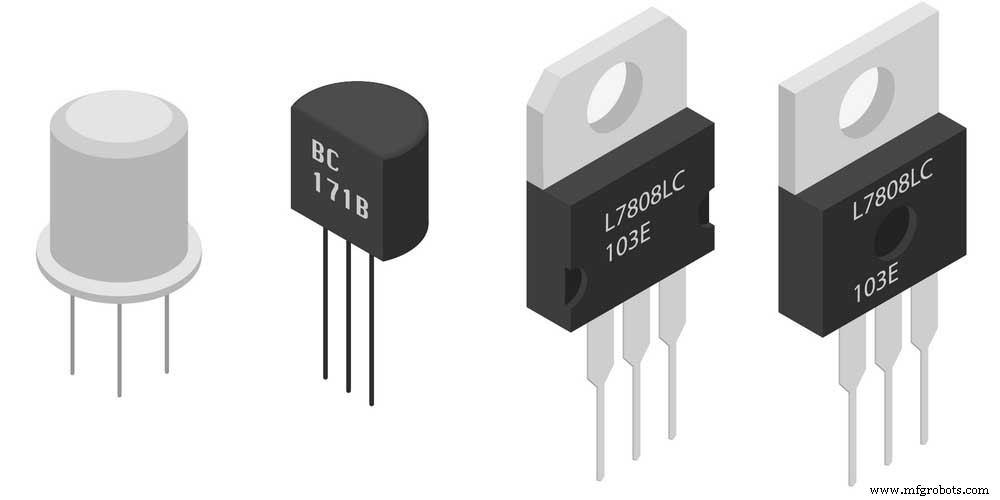
(transistors with three pins)
Features of the TIP122
- Firstly, the Tip122 Darlington transistor is available in a TO-220 type of package.
- Secondly, the transistor has a base current of 120Ma.
- Thirdly, the transistor has a collector current of 5A.
- Also, the Tip122 transistor is an NPN Darlington power transistor.
- Moreover, this transistor has a typical maximum rating and minimum direct current gain (hFE) valued at 1000.
- Additionally, the VCE or collector-emitter voltage is at 100v
- Also, the transistor has a 100v collector-base voltage.
- Next, the transistor has a maximum collector dissipation of 65W.
- In addition, the maximum storage and operating temperature of the TIP122 transistor are between -65 and +150 degrees Celsius.
- Lastly, the max emitter-base voltage is 5v.
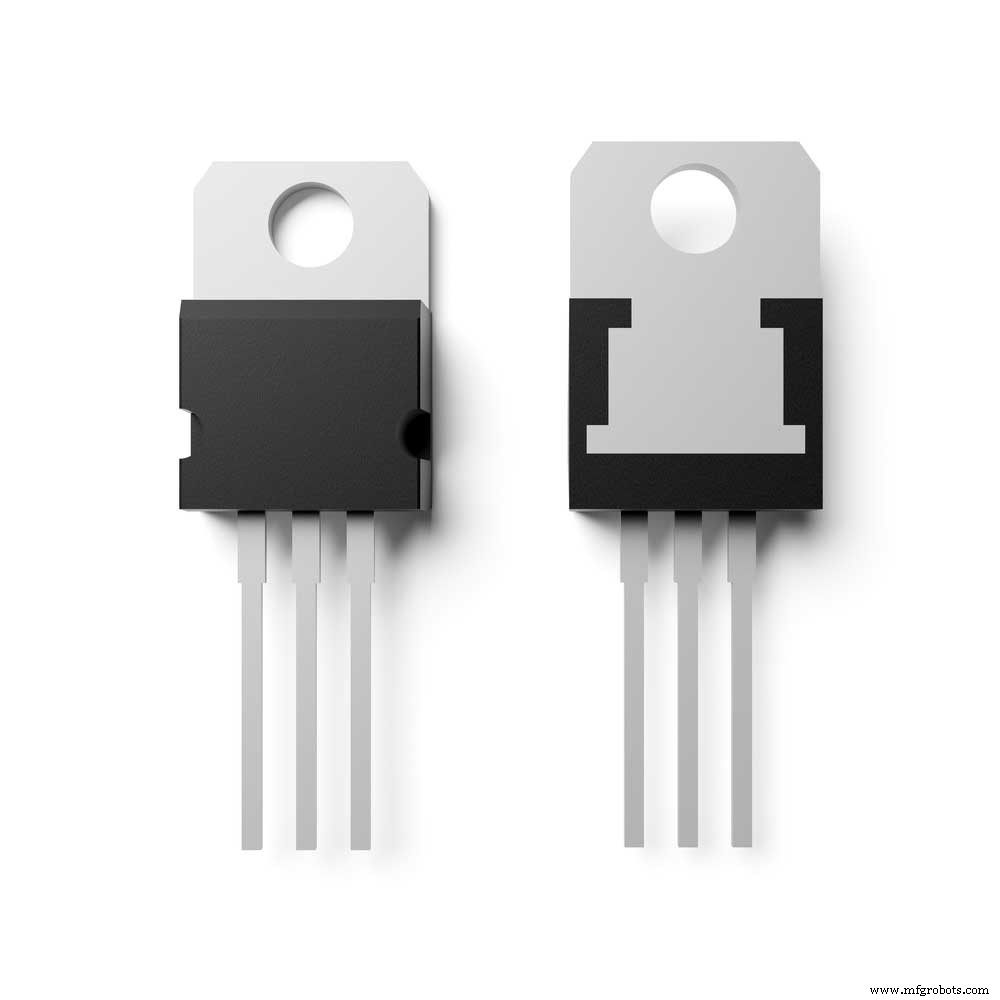
(transistors in a TO-220 package type.)
TIP122 Replacement and Equivalent
The TIP122 is in a family of the TIPXXX transistors. Some transistors in the same family as TIP122 include TIP120 and TIP121 which are all NPN transistors. Also, we consider the TIP127 transistor as the complementary Darlington transistor of the TIP122. Notable equivalent transistors include; KSD560, 2N6532, BDW2, 2N6045, MJF6388, 2SD2495, BDT63, KSB601, and 2SD1415.
Several different transistors can work in place of the TIP122. For example, the BC549, BC636, BC547, 2N3055, BC639, 2N3906, 2N3904, and the 2SC5200 transistors. However, the pin configurations may slightly differ from the TIP122.
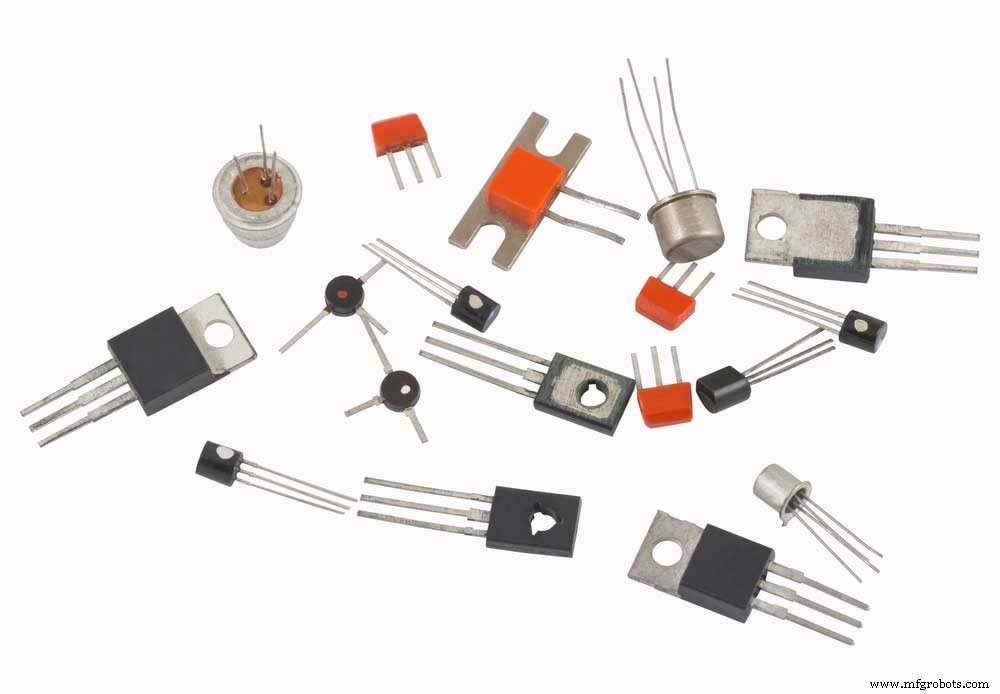
(different types of transistors.)
What is TIP 122 Used For?
The TIP122 Darlington transistor controls heavy loads with high current or in projects that require high amplifications. This transistor can control larger current loads because it has a constant current gain and a high collector current.
Due to its low base-emitter voltage, a logic device like a microcontroller can easily control the TIP122 transistor. However, precaution has to be in place to ensure the logic device works properly in an electronic circuit.
Moreover, the TIP122 transistor works well for projects that need a logic device to control it. The logic device works by switching high power loads. Also, the logic devices can work by amplifying high currents.
(a photo of transistors, microcontrollers, and other electrical components.)
The work of TIP122
Due to its high current gain and a higher collector current, the TIP122 transistor is very popular. The transistor switches loads of higher current. Also, you can use it in applications that use up a lot of current because of this feature.
The TO-220 package of the TIP 122 transistor comprises two transistors. The first transistor’s emitter connects to the second transistor’s base. At the same time, the collector pin in both transistors joins together. The Darlington pair is crucial in increasing the transistor’s current rating and current gain. Also, the tiny current flowing between the base and emitter can switch a bigger current between the collector and emitter pins.
However, with a low base to emitter voltage, a logic device can effortlessly organize the transistor.
Since the TIP122 transistor has extraordinary features in current gain and collector current, it’s impartially modest to switch the suitable. Meanwhile, it has an emitter-base of only 5v and a current in the base for 120mA.
Project explanation
For example, here is a project where you need to control a 48v motor. This motor has a continuous current of 3A but with a 100-ohm resistor. You already know that a TIP122 transistor has current in the collector pin at 5A. However, this project consumes only 3A. Also, the maximum base current is 120mA. But, you are using a 100-ohm resistor which ends up limiting the current to 42mA. The pulse current of the transistor is at 8A.
Make certain that your motor does not consume an excess of the peak current. This project should help you understand how the transistor can control the load.
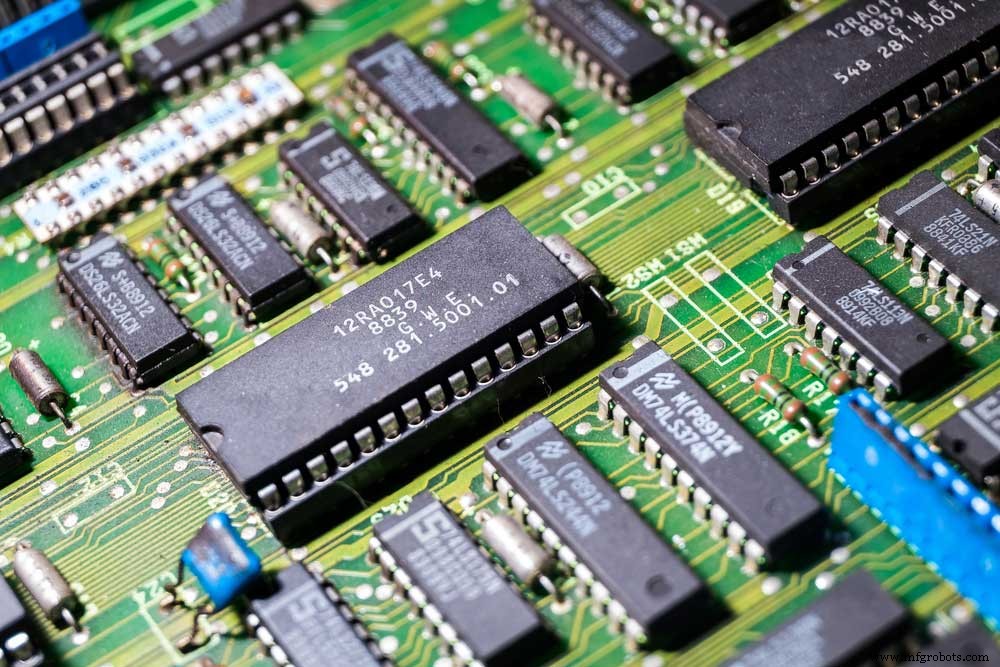
(microchips and transistors on a circuit board.)
How to use TIP122 Safely In A Circuit?
Importantly, to get an efficient functioning of the Darlington pair, always ensure you remain below the max ratings. An application circuit operating with more than 100v will damage the device. Also, avoiding loads that surpass 5A and a suitable base resistor is essential in providing the correct base current.
Moreover, a suitable heatsink is an electrical device accompanying the TIP122 transistor in a circuit. Therefore, the heatsink protects the circuit from overheating and ensures the electrical circuit is within the operating temperatures.
(an electronic chip with transistors.)
Application of TIP122
- Firstly, the transistor can work as an average current switch.
- Secondly, you can use the TIP 122 transistor as an inverter in a rectifier circuit.
- Thirdly, the TIP122 transistor can function in commanding velocities in motors.
- Also, the transistor works in applications that require you to adjust high current loads.
- Lastly, this transistor works in projects requiring high amplification to achieve good results.
Summary
The TIP122 transistor is fairly common for its high current gain and collection current. It is perfect for applications that need to switch high-powered loads.
We hope this article has been of help to you. For any queries on this topic or any of our work, please don’t hesitate to contact us. Our team will help!
Industrial Technology
- Transistor Saturation Explained: How to Identify and Use It Effectively
- Mastering the Raspberry Pi Camera Pinout: A Complete Guide to Setup and Usage
- S8050 Transistor Explained: Applications & Features
- PIC18 Microcontrollers: Features, Performance, and How to Use Them
- Complete 74HC00 Pinout Guide: Where & How to Use the NAND IC
- 2N5089 Transistor Pinout & Specifications: A Comprehensive Guide for Audio and Switching Applications
- 2N3055 Transistor: Comprehensive Guide, Features, and Applications
- 2N3771 NPN Transistor: Pinout, Key Features, Applications & Alternatives
- 78L05 Pinout Guide: Features & Wiring Instructions
- Arduino SD Card 101: Setup, Connection, and Usage Guide