



Enhancing 3D-Printed Parts: Secondary Operations for Superior Performance & Finish
Industrial 3D printing creates functional plastic parts quickly, but often times the parts can benefit from secondary operations that improve on cosmetic appearance and functionality.
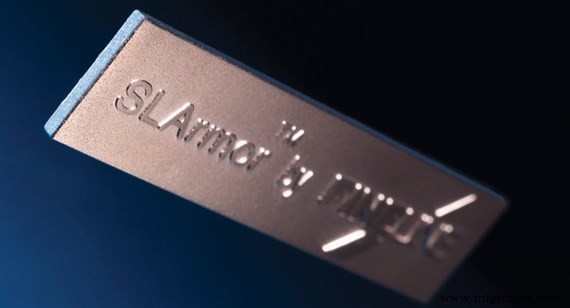 SLArmor adds mechanical strength to 3D-printed parts. It uses DSM Somos Nanotool to nickel plate SL parts.
Improving Performance
Threads don’t form well in 3D printing due to layering, tolerances, and over curing of the material. One option for improved thread performance is to have holes threaded or tapped after the build has been completed—this provides smooth threads and enhanced performance. Alternatively, threaded inserts can be installed to further improve strength. With stereolithography (SL), we install threaded inserts by gluing them in place and with selective laser sintering (SLS), we heat stake them in as SLS uses commercial-grade thermoplastic nylon.
Another way to improve parts performance is by having a nickel plating (SLArmor) applied to SL parts to provide increased heat and mechanical properties. SLArmor can be selected in your ProtoQuote when you need parts to mimic die cast aluminum, for example. SLArmor can also be applied with a few different surface finishes but has two thicknesses that can change material properties. Those thicknesses are approximately 0.002 in. and 0.004 in.
Colors and Cosmetics
Color and cosmetic appearance options are limited as manufactured, but many times this often can be improved in post-production so that 3D-printed parts resemble injection-molded parts. We have a few different ways of altering part color, which include applying a colored dye, custom paint, or soft-touch paint to SL and SLS parts. A dye is generally going to be less expensive and faster than paint.
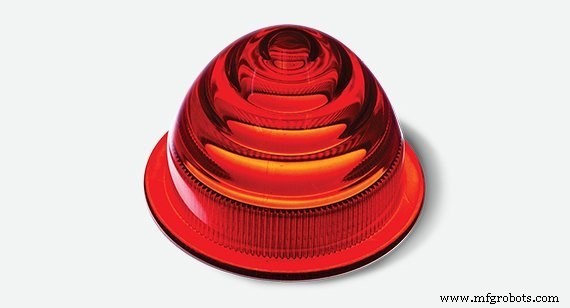 A transparent taillight lens was created with a red dye applied to clear SL part.
- With part dyeing we offer five primary colors: black, red, yellow, blue, and green. Dyeing results in an opaque or transparent appearance depending on the base material.
- Custom painting is also available with for those looking for different colors on various features. We can match to any Pantone number provided.
- If you’re looking for an early prototype of an overmolded design, soft-touch paint can add the look and feel of an overmolded part.
- Light, medium or heavy texturing can also be painted on to represent a mold finish.
- To have these finishes added to a part, we simply need a detailed PDF of the part, colors, and regions of the locations for each finish.
Also, many times decals or stickers work well for additional design elements like a company logo, for example. Since 3D printing typically produces small quantities of parts, this is easily achievable as long as the decals are provided to us before parts are produced.
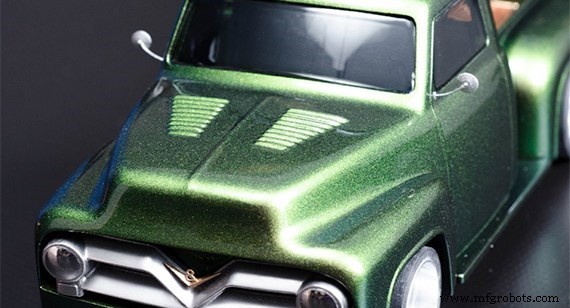 A 1955 Ford F100 model with custom paint to create fine detail and enhanced color.
Polishing, texturing, and clear coating are yet more options when a clear part without layer lines are required or a matte finish is needed. A clear coat is often times applied to SL parts when polishing is applied to a part or if longer UV protection is required.
How to Request a Custom 3D Printing Finish
When you request a quote for 3D printing, you’ll need to:
- Select the 3D printing process for manufacturing and material
- Upload an STL file to receive an instant, interactive quote that includes your base price and lead time
- Select “custom finish” in a drop down menu within the quote and enter a note with your desired finish
- Provide a PDF with clear instructions on how to complete your request
- Finalize your order after you receive a manual quote from one of our applications engineers that contains updated pricing and lead time—this normally takes less than a few hours to complete a non-auto quote
If you have questions regarding secondary operations for 3D printing, please contact our applications engineers at 877-479-3680 or ADMIN@MFGROBOTS.COM.
Industrial Technology
- Assessing Precision of a Current‑Pump Circuit Across Resistor Tolerances and Automotive Temperature Ranges
- In‑Process Inspection: Elevating 3‑D‑Printed Part Quality
- Professional Guide to Finishing and Painting 3D Printed Parts
- Rolling Mills Explained: Types, Parts, and How They Work
- Twist Drill Explained: Parts, Types, and Nomenclature – A Complete Guide
- Maximize Profits & Ensure Compliance with Smart Asset Tracking
- Revolutionizing Part Consolidation with Additive Manufacturing
- Expert Texturing Solutions for 3D-Printed Parts: Aesthetic and Functional Benefits
- Enhance 3D-Printed Parts with Expert Dyeing & Painting Services
- Mastering Fillets & Chamfers: Enhancing Safety & Aesthetics in Machining