



Accelerating Vehicle Development: How OEMs Shorten Launch Cycles
Vehicle development has never moved faster, nor faced greater pressure.
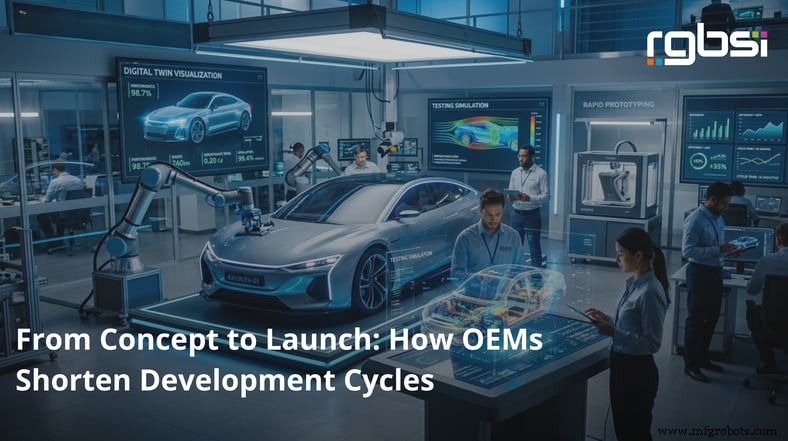
Automotive OEMs are juggling electrification, software‑defined vehicles, connected technologies, evolving regulations, and shifting consumer demands—all while competition intensifies.
A delayed launch not only pushes back timelines; it erodes profitability, market positioning, supplier coordination, and long‑term brand perception.
For many manufacturers, the question is no longer whether innovation is possible, but whether it can happen quickly enough.
Legacy vehicle‑development models, built around sequential engineering steps, struggle to keep pace. Long validation cycles, disconnected systems, late‑stage design changes, and fragmented supplier communication keep programs stuck.
To stay competitive, OEMs are reshaping how vehicles are engineered, tested, and launched using digital engineering, AI‑driven insights, agile development, and connected product ecosystems. The result is faster delivery without compromising quality.
Why Development Speed Is a Competitive Edge
Modern vehicle programs are far more complex than five years ago.
Today’s cars combine:
- Advanced software systems
- Electrified powertrains
- ADAS and autonomous technologies
- Connected vehicle platforms
- Global compliance requirements
That complexity elevates risk. A single design flaw discovered late can trigger costly delays across validation, sourcing, manufacturing, and launch readiness.
Consequently, shortening development cycles has become a strategic priority for OEMs worldwide.
Faster development allows manufacturers to:
- Respond rapidly to market demand
- Accelerate EV and mobility program launches
- Reduce engineering and validation costs
- Improve ROI across vehicle platforms
- Gain a competitive advantage in fast‑evolving segments
The leaders of this shift are not merely working faster; they are building smarter, more connected engineering environments.
Digital Engineering Replaces Traditional Silos
One of the biggest transformations in the automotive sector is the move toward integrated digital engineering ecosystems.
Historically, mechanical, electrical, software, manufacturing, and supplier teams operated in disconnected silos. Information moved slowly between departments, creating bottlenecks and increasing the likelihood of late‑stage redesigns.
Modern OEMs replace those silos with connected engineering platforms that weave a continuous digital thread across the product lifecycle.
Cloud‑based PLM systems, digital twins, and model‑based systems engineering now enable teams to collaborate in real time across global operations.
This connected approach gives engineering teams the ability to:
- Spot issues earlier
- Reduce design iteration delays
- Enhance cross‑functional visibility
- Accelerate decision‑making
- Streamline validation and launch readiness
The outcome is a faster, more agile development process.
Simulation and Digital Twins Cut Physical Testing Delays
Physical prototyping remains essential, but OEMs are drastically reducing reliance on time‑intensive builds through advanced simulation technologies.
Digital twins let manufacturers create virtual replicas of vehicles, components, and manufacturing systems long before physical production begins.
Engineering teams can simulate:
- Crash performance
- Battery thermal management
- Aerodynamics
- Structural durability
- Manufacturing line efficiency
- Software integration scenarios
Instead of waiting weeks for physical validation, engineers evaluate multiple design iterations simultaneously in virtual environments.
This capability is especially critical for EV programs, where battery packaging, thermal efficiency, and software integration require constant optimization.
AI‑assisted simulation tools also help OEMs identify lightweighting opportunities, improve energy efficiency, and reduce engineering complexity earlier in the cycle.
The result: fewer late‑stage engineering changes, lower validation costs, and faster program execution.
AI and Real‑Time Data Accelerate Decision‑Making
Artificial intelligence is becoming a major driver of development efficiency across the industry.
OEMs increasingly employ AI‑powered tools to:
- Detect design conflicts early
- Predict component failures
- Optimize manufacturing workflows
- Improve supply‑chain forecasting
- Automate software testing and validation
Real‑time analytics platforms give leadership teams deeper visibility into program health. Engineering managers now monitor supplier readiness, software milestones, validation progress, and production risks from centralized dashboards, enabling faster, more informed decisions.
This shift toward intelligent engineering environments fuels demand for professionals skilled in:
- Systems engineering
- Embedded software development
- Data analytics
- Digital manufacturing
- AI‑driven product engineering
These capabilities are increasingly valuable across OEMs and suppliers alike.
Modular Platforms Accelerate Product Development
Adopting modular architecture is another key strategy for shortening vehicle development cycles.
Instead of building entirely new platforms for each model, OEMs develop scalable vehicle architectures that support multiple models and powertrain configurations.
This enables manufacturers to:
- Reuse core engineering components
- Reduce development redundancy
- Simplify manufacturing integration
- Accelerate sourcing and supplier alignment
- Launch vehicles faster across global markets
Several leading OEMs now build entire EV portfolios from shared modular platforms, dramatically reducing time‑to‑market while improving production scalability.
Combined with over‑the‑air software capabilities, modular architecture lets manufacturers continue improving vehicle functionality after launch, easing pre‑production pressure.
The Future of Automotive Development Is Connected
Reducing vehicle development cycles is no longer just an operational goal; it is a defining capability for modern automotive organizations.
OEMs that successfully integrate digital engineering, AI‑driven development, simulation technologies, and collaborative product ecosystems position themselves to respond faster to market shifts while maintaining quality and profitability.
As vehicles become increasingly defined and connected, the industry will keep moving toward faster, smarter, and more adaptive development models.
The manufacturers leading this transformation are not merely accelerating production timelines—they are building the next generation of automotive innovation.
Ready to accelerate vehicle development without compromising quality, innovation, or launch readiness? Whether you’re optimizing engineering workflows, cutting validation bottlenecks, integrating digital engineering technologies, or scaling next‑generation vehicle programmes, RGBSI’s automotive engineering and digital transformation experts are ready to help. From connected product development and AI‑driven engineering to simulation, systems integration, and manufacturing readiness, we help OEMs reduce development cycles, improve cross‑functional collaboration, and bring vehicles to market faster with confidence and precision.
About RGBSI
At RGBSI, we deliver comprehensive workforce management, engineering, quality lifecycle management, and IT solutions that provide strategic partnership for organizations of all sizes. As a team of engineering experts, we understand the importance of modernization. Our solutions give clients agility and enhancement by optimizing the value chain to meet industry protocols and full product specifications. Learn more about our automation and digital engineering services.
Industrial Technology
- Designing Effective Predictive & Preventive Maintenance Strategies for Pump Reliability
- Selecting Microcontroller Peripherals for High‑Performance DSP Projects
- AI Surpasses Experienced Dermatologists in Skin Cancer Detection Accuracy
- The Ultimate Guide to PCB Annular Rings: Design Tips & Solutions
- Bridging the Manufacturing Skills Gap: 5 Essential Competencies for the Future Workforce
- Smart Buildings Beyond COVID: Sustainable Innovations for a Healthier Future (Part 2)
- Industry 4.0 Explained: Key Technologies & Benefits
- Converting Between Thevenin and Norton Equivalents: A Practical Guide
- Boost Healthcare Supply Chain Resilience with Advanced WMS Solutions
- Essential Precision Measuring Tools for Mechanical Part Machining