



Converting Between Thevenin and Norton Equivalents: A Practical Guide
Since Thevenin’s and Norton’s Theorems both simplify complex networks into manageable equivalents, it is natural to convert a Thevenin equivalent into a Norton equivalent—and vice versa—using a straightforward procedure.
Thevenin Resistance and Norton Resistance
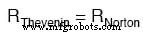
Both Thevenin and Norton resistances are determined by deactivating all independent sources and measuring the input resistance across the open terminals. Consequently, the two resistances are identical for a given network. The example circuits in the previous sections confirm this equality:
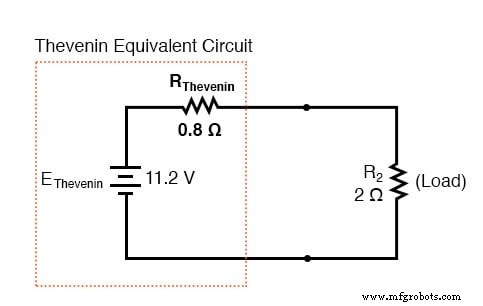
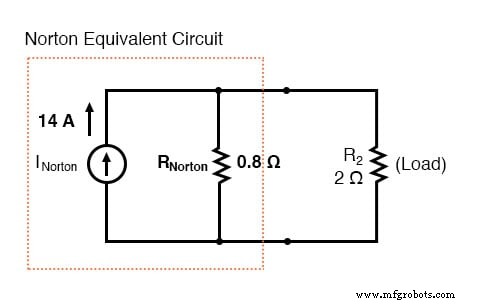
Because both equivalents represent the same original network from the load’s viewpoint, they must exhibit identical voltage‑ and current‑response characteristics.
When the load is open, both equivalents deliver the same open‑circuit voltage. In the example, the Thevenin voltage is 11.2 V. In the Norton representation, 14 A flows through the 0.8 Ω Norton resistance, yielding 11.2 V (E = IR). Therefore, VTh = IN × RN.

To convert a Norton equivalent into a Thevenin equivalent, keep the resistance unchanged and compute the Thevenin voltage using Ohm’s Law.
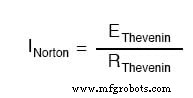
Similarly, the short‑circuit current through the load terminals must be identical for both representations. In the Norton case, the short‑circuit current equals the Norton source current (14 A). In the Thevenin case, 11.2 V across the 0.8 Ω Thevenin resistance produces the same 14 A (I = E/R). Hence, IN = VTh / RTh.
These equivalences are valuable tools for circuit analysis and design.
REVIEW:
- Thevenin and Norton resistances are equal.
- Thevenin voltage equals Norton current times Norton resistance.
- Norton current equals Thevenin voltage divided by Thevenin resistance.
RELATED WORKSHEETS:
- Millman’s Theorem Worksheet
- Thevenin’s, Norton’s, and Maximum Power Transfer Theorems Worksheet
Industrial Technology
- Electronics: A Hands‑On Science for All
- Setting Up a Home Electronics Lab: Tools, Work Area, and Supplies
- Mastering Voltmeter Use: Accurate Voltage Measurement Made Simple
- Mastering Factoring Identities: Key Algebraic Formulas
- Essential Trigonometric Equivalencies for Advanced Mathematics
- Thevenin’s Theorem: Simplifying Linear Circuits for Power System Analysis
- Norton’s Theorem: Simplifying Linear Circuits with Current Sources and Parallel Resistance
- Converting Between Thevenin and Norton Equivalents: A Practical Guide
- Norton’s Theorem Simplified: Step‑by‑Step Tutorial with Practical Example
- Master Thevenin’s Theorem: Step‑by‑Step Guide & Worked Example