



Millman's Theorem Explained: From Thevenin to Norton and the Millman Equation
Ever wondered how the seemingly complex formula for the “Millman voltage” is derived? It’s all about treating each parallel branch—each consisting of a series resistor and voltage source—as a Thevenin equivalent and then converting those to Norton equivalents. The resulting expression is simply the familiar parallel‑resistance calculation, but applied to current‑source equivalents.
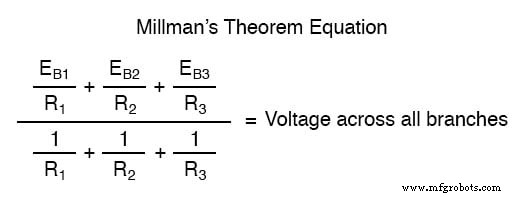
The numerator of the large fraction resembles the sum of branch currents (I=E/R), while the denominator mirrors the reciprocal of the sum of reciprocal resistances—the classic parallel‑resistance formula.
Thevenin Equivalent Circuit
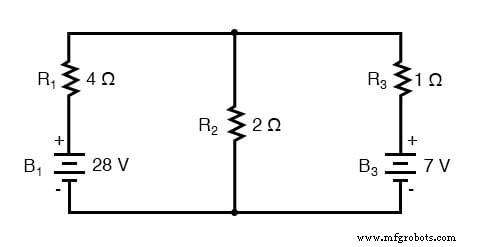
In the example, branch 1 (B1 + R1) is a Thevenin source of 28 V and 4 Ω. Converting to Norton gives a 7 A current source in parallel with 4 Ω. Branch 2 becomes a 7 A source with 1 Ω, and the middle branch—having no voltage source—converts to a 0 A source in parallel with 2 Ω.
Norton Equivalent Circuit
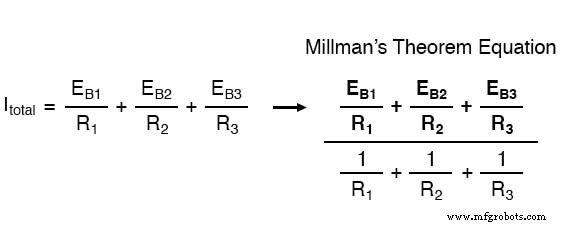
Because current sources in parallel simply add, the total circuit current is 7 A + 0 A + 7 A = 14 A. This addition is exactly the numerator in the Millman formula.
Millman Equation
All Norton resistances sit in parallel, reducing to an equivalent resistance:
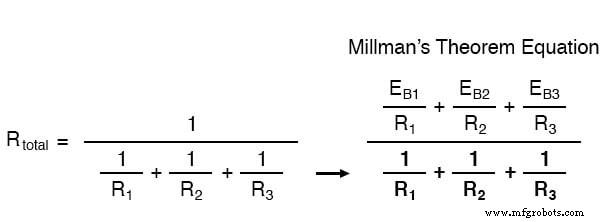
In this case the parallel resistance is 571.43 mΩ (0.571 Ω). The equivalent circuit simplifies to a single Norton source and resistance:
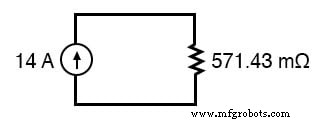
Applying Ohm’s law (E = IR) gives the voltage across the equivalent pair:
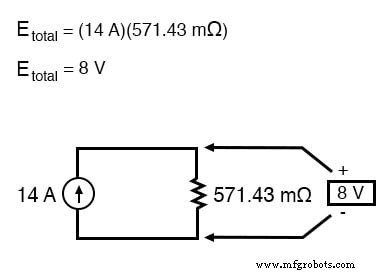
To recap: the total current is the sum of branch currents (E/R), the total resistance is the reciprocal of the sum of reciprocal branch resistances, and the total voltage equals the product of these two quantities. The Millman theorem is simply a concise expression of this relationship.
By understanding how Thevenin and Norton equivalents combine, the mystery of Millman’s equation disappears.
RELATED WORKSHEET:
- Millman’s Theorem Worksheet
Industrial Technology
- Circuit With a Switch: A Practical Guide to Basic Electrical Circuits
- Key Rules for Series Circuits: Current, Resistance, and Voltage
- Parallel Circuit Fundamentals: Voltage, Resistance, and Current Rules
- Mastering AC Circuit Equations: Impedance, Reactance & Resonance
- Comprehensive Guide to Analyzing Series‑Parallel Resistor Networks
- Millman’s Theorem: A Practical Guide to Parallel Branch Analysis
- Thevenin’s Theorem: Simplifying Linear Circuits for Power System Analysis
- Master Thevenin’s Theorem: Step‑by‑Step Guide & Worked Example
- Millman’s Theorem: Step‑by‑Step AC & DC Circuit Analysis with Practical Examples
- Master the Superposition Theorem: Step‑by‑Step Circuit Analysis with Practical Example