



Terahertz Band: Fundamentals, Properties, and Emerging Applications
Discover the Terahertz Spectrum, Its Key Characteristics, and Growing Use Cases
If you’ve encountered the term “THz gap” and wondered what it means, this article provides a clear, expert‑backed explanation.
The Terahertz Spectrum
Terahertz (THz) radiation occupies the electromagnetic band between 100 GHz (3 mm) and 10 THz (30 µm), straddling the millimeter and infrared regions. The band is also referred to as sub‑millimeter, far‑infrared, or near‑millimeter wave.
At 1 THz, a THz wave exhibits:
- Wavelength: 300 µm in free space
- Period: 1 ps
- Photon energy: 4.14 meV
Its temperature equivalent, given by hf/k_B, is 48 K (where h is Planck’s constant and k_B is Boltzmann’s constant).
The THz region’s placement within the broader spectrum is illustrated in Figure 1.
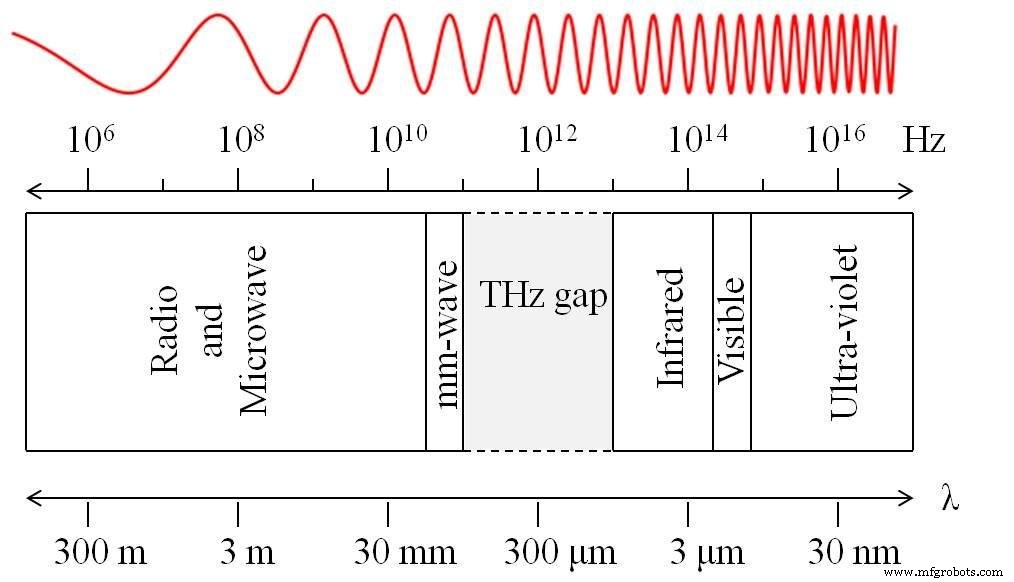
Figure 1. Location of the THz band in the electromagnetic spectrum.
Compared to the well‑studied microwave and optical bands, the THz region remains one of the least explored areas, hence the nickname “THz gap.” This under‑development has sparked interdisciplinary research across physics, materials science, electronics, optics, and chemistry.
Properties of Terahertz Waves
While interest in THz waves dates back to the 1920s, significant advances have occurred in the past thirty years, driven by the band’s unique attributes and potential applications.
Key characteristics include:
- Penetration: THz wavelengths exceed infrared wavelengths, resulting in reduced scattering and deeper penetration (centimetre‑scale) into dry, non‑metallic materials. Such materials are transparent at THz frequencies but opaque in the visible spectrum.
- Resolution: Shorter wavelengths than microwaves yield finer spatial imaging resolution.
- Safety: Photon energies are far below those of X‑rays, making THz radiation non‑ionizing.
- Spectral fingerprint: Many molecules exhibit inter‑ and intra‑vibrational modes that fall within the THz range, enabling unique spectroscopic signatures.
Challenges in Developing the THz Band
Despite its promise, the THz field lags behind adjacent bands mainly due to the scarcity of efficient, coherent, and compact THz sources and detectors. Traditional microwave devices (transistors, RF antennas) and optical devices (semiconductor laser diodes) are ill‑suited for the THz range, leading to significant power and efficiency losses.
Solid‑state electronics dominate the lower THz spectrum but suffer from 1/f² roll‑offs due to reactive‑resistive effects and long transit times. Optical approaches, such as diode lasers, falter near the THz upper limit because of insufficiently small bandgap materials.
Atmospheric attenuation also poses a major hurdle. THz waves are strongly absorbed by water vapor, with losses illustrated in Figure 2. This absorption leads to higher signal degradation than in microwave or infrared bands, especially in moist environments.
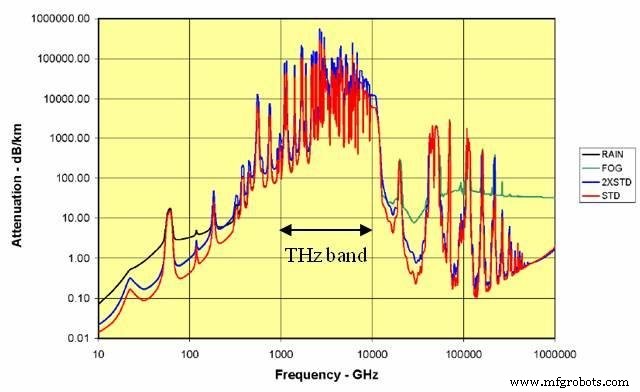
Figure 2. Atmospheric attenuation at sea level under various conditions: Rain = 4 mm/h; Fog = 100 m visibility; STD = 7.5 g/m³ water vapor; 2×STD = 15 g/m³ water vapor. Image from M. C. Kemp via IEEE Xplore.
These challenges, however, create niche opportunities:
- Aerospace: In the near‑vacuum of space, water‑related attenuation disappears, and THz sensors can detect interstellar dust signatures, as demonstrated by the Herschel Space Observatory.
- Short‑range applications: Over short distances, atmospheric effects are negligible, enabling high‑precision spectroscopy and high‑data‑rate wireless links.
Applications of Terahertz Radiation
THz technology spans imaging, spectroscopy, and wireless communication. In biomedical imaging, THz waves penetrate several hundred micrometers into tissue, making them useful for skin, oral, breast, and dental diagnostics. Security systems exploit THz’s ability to detect explosives and contraband. In industry, THz imaging aids semiconductor packaging inspection.
THz spectroscopy offers unparalleled insight into material properties. Figure 3 shows the vibrational spectrum of maltose, illustrating how THz frequencies map molecular vibrations.
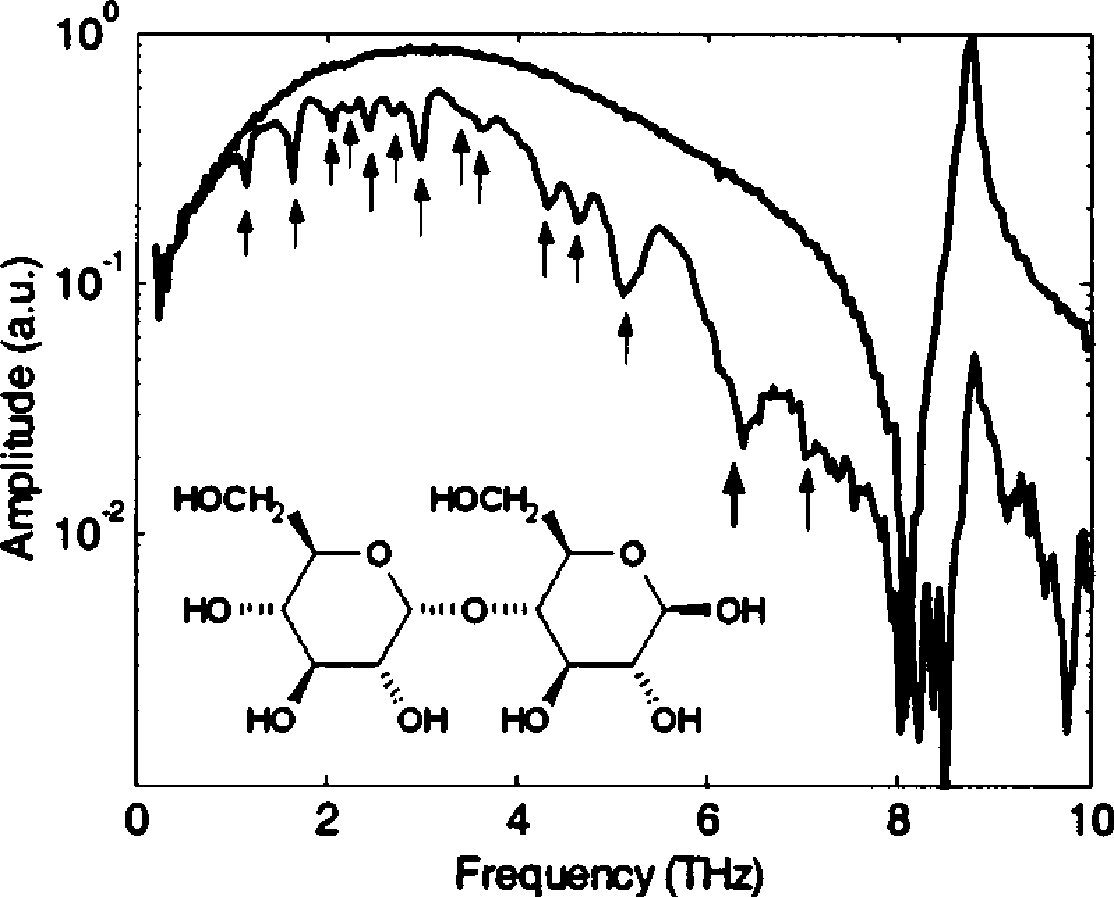
Figure 3. Vibrational spectrum of maltose measured with a THz time‑domain system. The upper graph shows the baseline THz signal; arrows in the lower graph mark vibrational frequencies. Inset: maltose structure. Image from Y. C. Shen et al via Applied Physics Letters.
In chemical analysis, THz spectroscopy can identify DNA signatures, protein structures, and differentiate hydrated from dry substances—a critical capability in the paper industry for monitoring moisture and thickness.
Non‑destructive testing frequently combines THz imaging and spectroscopy. For example, Figure 4 reveals the hidden layers of an ancient painting with micron‑scale detail.
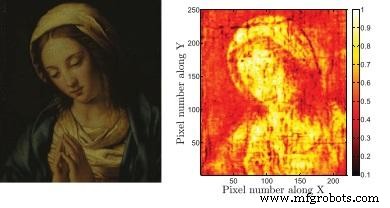
Figure 4. (a) Visible photograph of Madonna in Preghiera; (b) THz image (0.5–1 THz) showing underlying layers. Image from J. Dong et al via Scientific Reports.
Pharmaceutical quality control also benefits from THz methods. Figure 5 demonstrates how THz imaging quantifies coating thickness variation across tablets produced under identical conditions.
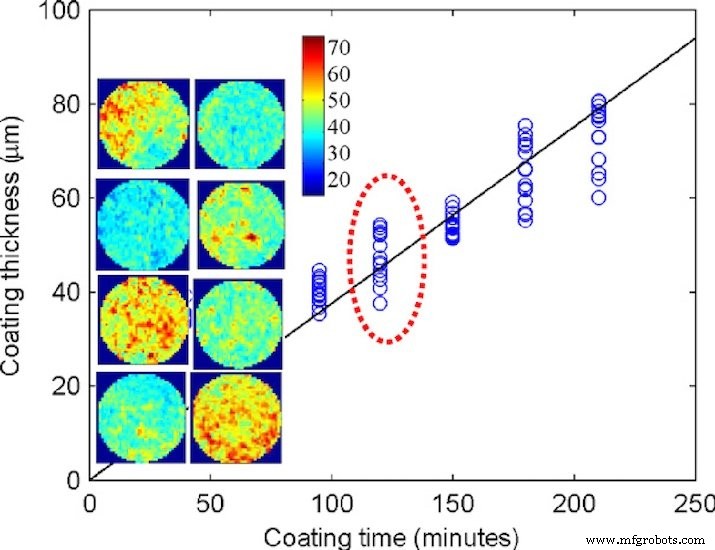
Figure 5. Average coating thickness per tablet versus coating time. Inset: µm map of eight tablets after 120‑min coating. Image from Y. C. Shen via International Journal of Pharmaceutics.
The Potential of the Terahertz Band
Over the past decade, lab experiments have showcased THz’s capabilities, spurring commercial interest. To fully realize THz’s promise, challenges such as high‑power, compact sources; system miniaturization; rapid beam scanning; and cost reduction must be addressed.
High‑speed THz wireless communication is a particularly vibrant research area, offering the prospect of data rates beyond current 5G systems.
What would you like to learn about terahertz band technologies? Share your questions in the comments below.
Industrial Technology
- Understanding the Key Components of a Bolt: A Comprehensive Guide
- Choosing the Right Drawer Slides: Center‑Mounted, Under‑Mounted & Ball‑Bearing Options
- Mastering Resin Infusion: A Complete Expert Guide
- Ultrasonic Welding of Plastics: A Professional Guide to High-Strength, Eco-Friendly Bonding
- Mastering Forklift Forks: Essential Guide for Safety and Efficiency
- Welcome to the Hurco Blog: Expert Insights on High-Speed & 5‑Axis Machining
- The Revolution of Semiconductors: A Comprehensive Introduction
- Key Benefits of Industrial Horizontal Band Saws for Precise Metal Cutting
- Mastering Stainless Steel Investment Casting: Precision, Durability, and Industry Applications
- Enhance CNC Accuracy with a Trunnion Table: A Comprehensive Guide