



Bullet Overview: History, Design, Manufacturing, and Future
Bullet Overview: History, Design, Manufacturing, and Future
Background
A bullet is the projectile fired from a firearm. Typically a pointed metal cylinder, it is the core of an ammunition cartridge that is loaded into the weapon. While the term "bullet" is sometimes used for the entire cartridge, this article focuses solely on the projectile used in pistols, rifles, and shotguns.
History
The evolution of the modern bullet is inseparable from the development of firearms. After 1249, gunpowder began propelling projectiles from metal tubes. Early handguns emerged in the mid‑14th century, firing stone or metal rounds that fit the barrel’s diameter. By 1550, lead and lead alloys were the preferred core material, allowing consistent calibers to be produced.
The Industrial Revolution introduced rifled barrels—spiral grooves that spin the bullet for improved accuracy—and smokeless powder, which required stronger bullet jackets. Jacketed bullets, with a harder metal layer surrounding a softer lead core, eliminated residue buildup and increased reliability. By World War I, the standard metallic cartridge (bullet, case, primer, propellant) was ubiquitous.
Raw Materials
Traditional cores are lead or lead‑antimony alloys. Jackets are typically copper or gilding metal (copper‑zinc alloy). Modern bullets also use aluminum, bismuth, bronze, steel, tungsten, and even plastics or rubber for specialized purposes.
Lubricants—carnauba wax, oils, or molybdenum disulfide (moly)—reduce barrel fouling. Moly sticks to metal on contact, while wax and oil formulations are proprietary. Grease is removed by solvents after machining.
Design Considerations
Bullet design is tailored to its intended use—military, law enforcement, hunting, target shooting, or self‑defense. Each application demands specific performance: penetration depth, expansion, weight, and speed. Legal and ethical factors such as bystander safety and environmental impact also shape design choices.
Key design aspects include:
- Caliber fit: A bullet too small fails to engage rifling; one too large may jam.
- Weight‑to‑powder ratio: Matching bullet mass to propellant ensures optimal velocity.
- Shape: Conical ogives improve penetration; boat‑tail bases enhance accuracy.
- Jacket thickness: 0.03–0.07 in (0.08–0.17 cm) is typical, balancing expansion and durability.
- Expansion features: Hollow points, soft cores, and scoring promote controlled deformation upon impact.
Testing uses bullet gelatin or other simulants to evaluate accuracy, penetration, and damage potential. Data from these tests inform iterative design refinements.
Manufacturing Process
Core Formation
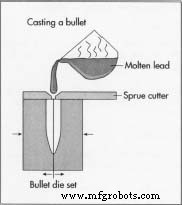
- Casting: Molten metal is poured into a hinged mold, cooled, and finished.
- Swaging: Cold‑forming in a die shapes the bullet without melting.
- Hard‑metal bullets: Stamped and machined from metal stock.
Jacket Production
- Jacket pieces are punched from sheet or strip metal.
- Annealing softens hard alloys for easier forming.
- Jackets are placed in dies or over punches to achieve uniform thickness.
Assembly
- Components are joined by swaging, casting, soldering, epoxy, or welding.
- Grooves are cut into the shank for lubrication or crimping.
- Bullets are lubricated with wax, oil, or moly, then degreased.
- Finished rounds are manually inspected and packaged.
Quality Control
Large manufacturers implement statistical process control (SPC), total quality management (TQM), and random testing. Bullets are weighed, measured for symmetry, and dissected to verify internal features. Military and premium rounds maintain tighter tolerances than commercial sizes.
Byproducts and Environmental Impact
Ammunition production releases up to 24 toxic substances. Lead is the most hazardous, posing risks to workers, users, and ecosystems. Lead contamination has led to the shutdown of several firing ranges and necessitates extensive cleanup efforts.
Future Trends
Regulatory pressure and public concern are driving the shift from lead to alternatives such as tungsten, steel, bismuth, and plastics. New materials alter ballistic performance, prompting innovations in cartridge design. The debate over expanding or armor‑penetrating bullets continues to influence legislation and public perception.
Emerging concepts include finned projectiles for stabilizing high‑velocity rounds and small‑scale rocket‑propelled munitions that blur the line between traditional bullets and rockets.
Where to Learn More
Books
- Barnes, Frank C. Cartridges of the World. 9th ed. Krause Publications, 2000.
- Grennell, Dean A. The ABCs of Reloading. 5th ed. DBI Books, 1993.
Periodicals
- "Brass Hats Led To Tungsten." The Economist, 31 July 1999.
- Petzal, David E. "Rifles: 2000 and After." Field & Stream, September 1998.
- Stolinksky, David C. "Stopping Power: Myth or Science?" Handguns, April 2000.
- Zutz, Don. "The Story Behind Winchester's Supreme Effort." Shooting Industry, December 1989.
Other Resources
- Gunnery Network Web Page, December 2001. https://www.gunnery.net
- Hasenauer, Heike. "Bushels of Bullets." Soldiers Magazine Online, November 1998. https://www.dtic.mil/soldiers/nov1998/features/ioc3.html
Andrew Dawson
Manufacturing process
- What is VMC Machining? An Expert Overview of Vertical Machining Centers
- Expert Guide to Aluminum Laser Marking: Precision, Durability, and Industry Applications
- MIG vs. TIG Welding: Selecting the Right Arc Welding Technique for Your Project
- Comprehensive Guide to Laser Marking: Types, Benefits, and Applications
- Tungsten Alloy Bullets: The Eco‑Friendly, High‑Performance Alternative to Lead
- Bullet Overview: History, Design, Manufacturing, and Future
- Ammunition: Composition, Manufacturing, and Future Trends
- MillerCoors Boosts Operations with Expert Maintenance Planning
- Wi‑Fi: The Cornerstone of Smart Everything
- Robotic Process Automation: The Key to Operational Efficiency and Cost Reduction