



A Comprehensive Guide to Typewriters: History, Design, and Modern Legacy
Background
Typewriters are traditionally divided into five categories: standard, portable manual, electric, portable electric, and electronic. The original standard model weighed 15‑25 lb (5.6‑9.3 kg) and was designed for desk use, featuring a wide rubber‑covered platen that could accommodate oversized forms. Portable manual units were lighter, smaller, and came with a carrying case, making them popular in homes and schools. Electric machines added motors and electrical components, easing key strikes and often including a carrying case with a power cord. The latest electronic typewriters, built on circuit boards, cut weight to about 10 lb (3.7 kg) and incorporated features of early word processors, bridging the gap between mechanical and digital text creation.
History
Writing machines date back to the 14th century, but the first patented device in England (1714) was never built. The first commercially produced typewriter appeared in 1870, the Hansen Writing Ball by Malling Hansen, featuring a spherical key plate. Christopher L. Sholes and Carlos Glidden later introduced a keyboard, rubber platen, and wooden space bar; Remington & Sons began manufacturing in 1874. To reduce typebar jamming, Sholes and Glidden arranged keys by frequency, creating the QWERTY layout that remains standard today.
The initial Remington models printed only capitals; a 1878 version added a shift key for lower case. By 1901, John Underwood introduced backspace, tab, and ribbon selector functions. George Blickensderfer produced the first electric typewriter in 1902, but practical models emerged around 1925. IBM launched the Selectric electric typewriter in 1961, and the Selectric II followed in 1984. By the early 1990s, IBM shifted to the electronic Wheelwriter, coinciding with the rise of personal computers.
In the late 1990s, manual typewriters were largely supplied by three companies: Olympia (Germany) produces standard portables; Olivetti (Italy) offers a standard office model and two portables; and India’s Godrej & Boyce Manufacturing Company remains the largest global producer.
Raw Materials
Carrying cases may be wood, steel, or plastic, but steel is predominant in standard models. Typewriters feature thousands of moving parts, most of which are forged from cold‑rolled steel for reliability. The platen is a steel tube wrapped in a rubber sleeve made from a special “buna‑N” rubber; glue secures the sleeve. Keys are molded plastic, initially white with colored tops; since the 1970s, pad‑printing and clear‑coat finishes provide durability.
Mylar ribbons with ink on one side transfer typeface to paper. Ribbons are housed in disposable plastic cartridges. Other materials include glue, paint, chemical solvents, zinc and chromium for plating, and acetic acid for black oxide finishes.
Design
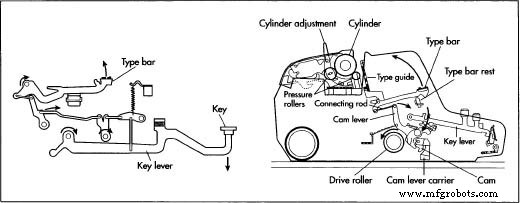
The core components are the keyboard, typebasket (typebars and typefaces), platen, carriage, and escapement. Each key operates a typebar that lifts a typeface—upper and lower case, numbers, and symbols—into contact with the platen. The platen, a rubber‑covered cylinder, allows enough force for ink transfer while protecting the typeface.
The carriage holds the paper, guiding it through a feed rack and paper trough. It is connected to the carriage‑return lever and line‑spacing mechanism, which advance the paper and reset the carriage after each line. The escapement, a precision gear system, moves the carriage one space to the right after each keystroke. A mainspring powers the escapement, and ball bearings enable smooth carriage motion.
The typebasket contains roughly 3,200–3,500 parts: typebars with soldered typefaces, springs linking keys to typebars, and ball bearings that aid in shifting between upper and lower case. The keyboard subassembly attaches key levers to springs and an internal frame, preparing the machine for final assembly.
Manufacturing Process
- 1. Steel rods (10‑12 ft) are cut and machined into screws, bolts, and rivets.
- 2. Fabrication tools cut and shape fasteners; lathe‑like machines form threads.
- 3. Parts undergo zinc or chromium plating in electrolytic baths to prevent corrosion.
- 4. Internal components are blued with acetic acid baths, then coated with light oil for protection.
- 5. Exterior parts are polished using buffing wheels and hand‑held compounds.
- 6. Riveting or brazing joins parts; brazing uses low‑temperature alloys to avoid warping.
- 7. The platen subassembly is precision‑ground and fitted with a rubber sleeve using a heated press.
- 8. Typefaces are cast from metal slugs in dies, then soldered onto typebars.
- 9. The carriage rail system is assembled with ball bearings and springs.
- 10. The carriage‑return lever, paper‑handling system, and escapement are integrated into the frame.
- 11. The typebasket and keyboard subassemblies are assembled and attached to the main frame.
- 12. Final assembly places all subassemblies on a frame, attaches the steel jacket, and seals the interior to prevent dust ingress.
Quality Control
Incoming materials are logged and verified against blueprints using precision instruments such as verniers, micrometers, and height gauges. Finished machines undergo functional tests: key binding, print quality, ribbon advance, and carriage movement. Visual inspections detect surface defects that could lead to rust.
Byproducts and Waste
Steel waste (skeletons, punch‑press fragments, and turnings) is sold to salvage dealers or melted for reuse. Plastic waste is recycled; rejected plastic parts are regrinded and blended into new batches. Rubber dust from platen grinding is collected and disposed of responsibly. Inked ribbons and Mylar cartridges are typically landfilled after disposal of the ink.
Future
In the Western world, typewriters have largely been supplanted by computers, yet niche markets—such as certain businesses and hobbyists—still use them for specific tasks. In developing countries, standard, electric, and electronic models remain in demand. Manufacturers like Brother (Japan), Chinese factories, and Godrej & Boyce (India) continue production. The collector’s market also sustains a modest future; antique dealers and collectors trade rare models online, and specialized newsletters share market insights.
Where to Learn More
Books
Bryant, Carl. All About Typewriters and Adding Machines. New York: Hawthorn Books, Inc., 1973.
Davies, Margery. Woman’s Place is at the Typewriter: Office Work and Office Workers 1870-1930. Philadelphia: Temple University Press, 1982.
Linoff, Victor M., ed. The Typewriter: An Illustrated History. Dover Publications, 2000.
Periodicals
Frazier, Ian. “Typewriter Man.” The Atlantic Monthly 280, no. 5 (November 1997): 81‑92.
Groer, Annie. “True to Type.” The Washington Post (3 May 2001): HOI.
Other
“Typewriter History at a Glance.” MyTypewriter.com Web Page. December 2001. https://www.mytypewriter.com.
Manufacturing process
- Mastering C Standard Library Functions: A Practical Guide
- Are Your Lubrication Practices Truly Effective?
- Crafting Effective Standard Maintenance Procedures: Boost Reliability and Safety
- Standard Work Practices: Elevate Maintenance Reliability
- New Feature: Standard Failure Codes – Streamline Maintenance & Cut Costs
- Aluminum vs. Standard PCBs: Which Is Best for Your Electronics Design
- Understanding Standard Work: Key to Quality and Waste Reduction
- Rosenboom: Precision Custom Hydraulic Cylinders for Industrial Applications
- Precision Machining: Standard vs. Non-Standard Parts Explained
- Precision CNC Machining vs. Standard Machining: Key Benefits and Efficiency Gains