



The Modern Tuxedo: History, Design, and Production Insights
The tuxedo is a tailored suit for semi‑formal or formal occasions, traditionally black but increasingly available in bright colors and unconventional fabrics. While many men purchase tuxedos, most rent them for special events due to their infrequent use and perceived cost inefficiency.
Background
A tuxedo jacket typically features satin lapels, while the trousers include a satin or ribbon stripe along the outer seam. Accessories such as a stiffened white pleated shirt with shirt studs, a cummerbund, or a fabric belt complete the ensemble.
Ready‑to‑wear tuxedos are produced in standard sizes, but custom or couture options are available from personal tailors for a precise fit.
History
The tuxedo originated as a less formal alternative to the frock coat and tailcoat of the late 19th and early 20th centuries. Around the turn of the 20th century, wealthy New Yorkers in Tuxedo Park simplified evening wear by adopting a black jacket styled like a work suit, paired with matching trousers. The satin lapels and stripe on the trousers, a nod to the gray‑striped daywear of the 1800s, became defining features.
By the 1920s, the black tuxedo had largely displaced the formal tailcoat as acceptable evening attire. Today, designers continue to experiment with colors, patterns, double‑breasted styles, and even long coats, expanding the tuxedo’s traditional boundaries.
Raw Materials
Modern tuxedos are crafted from wool, polyester, or rayon. The satin detailing is often a polyester or rayon imitation. Linings are typically acetate or polyester. Stiffeners such as felt and buckram help maintain structure, while synthetic buttons and metal‑toothed zippers endure repeated dry cleaning.
Design
Designers analyze current menswear trends to develop tuxedo styles that resonate with consumers. Key design elements include lapel shape, coat length, and trouser flare. Pattern makers draft prototypes in a 40‑regular size (40‑inch chest, 32‑33‑inch sleeve, 33‑34‑inch waist) and then grade the pattern across a wide range of sizes—from 36 extra short to 60 XXL.
Fabric selection is critical; each material influences cutting, stitching, and reinforcement. Once specifications are finalized, production proceeds.
The Manufacturing Process
A tuxedo’s production spans several days to weeks, with each step carefully monitored. Below is an overview of the main stages.
- Fabric Cutting: Manufacturers use manual scissors, a hand‑held circular cutter, or computer‑controlled machinery to cut up to 25 layers of fabric simultaneously, ensuring all pieces come from the same bolt and dye lot.
- Tagging: Each piece is labeled with the bolt number, size, and style to maintain consistency throughout assembly.
- Stitching: Industrial‑grade machines handle the heavy fabrics. One company, for example, divides construction into 150 distinct sewing operations—110 for the coat and 40 for the trousers.
Assembling the Coat
- Front panels are sewn together with stiffening fabric, then turned right side out.
- Pockets are added, with patch pockets stitched on the outside and seam pockets lined inside.
- The back panels are joined at the center; front panels are connected at the shoulders.
- If lined, sleeves are stitched to thin lining on the inside.
- The lining, typically satin‑like, is sewn into the coat body and sleeves are attached at the armhole.
- Collar and lapel are assembled: satin shell, felt/ canvas interface, and buckram provide structure; satin striping is added before attaching to the jacket.
Assembling the Trousers
- Legs are lined with thin satin‑like fabric before being sewn together at the back inseam and side seams.
- The satin stripe is top‑stitched along the outer seam.
- The waistband is folded and stiffened with buckram, then sewn around the raw edge; belt loops are attached.
- A zipper is sewn to the interior, covered by fly fabric.
- Final finishing includes edge stitching, button placement, and pressing.
Quality Control
Fabric is inspected for flaws before cutting. Only bolts from the same dye lot are used to avoid color variation. Every sewing operation is evaluated against strict criteria, and visual checks are performed at each stage. Final inspection focuses on seam durability and overall finish.
Prototyping is essential: armholes, lapels, and trouser flare are tested to eliminate design flaws before mass production.
Byproducts/Waste
Fabric waste can reach 12% of the original bolt. Manufacturers sell scrap to companies that create reconstituted fibers, used in garments and floor coverings.
The Future
Tuxedo manufacturers must adapt to evolving menswear, driven by high‑fashion designers and public events like the Oscars. While the classic black tuxedo with white shirt remains stable, innovation in color, fabric, and silhouette continues to push the boundaries of formalwear.
Where to Learn More
Books
Constantino, Maria. Men’s Fashion in the Twentieth Century. New York: Fashion Press, 1997.
Hollander, Ann. Sex and Suits. New York: Alfred A. Knopf, 1994.
Other
Oral interview with Barry Cohen, Vice‑President of Manufacturing for Hartz and Company. Frederick, MD. September 2001.
Nancy E.V. Bryk
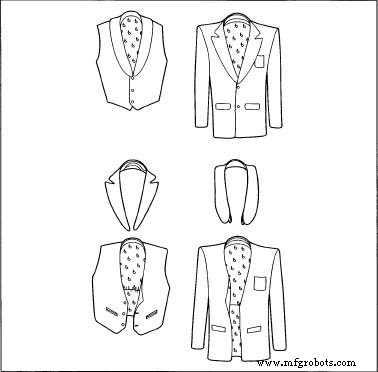
Manufacturing process
- What is VMC Machining? An Expert Overview of Vertical Machining Centers
- Expert Guide to Aluminum Laser Marking: Precision, Durability, and Industry Applications
- MIG vs. TIG Welding: Selecting the Right Arc Welding Technique for Your Project
- Comprehensive Guide to Laser Marking: Types, Benefits, and Applications
- Key Considerations for High‑Volume Swiss Machining
- CNC Prototyping Guide: Precision, Speed, and Cost‑Effective Production
- Expert Shaft Manufacturing: Precision Processes & Custom Solutions
- Fiber Laser Marking: Precision, Speed, and Versatility for Modern Industries
- The Modern Tuxedo: History, Design, and Production Insights
- Mastering Formal Verification of VHDL Modules with PSL