



The Toaster: From Ancient Fire to Smart Kitchen Appliance
Background
A toaster is a compact appliance that uses heat to brown and crisp bread, turning a simple slice into a breakfast staple.
History
The art of browning bread dates back millennia. Early societies placed bread over open flames to prevent mold. The Romans revived this practice from Egypt around 500 B.C. and introduced it to Britain during the 44 A.D. invasion.
In the 18th century, a hinged fork held bread above the fire, but the rise of wood and coal stoves in the 1880s demanded a safer, stove‑mounted solution. A tin and wire pyramid‑shaped device was introduced, with the bread placed inside and heated directly on the stove.
Electricity arrived in 1905 when engineer Albert Marsh invented Nichrome—an alloy of nickel and chromium that could be formed into low‑conductivity wires. Within months, other inventors leveraged Nichrome to create the first electric toasters.
Westinghouse’s 1905 toaster stove featured a heating element on a raised base, while General Electric patented a bare‑wire skeleton with a mica‑woven heating element in 1910. These early models lacked temperature control and required manual turning.
Initially used mainly in restaurants, electric toasters entered the home as 24‑hour electrical service became widespread. The 1920s saw the flip‑top toaster, and by 1919 Charles Strite had patented the first automatic toaster with a spring‑driven pop‑up mechanism. Strite’s Toastmaster line was hand‑built, limiting production until Murray Ireland’s 1925 redesign enabled mass production.
The late 1920s introduced the first bimetal‑timed toaster. By 1940, Sunbeam Corporation refined the sensor to trigger at 310 °F (154 °C), cutting heat when the bread reached optimal browning. General Electric’s Toast‑R‑Oven emerged in 1955, further standardizing automatic toasting.
The microchip era of the late 1950s—thanks to Jack Kilby and Robert Noyce—gave manufacturers the ability to measure bread moisture and tailor heating times, leading to smarter, more precise appliances.
The 1970s heat‑resistant plastics allowed sleeker, color‑varied designs, wider slots for bagels, and multi‑slot models. The 21st century ushered in “smart toasters” capable of cooking a range of baked goods with programmable settings. Dual‑toaster variants, such as Hamilton Beach’s combo oven/broiler and Black & Decker’s Versa‑Toast 4‑Slice, enable simultaneous cooking of different breads.
Raw Materials
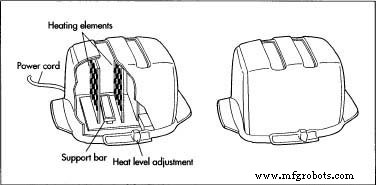
Toasters comprise numerous components: a heating element, spring, bread rack, heat sensor, trip plate, timing mechanism, electromagnet, catch, and browning control. These parts are assembled from metals—primarily aluminum and nickel—and molded plastics. Screws, nuts, bolts, and washers secure the components.
Heat‑resistant plastic casings incorporate flame retardants and smoke suppressants. When metal casings are used, aluminum is favored for its lightweight, conductivity, and corrosion resistance. Mica sheets serve as an insulating layer for Nichrome wires, protecting the user from heat.
Design
Design drives continuous innovation. Recent trends include wider slots for bagels, heat‑resistant bodies, and microchip controls. Each new design undergoes prototyping, rigorous testing, and sometimes limited test‑marketing before full release.
Manual toasters use a simple turntable, while semi‑automatic models add buzzers or thermostats to signal completion. Automatic toasters incorporate a pop‑up feature, typically controlled by a thermostatic switch or timing device that turns off the heating element when the bread reaches the desired temperature.
The Manufacturing Process
Making the Case
- Pressure‑molded plastic cases are produced by heating plastic pellets to 350 °F (177 °C) and pouring the semi‑fluid compound into a mold. Once cooled, the case is removed.
- Aluminum cases begin with a sheet that is punched by a die to the correct dimensions, then extruded backwards into a toaster‑shaped shell.
- Nichrome wire is wrapped around mica sheets in an automated machine and bolted to the toaster base.
- A spring‑loaded tray is manually installed between the mica sheets.
- Bi‑metallic elements and support brackets are assembled, with a spring and stop mechanism to activate the pop‑up.
Assembling the Terminal Board
- Two sheet‑metal conductors sandwich an insulation layer, creating the terminal board. The board is secured to the toast rack, and temperature‑sensing leads are fastened to the conductors.
Installing the Base
- The electrical cord is threaded into the molded base, and all internal components are mounted. The casing is then fitted over the base to complete the assembly.
Byproducts/Waste
Plastic molding and metal stamping generate excess waste, but recycling programs reclaim plastic scrap for new products and recycle aluminum for fresh manufacturing.
Quality Control
Toasters are tested on the assembly line for durability and performance. Test reports capture browning quality, temperature at which the element shuts off, and total toasting time. Surplus toast is often donated to ranchers as livestock feed.
The Future
Designers continually push the toaster into new realms. In 1996, University of Washington students created a talking toaster that confirms user settings aloud, though it never entered mass production. Today’s smart toasters integrate voice assistants, IoT connectivity, and adaptive heating to accommodate everything from bagels to frozen pastries.
The toaster has become a cultural icon, appearing on apparel, album covers, and even as the medium for a 3,053‑piece toast mosaic in an Italian art gallery.
Where to Learn More
Books
Alfin, Elaine Marie. Toasters. Minneapolis: Caroirhoda Books, 1998.
Travers, Bridget, ed. World of Invention: History’s Most Significant Inventions and the People Behind Them. Detroit: Gale Research Inc., 1996.
Other Resources
Anderson, Corin. The Talking Toaster Home Page. 8 September 1996. December 2001. https://www.the4cs.com/~corin/cse477/toaster/.
Huggler, Peter E. “Temperature Sensitive Timing Assembly for Toaster Appliance.” United States Patent and Trademark Office Web Page. Patent no. 5901,639. 19 December 1996. December 2001. https://www.uspto.gov/patft/index.html.
The Toaster Museum Foundation Web Page. September 2001. https://www.toaster.org/museumintro.html.
Mary McNulty
Manufacturing process
- Amber: From Ancient Resin to Scientific Treasure – History, Properties, and Modern Uses
- The Guillotine: History, Design, and Legacy
- Silicon: Properties, Production, and Market Outlook
- The Ukulele: From Portuguese Roots to Modern Craftsmanship
- The Complete Guide to the U.S. Chicken Industry: History, Production, and Quality Control
- Compost: The Ultimate Soil Enrichment Solution
- Gelatin: From Ancient Protein to Modern Applications – Production, Uses, and Safety
- The Evolution and Manufacturing of Modern Pin‑Tumbler Locks
- Vodka: From Ancient Distillation to Modern Production
- Bread: From Ancient Grains to Modern Production