



The Complete Horseshoe Handbook: Types, History & Manufacturing Secrets
Background
Horseshoes are essential protective gear that shield a horse’s hooves from abrasion on hard or uneven terrain. Beyond protection, they enhance gait, correct conformation issues, and mitigate interference problems—such as winging, where the hoof swings inward during a stride—by using specialized shapes like square‑toe shoes.
Traditionally, a horseshoe is a U‑shaped metal plate. While steel is the most common material, aluminum and plastic‑coated metal options exist, each offering distinct benefits. Aluminum shoes tend to be pricier but provide lighter weight and corrosion resistance. Two‑piece steel shoes with removable plastic inserts offer flexibility for varying riding conditions. The ubiquitous keg shoe—so named because early versions were packaged in wooden kegs—remains the standard for leisure riders. Installation is straightforward: nails are driven into the dense, nerve‑free hoof, a process that is quick, safe, and highly effective. Prices range from $80 to $280, depending on material and shoe design.
There are roughly 15 other shoe types tailored to breed, discipline, and functional needs. For example, front hooves of Thoroughbred racehorses wear lightweight aluminum racing plates, while the hind hooves use a hybrid caulk shoe—an aluminum base with embedded steel—to increase wear resistance. Standardbred racehorses combine half‑round and grooved “swage” front shoes with steel back shoes, choosing between designs for trotting or pacing. Jumpers and hunters often wear a wider keg‑style shoe with optional traction studs for better footing. Draft horses require heavier, thicker shoes due to their size and weight, whereas Saddlebreds use toe‑weight shoes that narrow at the front for optimal gait. Each design is engineered to meet specific performance and health requirements.
History
For centuries, horses were the backbone of American transportation and agriculture. The advent of the automobile caused a sharp decline in the horse population from 1910 to 1960. The 1960s saw a resurgence driven by horse racing and recreational riding, and the numbers have since stabilized. While the decline in professional racing has been offset by growing participation in leisure riding and equestrian competitions, the cultural significance of horses remains strong.
The craft of forging and fitting horseshoes dates back to medieval times and played a pivotal role in the development of metallurgy. Blacksmiths—often called farriers, derived from the Latin ferrum—used furnaces, anvils, tongs, and hammers to shape iron into functional hoof protectors. The process involved cleaning and shaping the hoof, heating the shoe until pliable, forging it to fit, cooling it rapidly in water, and securing it with nails. Although modern machinery has largely replaced manual forging, the fundamental techniques and tools remain integral to the industry.
Raw Materials
The most widely used material is low‑carbon mild steel (A‑36), available in round bars 0.5–0.7 inches (1.27–1.8 cm) in diameter. These bars are cut to the required length for each shoe type and then forged into shape.
Design
Horse shoe design varies by breed, activity, and intended function. Standard mass‑produced shoes are stamped from two‑part dies that match precise dimensions, ensuring consistency. When a shoe wears out, a new die is manufactured. Specialty shoes—such as those for lame or ill horses—may be hand‑crafted by farriers, sometimes featuring a heart shape instead of the traditional U to aid healing.
The Manufacturing Process
Forging—one of the oldest metal‑forming methods—remains the core technique for producing horseshoes. The process can be broken into three main stages:
Cutting & Bending
- Bars are sheared to the correct length. The cutting equipment may be manual or foot‑pedal‑driven.
- Bars are heated in an induction or gas forge to ~2,300°F (1,260 °C) until soft.
- Using a die or plunger shaped like a horseshoe, the bar is bent into the required form.
Forging
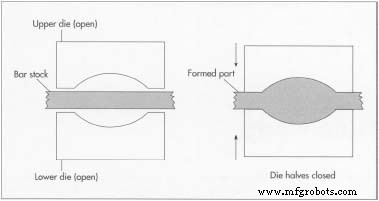
- Drop forging is used to press the bent bar into a die that imparts the final dimensions. A powered hammer and anvil shape the shoe precisely.
Finishing Operations
- After forging, the shoe moves to a punch press to create eight nail holes per shoe.
- A trim press removes excess material (flash), leaving a clean edge. The shoe remains hot (1,900–2,000°F / 1,038–1,093 °C) during this stage.
- Air cooling for 45–60 minutes brings the shoe to working temperature.
Packaging
- Cool shoes are hand‑packaged in 25 or 50‑pound boxes, with a 50‑lb box holding approximately 80 shoes. Some manufacturers offer boxes with 15 or 30 pairs.
Quality Control
Raw materials are tested against chemical specifications before shipment. To prevent rust, round bars are stored under tarps. During forging, operators inspect dies for wear and defects. Dimensional tolerances—width and thickness—must stay within 1/16 inch, and nail holes are checked for correct placement and integrity. Defective or irregularly shaped shoes are reprocessed or recycled.
Byproducts & Waste
Trimmed flash is collected and sent to scrap yards for remelting and re‑rolling. Defective shoes are also re‑processed and reused, ensuring minimal waste.
The Future
Steel will likely remain the dominant material for horseshoes, with forging presses becoming increasingly automated and programmable. Design innovations will continue to cater to niche markets—such as improved traction for competitive disciplines and lighter materials for endurance riding.
While the overall horse population is expected to stay relatively stable, regional variations will arise. High real‑estate costs in states like New Jersey limit land availability for horses, whereas Michigan has seen a 20% decline in horse numbers from 1984 to 1997 due to farmland conversion and casino expansion.
Manufacturing process
- The History, Materials, and Craftsmanship of Wooden Clogs
- The Evolution and Design of Modern Running Shoes
- Saddle Fundamentals: Design, Types, and Craftsmanship
- Covestro Drives Innovation in High-Performance Footwear with Advanced Composite Materials
- Covestro Enhances Klay Thompson’s Signature Sneaker with Advanced Thermoplastic Composite Technology
- Fine-Tuning Running Shoes for Peak Performance
- Industrial Brake Shoe Relining: Cost‑Saving, Reliable Repairs for Safety
- Designing a 3D‑Printed Shoe: Expert Guidance from Fast Radius
- Brake Shoe Seam Welder: Expert Guide to Safe Welding
- The Evolution of Horsepower: From Myth to Modern Measurement