



The Hula Hoop: A Cultural Icon, Proven Exercise Tool, and Engineering Marvel
In the late 1950s, the Hula Hoop emerged as one of the most rigorously studied fads in sociology. The toy’s deceptively simple design – a hollow, brightly colored plastic ring that sometimes houses ball bearings, bells, or other sound‑making elements – has captivated audiences for decades. With diameters ranging from 20 in (51 cm) to 3 ft (91 cm), it offers a wide spectrum of sizes suitable for every age group.
Background
Fads are of particular interest to sociologists because they spread rapidly across diverse populations. To qualify as a fad, an idea must be a “key invention” capable of spawning numerous offshoots. The Hula Hoop meets this criterion through its vast array of color, size, and ornamental variations, allowing each child to own a distinct version and enabling the creation of countless spinning styles. Local fairs hosted hoop‑spinning contests, and records were set for the longest continuous rotations. Jugglers have incorporated small‑diameter hoops into performances on stages and circus tents for generations.
History
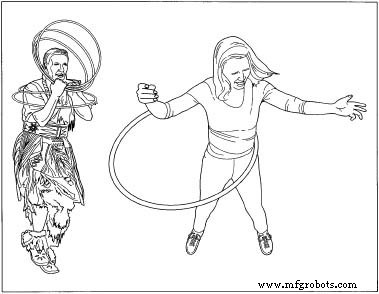
Hoops have been a staple toy for millennia. The ancient Greeks were among the first to popularize them; pottery fragments and manuscripts depict children rolling hoops as both playthings and exercise tools. Roman children also played with metal hoops fashioned from scrap strips. In North America, Indigenous peoples used hoops in games that honed harpooning and hunting skills. Eskimos rolled hoops while throwing poles through them, a practice that sharpened coordination. The Lakota developed a sophisticated hoop dance that remains a cultural touchstone; their dancers employ 12‑28 hoops to form intricate patterns, each hoop symbolizing the circle of life and the natural rhythms of the world.
In 19th‑century England, wooden hoops fitted with metal strips or tires became a fad known as “bowling a hoop.” These were propelled along streets with a hand or a skimmer. The craze crossed the Atlantic, and early American hoops were used to teach toddlers to walk, often featuring bells or jingling spools. In 1871, Albert Hill patented the first rolling hoop, measuring 12‑20 in (20‑51 cm) in diameter and propelled with a 20‑27 in (51‑69 cm) handle.
Hoops have long found roles in games such as quoits, basketball, and football, where they serve as targets or training aids to improve footwork, coordination, and accuracy.
The modern Hula Hoop was conceived in 1958 by American toy inventors Arthur “Spud” Melin and Richard Knerr, who drew inspiration from Australian children’s bamboo rings. Their prototype – a simple plastic hoop – was distributed throughout Los Angeles playgrounds, generating a cultural phenomenon unmatched in U.S. toy history. In four months, over 25 million hoops were sold in the United States for an average of $1.98 each; worldwide sales exceeded 100 million that same year. At its peak, Wham‑O, Inc. produced 20 000 hoops daily, and the total length of tubing used would have circled the globe more than five times.
Records of hoop spinning have been chronicled by the Guinness World Records, including Lori Lynn Lomeli’s 1999 feat of spinning 82 hoops simultaneously for three complete revolutions. While the craze waned in the 1970s, the Hula Hoop resurfaced in the late 1990s and continues to enjoy steady popularity today.
Raw Materials
Most Hula Hoops are manufactured from high‑density polyethylene (HDPE) plastic, colored with pigments, and optionally filled with ball bearings, beads, glitter, bells, or other noise makers. Metal staples secure the ends, and paper labels provide safety and branding. External suppliers provide the staples and labels; internal processes handle the plastic extrusion.
Design
Design evolution keeps the Hula Hoop relevant. Wham‑O annually refreshes color palettes to align with market trends. Recent innovations include fruit‑scented hoops that emit a subtle aroma matching the color, and glitter‑wrapped variants. While children remain the primary audience, many adult consumers use hoops for exercise, and some manufacturers now incorporate a calorie counter that tracks revolutions, duration, and calories burned.
The Manufacturing Process
- The factory receives HDPE pellets, already pigmented or tinted on‑site. Pellets are fed into an extrusion hopper, heated by friction, and shaped by dies to produce a continuous tube. Wham‑O’s proprietary twist machine adds a stripe pattern during extrusion.
- The extruded tube cools rapidly and is cut into lengths equal to each hoop’s circumference. Three distinct lengths correspond to the company’s three standard sizes.
- Lengths are loaded onto carts and manually fed into a benching machine that curves them into perfect circles.
- Noise elements are inserted, and a smaller extruded dowel is stapled into the hoop’s ends to secure the joint. A protective label is then affixed.
- Finished hoops are bundled together in a single packing box to minimize material usage and maximize retailer shelf space.
Byproducts & Waste
Waste is minimal; color changes result in only ~0.1 % of material loss. Defective hoops are collected for recycling. OSHA regulations and rigorous employee training ensure zero factory injuries in Wham‑O’s 50‑year history.
Quality Control
Quality begins at design: extrusion dies are fabricated to tight tolerances to reduce variation. Inspectors monitor every machine, and any faulty hoop is removed immediately. A final audit precedes packaging.
The Future
As health and fitness trends continue to grow, the Hula Hoop is positioned to remain a staple of both play and exercise. Future iterations will likely emphasize game‑based play and personalization, echoing the symbolic importance of the circle that has captivated cultures worldwide for centuries.
Manufacturing process
- What is VMC Machining? An Expert Overview of Vertical Machining Centers
- Expert Guide to Aluminum Laser Marking: Precision, Durability, and Industry Applications
- MIG vs. TIG Welding: Selecting the Right Arc Welding Technique for Your Project
- Comprehensive Guide to Laser Marking: Types, Benefits, and Applications
- Key Considerations for High‑Volume Swiss Machining
- CNC Prototyping Guide: Precision, Speed, and Cost‑Effective Production
- Expert Shaft Manufacturing: Precision Processes & Custom Solutions
- Fiber Laser Marking: Precision, Speed, and Versatility for Modern Industries
- Electropolishing vs. Passivation: Choosing the Right Stainless Steel Finishing
- The Hula Hoop: A Cultural Icon, Proven Exercise Tool, and Engineering Marvel