



How Lubrication Enhances Metal Working: A Tribology Perspective
Role of Lubrication during the Process of Metal Working
For understanding the role of lubrication during the processes of metal working, it is important to know the tribology of the lubrication. Tribology consists of boundary friction, which is associated with almost all operations of the metal working. It is caused by the relative movement of two adjacent surfaces under pressure. During the metal working processes, the relative movement between rolls and work piece is improved by the surface speed differential of the rolls
Friction
Friction plays an important role during metal working process. It is defined as the resistance to relative motion between two bodies in contact. It is an energy dissipating process, causing the temperature at the interface to rise and, if excessive, can result in surface damage. It also influences the deformation taking place in the metal working process. As per the earliest theories, friction is the result of interlocking two rough surfaces sliding along each other. Friction is actually brought on by a large number of variables, such as load, speed, temperature, the materials involved in the sliding pair, and the various effects of fluids and gases at the interface.
Most commonly accepted theory of friction is based on the resulting adhesion between the severities of the contacting bodies. It has been seen that regardless of how smooth the surfaces are, they contact each other at only a fraction of their apparent area of contact. Thus, the load during the process of metalworking is supported with few severities in contact. Hence, the normal stress at the severity junctions is high. Under light loads, the contact stresses can only be elastic. However, as the load increases to some of the levels involved in the metal working process, elastic deformation of the severities can take place and the junctions form an adhesive bond (micro welds).
The nature and strength of the adhesive bond depend on many factors. Among these are (i) mutual solubility and diffusion of the two surfaces in contact, (ii) temperature and time of contact, (iii) nature and thickness of oxide films or contaminants present at the interface, and (iv) the presence of a lubricant film.
With clean nascent surfaces (such as those produced by cutting, or in metal working operations in which surface extensions are large) and in the absence of any contaminants or lubricant film, the strength of the junctions is high because of cold pressure welding. Consequently, the shear strength of the junction is high, and hence friction is high. As contaminants or lubricants are introduced, or as oxide layers develop (which may take only a few seconds in some cases), the strength of the junction is lowered because, under these conditions, a strong bond cannot be formed. Thus, friction is lower.
Friction force raises the temperature at the surface. The temperature is increased with (i) speed, (ii) coefficient of friction, and (iii) decreasing thermal conductivity and specific heat of the materials. Higher the thermal conductivity, the greater is the heat conduction into the bulk of the work piece. In addition, higher the specific heat, the lower is the temperature rise. Temperature rise can be sufficiently high to melt the interface or to cause phase transformations, residual stresses, and surface damage (metallurgical burn).
Wear
Wear is defined as the loss or removal of material from a surface. Wear can take place under different conditions. Wear because of these conditions can be (i) dry or lubricated wear, (ii) sliding or rolling contact wear, and (iii) wear due to fracture, or (iv) wear due to plastic deformation. There are four basic types of wear. These are (i) adhesive wear, (ii) abrasive wear, (iii) fatigue wear, and (iv) corrosive wear. Generally, the first three types of wears are of interest during the process of metal working. The last type of wear can also occur as a result of roll and work piece interactions in the presence of various liquids and gases. Particularly in this case, appropriate choices of lubrication chemistry are to be made, depending upon the roll composition to avoid excessive corrosive roll wear.
- Adhesive wear – This type of wear is due to the result of the junctions sheared during sliding. If the junctions have strong bonds (such as with clean interfaces, under high loads, and with sufficient time to contact between the two bodies), then fracture of the junction takes place either above or below the interface of the severities. Generally, it is through the softer metal the crack forms and propagates. Under repeated cycling, the transferred particle becomes a loose wear particle. In severe cases of adhesive wear, the process is called galling, scuffing, or seizure. For adhesive wear to occur, there has to be an affinity (reactivity) for adhesion and welding between the two sliding surfaces. The most severe case of wear occurs between two clean surfaces, under high normal load and in vacuum. The basic role of an effective lubricant is to reduce the tendency for welding of the severities, either by separating the surfaces with a layer of lubricant or by reducing the shear strength of the interface by forming low shear strength compounds through chemical reactions. Surface films are of great importance in adhesive wear. Other than the lubricant layer, the surfaces are almost always covered with oxide layers, contaminants, and adsorbed gases or fluids. These films significantly reduce the shear strength of the interface. Thus, the wear observed in practice is generally lower than it would have been otherwise. Oxide films have a significant role in friction and wear. The effect depends on the relative rate at which oxide layers are destroyed during sliding and the rate at which they form. If the rate of destruction is high, then the surfaces are not well protected and the wear is high.
- Abrasive wear – In the abrasive wear process, material is removed from the surface by scratching and by producing slivers and microchips. Hence, the softer the material, the higher is the rate of abrasive wear. Also, with the higher load, the wear rate is higher. Abrasive wear can be of two- body type and three-body type. In the latter, the third body is composed of wear particles or any other hard contaminants (such as those built up in a lubricant) which are trapped between the two sliding surfaces. This mechanism is also called erosive wear. This type of wear is important in the processes of metal working and in the maintenance of equipment. For the purpose of reducing the buildup of oxides, metal chips, or other metallic particles, periodic inspection, filtering, or changing of the lubricants is necessary.
- Fatigue wear – Fatigue wear is normally called surface fatigue or surface fracture wear. It is a result of cyclic loading of an interface between the rolls and the work piece. Cracks develop on the surface over a period of time by a fatigue mechanism, resulting from either mechanical forces or thermal stresses (thermal fatigue). In both the cases, material is removed from a surface (usually the metal working tool) by spalling or pitting, whereby cracks coalesce by joining each other below the surface. In fatigue wear lubrication plays a complex role. Lubricants reduce friction and hence reduce the level of stresses which can cause fatigue failure. On the other hand, if a crack develops because of some mechanism or cause, the fluid penetrates the crack by surface tension. During subsequent loading cycles, the fluid is trapped and, because it is incompressible, high hydrostatic pressure in the crack opening develops. This, in turn, propagates the crack farther into the body of the metal working tool. Pitting, for example, does not occur in unlubricated interfaces unless chemical attack takes place.
Lubricating mechanisms
It is obvious that friction and wear can be reduced or eliminated by keeping the sliding surfaces apart from each other. While in machine elements, such as lubricated journal bearings and air bearings, this requirement can be fulfilled easily, on the other hand, due to the loads and speeds involved in metal working process and the geometry of the metal working tool and the work piece interfaces are usually such that they do not readily allow the existence of a lubricant film. Lubricants are also used as coolants to dissipate the heat generated by friction or rolling. It is also applied to flush away particles such as iron oxide and slivers. However, the primary function of the applied fluid is lubricating, hence, the term ‘coolant’ is not normally used. The major lubricating mechanisms of interest to rolling process are given below.
- Thick-film (hydrodynamic) lubrication – In this type of lubrication (also called full-fluid film), the two surfaces are completely separated from each other by a continuous fluid film. The thickness of this film is around 10 times the magnitude of the surface roughness of the mating surfaces. The fluid film can be developed either hydrostatically (by entrapping the lubricant) or, more generally, by the wedge effect of the sliding surfaces in the presence of a viscous fluid at the interface. Therefore, in this type of lubrication, the bulk properties of the lubricant (especially viscosity) are important and chemical effects of the lubricant on the surfaces of the metal are not significant. In thick-film lubrication, the loads are usually light and the speeds are high. The coefficient of friction is very low, normally in the range of 0.001 to 0.02. There is no wear, except from any foreign material (third body) which might have entered the lubricating system. This type of lubrication does not usually occur in metalworking processes (including rolling process), except in isolated regions at die-work piece interfaces with high viscosity lubricants and at high operating speeds.
- Mixed lubrication – The film thickness in thick-film lubrication can be reduced by (i) decrease of the viscosity (e.g. owing to temperature rise), (ii) decrease of the sliding speed, or (iii) increase of the load. The surfaces become close to each other and the normal load between the metal working tool and the work piece is supported partly by metal-to-metal contact of the surfaces and partly by the fluid film in hydrodynamic pockets in the surface roughness of the interfaces. This is usually referred to as mixed lubrication and also as the thin film or quasi-hydrodynamic regime. The film thickness is lower than three times of the surface roughness. The coefficient of friction can be as high as about 0.4 (hence, forces and power consumption can increase considerably), and wear can be significant. There is an optimum roughness for effective lubricant entrapment, with a recommended roughness of commonly 15 microns. The hydrodynamic pockets also serve as reservoirs for supplying lubricant to those regions at the interface which are starved for lubricants.
- Boundary lubrication – In case of boundary lubrication, a thin layer of lubricant film physically adheres to the surfaces by molecular forces (e.g. van der Waals forces) or by chemical forces (chemisorption). Usual boundary lubricants are oils, fatty oils, fatty acids, and soaps. Boundary films can form rapidly on clean surfaces, even though reactivity on some materials such as titanium and stainless steel is very low. In such case lubrication can be enhanced by the formation of boundary films on the metal working tool surfaces instead of on the surface of the work piece. An important difference is that, unlike in full-fluid film lubrication, where the bulk properties of the lubricant (e.g. viscosity) are important, in boundary lubrication, the chemical aspects of the lubricant and its reactivity with the surfaces of the metal are important and viscosity has a secondary role. In the boundary lubrication area, the coefficient of friction is normally in the range of 0.1 to 0.4, depending on the strength and thickness of the boundary film. Boundary lubrication is frequently observed and practiced in metalworking operations such as rolling. Wear rate in this type of lubrication depends on the rate at which films are destroyed by rubbing off, or by desorption owing to excessive temperature generated during the metal working process. If the protective boundary layer is destroyed, then friction and wear is usually high. The adherence and strength of this film is thus a very important factor for the effectiveness of boundary lubrication. The role of pressure, speed, and viscosity on film thickness is also to be recognized.
- Extreme pressure (EP) lubrication – In the case of EP lubrication, the surface of the metal is activated chemically by irreversible chemical reactions. These reactions, involving sulphur, chloride, and phosphorus in the metal working fluid, form salts on the mating metal surfaces. These surfaces prevent or reduce welding of the severities at the interface even under high metal working tool-work piece contact pressure. Hence the lubrication is termed ‘extreme pressure’. Moreover, because of their low shear strengths, these surface films also reduce friction. As temperature increases, though, these films can break down, the temperature for breakdown depending on the particular EP additive (used either singly or in combination, such as both sulphur and chlorine) and the composition of the metal surfaces. When the film breaks down, metal-to-metal contact takes place, with a subsequent increase in friction and wear. However, the protective films of sulphates and chlorides form again with relative ease, especially on clean new surfaces. Air, oxygen, humidity, and water play important roles on EP lubrication.
- Elasto-hydrodynamic (EHD) and plasto-hydrodynamic (PHD) lubrication – During the process of metal working, the deflections and distortions of the metal working tools can happen as a result of the stresses encountered in the process of metal working. It has been shown that owing to the finite modulus of elasticity of steels, these deflections can be sufficiently extensive to alter the geometry of the metal working tool-work piece interface, thus affecting the stresses, contact areas and geometry, and pressure distribution. Therefore, the term ‘elasto-hydrodynamic’ is used. Another factor which is applicable, is the increase in viscosity (and even solidification) of lubricants with pressure. This, in turn, helps develop hydrodynamic films, causing in an increase in the film thickness. An extension of EHD is ‘plasto-hydrodynamic’ lubrication. In this system, encountered in the processes such as strip rolling, the lubricant is entrained or entrapped at the converging gaps in the roll-work piece interfaces. Thus, a full-fluid film is developed with a large drop in friction and wear. These phenomena are particularly important in processes in concentrated contacts such as cold rolling of thin strip, because of the influence of small changes in the relative interfacial dimensions on forces and deformation geometry.
Role of surface tension and wetting
In addition to the viscosity of lubricants and their chemical properties in reaction to the work piece as well as metal working tool materials, surface tension and wetting also play an important role in lubrication. Wetting is a phenomenon related to surface tension, which is an expression of surface energy. Wetting characteristic of a lubricant is determined by how well it spreads over the surface of the work piece as a continuous film since it is an important aspect of lubrication. There can be a situation in which it is desirable for the lubricant to remain in a certain area of the interface of the metal working tool and the work piece. As an example, in a watch, there is a need for non-migrating (non-wetting) lubricant for the pivot point. The shape of a drop of fluid (such as metal working lubricant) on a solid metal surface depends on the interfacial tensions between the metal, fluid, and air. The angle that the periphery of the droplet makes with the surface is called the contact angle. The smaller is the contact angle, the superior the wetting characteristics of the fluid. Wetting in metal working fluids is improved by the addition of wetting agents, such as alcohols and glycols, or by increasing the temperature. It is also noticed that wetting is improved by increasing the surface roughness.
It can be seen that lubrication in metal working involves different mechanisms which depend on (i) the chemistry of the metal working tool-lubricant-work piece interface, (ii) the method of lubricant application, (iii) the geometry of the process, and (iv) the mechanics of the operation. Also, the lubrication mode frequently varies during the cycle of metal working, depending upon the changes in the speed of the rolling process as well as the amount of deformation and attendant pressures and stresses involved.
Selection of lubricants
There are five different categories of families of metal working lubricants which are being used presently in performing operations in metal working on the various surfaces and materials. The lubricant chosen is to provide good productivity as well as it is also to meet the environmental restrictions imposed on plant operations by the statutory bodies. The different types of metal working lubricants are (i) evaporative compounds, (ii) chemical solutions (synthetics), (iii) micro-emulsions (semi-synthetics), (iv) macro-emulsions (solubles), and (v) petroleum-based lubricants. The reactive physical and chemical properties for each group of lubricant are described below. Comparison of these different lubricants is at Tab 1.
- Evaporative compounds – Evaporative lubricants are also known as vanishing oils. These are widely used lubricants during the working of metals. This group is quite flexible in its physical properties. The wetting capabilities can be adjusted or modified to suit the severity of the metal working process. The drying rate of the lubricant can also be controlled (depending on the evaporative carrier). On heavy-duty evaporative applications, the extreme pressure additives can be added to provide additional protection to both tooling and work-piece part. Evaporative lubricants are generally not cleaned from the work-piece and usually require no degreasing. Evaporative lubricants can be easily applied by using the roller-coater method. They can also be applied by using the proper type of airless spray method. Evaporative compounds, however, are not to be recirculated. This family of lubricants is ideal for painted, coated, vinyl, and galvanized surfaces as well as nonferrous and ferrous materials. In many instances, the same specialized metal working lubricant can be used not only to the product, but also to provide long-term rust protection from the applied lubricating film.
- Chemical solutions (synthetics) – Chemical solutions (synthetics) are one of the fastest growing family of the metal working lubricants. These lubricants are economical, environmentally safe, easy to handle, and are ideal for use on coated, galvanized, cold roll steel, and in some cases, stainless steel. Chemical solutions allow for easy welding without prior cleaning and can be used for other secondary operations such as punching, cutoff, and even drilling and tapping. Chemical solutions are homogeneous mixtures, which are formed when solid, liquid, and gas are completely dissolved in a liquid called the solvent. These solutions (also called synthetic fluids or chemical fluids) do not contain oil, only water-soluble corrosion inhibitors, wetting agents, lubricants (complex esters), biocides (fungicides), defoamers, and sometimes extreme pressure agents. There are several different types of chemical solutions available. There are soap-type solutions for heavy-duty metal working. Extreme pressure-type solutions are used for high strength alloys and the nonionic types are excellent for metal working of aluminum and coated steel components. Chemical solutions can be applied by roller-coater, sprayed, or used in suitably designed recirculating systems.
- Micro-emulsions (semi-synthetics) – Sometimes, a metal working operation requires a lubricant which provides outstanding flushing, cooling, and improved lubricating qualities. Micro-emulsions are ideal for use on galvanized, hot rolled, cold rolled, and stainless steel. Micro-emulsions provide some film strength from the combination of emulsifiers, water-soluble corrosion inhibitors, wetting agents, organic and inorganic salts, and sometimes extreme pressure agents. Micro-emulsions are emulsions in which the dispersed particles are in the range of 0.01 mm to 0.06 mm. These emulsions are usually translucent or transparent in appearance. Their small particle size provides excellent penetration and cooling for various types of metal working. Micro-emulsions can be sprayed, roller-coated or used in a flood-type coolant system.
- Macro-emulsions – Macro-emulsions (sometimes called as ‘soluble oils’) contain an oil-based lubricant, such as a mineral or compounded oil in the form of suspended droplets, which have been dispersed with the aid of special chemical agents called emulsifiers. The emulsified oil droplets are large enough to make the made up lubricant milky (or sometimes translucent) in appearance. The action of emulsions as lubricants can be close to that of the dispersed phase. Emulsions can also be formulated to include higher levels of extreme pressure agents or barrier films (polymers, fats, etc.) for heavy-duty operations. Macro-emulsions are usually milky white in appearance. They are normally used in heavy-duty metal working processes like roll forming of structural members, shelving, automotive, and furniture components.
- Petroleum-based metal working lubricants -This family of metal working lubricants provides the users with broadest range of choices of various lubricant properties both chemical and physical in nature. The primary vehicle in the make-up of this family of lubricants is the blending oil (which can be of varying viscosities). For obtaining additional physical properties additives such as fats, polymers, and wetting agents can also be added. If necessary, chemical extreme pressure agents such as sulphur, chlorine, and phosphorous can be added to the formulation. In special cases, additives can be added for the rust prevention. Also, cleaning inducers can be included to provide for easier cleaning. Petroleum-based lubricants are used in metal working processes on a selective basis. Cosmetic-type piece parts of stainless steel and some heavy-duty formed sections can require petroleum-based lubricants.
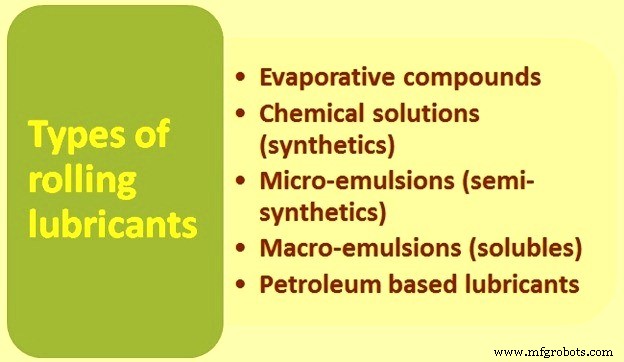
Fig 1 Types of rolling lubricants
| Tab 1 Comparison of metal working lubricants | ||||||
| Sl.No. | Function | Evaporative compounds | Chemical solutions (synthetic) | Micro-emulsions (semi-synthetic) | Macro-emulsions (emulsion) | Oil-based (solutions) |
| 1 | Reduce friction between roll and work piece | 3 | 3 | 3 | 2 | 1 |
| 2 | Reduce heat caused by plastic deformation transferring to the roll | 1 | 1 | 2 | 2 | 5 |
| 3 | Reduce wear and galling between roll and work piece due to chemical surface activity | 4 | 1 | 2 | 2 | 4 |
| 4 | Flushing action to prevent buildup of dirt on rolls | 1 | 1 | 2 | 3 | 4 |
| 5 | Minimize subsequent processing costs welding and painting | 1 | 1 | 2 | 4 | 5 |
| 6 | Provide lubrication at high pressure boundary conditions | 4 | 3 | 3 | 2 | 1 |
| 7 | Provide a cushion between the work piece and roll to reduce adhesion and pick-up | 4 | 4 | 3 | 2 | 1 |
| 8 | Non -staining characteristics to protect surface finish | 1 | 1 | 2 | 3 | 5 |
| 9 | Minimize environmental problems with air contamination and disposal problems | 4 | 1 | 2 | 3 | 5 |
| Note: 1-Most effective and 5-Least effective. | ||||||
Additives for lubricants
Properties of lubricants are modified and they are made suitable for specific applications by additives. Additives can improve lubricating properties, protect surface of metal, besides performing several other functions. Rust or corrosion inhibitors are commonly nitrates or phosphates. EP additives are sulphur, chlorine, or phosphorus compounds. EP additives reduce the cold welding of metals under pressure and prevent metal ‘build up’ but can reduce lubricating properties. Additives, such as esters, animal fats and fatty acids are added to oils to reduce surface tension or make it spread better. Synthetic-type lubricants are modified with phosphorus compounds or other chemicals, to act as lubrication detergents. The reduced surface tension allows the lubricant to reach the contact area more evenly and quickly.
Application methods
There are usually four methods used for the application of the lubricants. These methods are (i) drip, (ii) roller-coater, (iii) recirculating systems, and (iv) airless spray. Each method has its own advantages as given below.
- Drip – Chemical solutions, soluble oils, and evaporating compounds can be applied by using a drip lubricator in combination with some type of wiper consisting of a felt pad, open cell foam, rug material, or packing. Drip lubricators are not positive enough by themselves to provide an adequate and continuous film of lubricant. Normally the container feeding the drip lubricator is to be large enough to contain substantial quantity for at least 1 to 2nhours of supply of lubricant. Lubricant can be applied to the strip or to the top and bottom rolls.
- Roller-coater –This method consists of a small movable tank and pumping unit, which feed a wiping head or roller with lubricant. The thickness and the amount of lubricant can be controlled, and the excess flows back to the reservoir. When lubricating pre-coated or polished materials with a roller-coater, it is advisable to use polyurethane or neoprene rolls to make sure the working surfaces are not scratched or marked. Steel rolls can sometimes cause problems on coated surfaces. In many cases, roller-coaters by themselves do not produce enough lubrication film to flush out particles generated by aluminum, galvanized, and hot roll. Sometimes, a sprayer installed in the critical areas of metal working where there is a possibility of buildup to occur, can flush out unnecessary particles. Another issue which can happen when applying lubricant (especially on wide strip) is a result of material which has a ‘crown’. In such a case, the roller can only lubricate the high spots, leaving the outside edges without lubricant. A similar issue can occur on wavy strip. A soft roller can help in adjusting itself to this crown or wavy condition.
- Recirculating systems – When working with thicker material and cold rolled and hot rolled steel (especially with scale), the recirculating system of applying lubricant is normally the best approach. Here, sufficient amounts of lubricant not only have to protect the metal working tools, but the scale and metal fines which are generated by the process are to be flushed off the tooling and into the reservoir. The use of baffles, settling tanks and filters help collect large quantities of contaminants and metal fines, helping keep the coolant relatively clean. Magnets can be extremely helpful in keeping the amount of metal being recirculated down to a minimum.
- Airless sprayers – The airless spray systems are being used effectively to act as auxiliary units on specific metal working stations, for reapplying the lubricant at some critical point in the process, and on cutoff die lubrication. These system work well with solubles, light oils, and evaporating compounds and are quite reliable. The spray pattern obtained with the use of airless spray can be either round or fan shaped. Owing to the various spray patterns available, it is a reliable method for spot lubrication, either lubricating the work-piece before it enters the metal working tool or in the tool itself. A modern, airless, spray system does not produce mist or fog which results in overspray problems. On the contrary, it can be precisely directed at a target area in the metal working tool and is timed to operate in conjunction with the equipment cycle.
Manufacturing process
- Sintering of Refractory Metal Powders: Processes, Classifications, and Performance Outcomes
- Understanding the Metal FFF 3D Printing Process: From Printing to Sintering
- Sheet Metal Fabrication: From Design to Delivery – A Complete Process Guide
- The Complete Brass Recycling Process: From Scrap to New Products
- How IoT Revolutionized Healthcare During the Covid‑19 Pandemic
- Understanding Metal Forming: Types, Advantages, and Classification
- Inside Metal Casting: A Complete Foundry Tour from Pattern to Product
- Understanding Sand Casting: The Step‑by‑Step Process Explained
- Metal Additive Manufacturing: Transforming Production for Aerospace and Beyond
- Mastering the Shearing Process: Techniques & Best Practices