



The Art & Science of Fly Fishing: History, Materials, and Craftsmanship
Background
A fly in angling is a specialized hook dressed with feathers, fur, thread, and other materials to mimic an insect, fish, or other small prey. Over 5,000 distinct patterns exist, each with a unique name. For instance, the Cosmo Gordon fly was created for salmon in early 20th‑century England and honors a legendary angler, while the Seth Green American Trout Fly pays tribute to a 19th‑century conservationist who restored New England rivers. Names like Green Peacock or Silver Grey reflect appearance, and flies named after insects—mayfly, caddisfly, stonefly—are designed to look exactly like their namesakes.
Fly lures are central to sport fishing, attracting fish with realistic or visually stimulating designs. Within lures, flies are the most celebrated for their beauty and realism. Broadly, flies emulate three life stages of insects: nymphs (larval stage on stream beds), wet flies (sub‑surface or floating insects), and dry flies (surface‑floating insects that represent either newly hatched or mature stages). Streamers and bucktails diverge from insect imitation; they resemble baitfish, minnows, or leeches, often using long deer‑tail hair to suggest slender bodies.
Tier philosophy splits into two schools. Traditionalists follow a “match the hatch” approach, studying seasonal insect hatches to craft flies that match exact colors and patterns. Attraction‑focused tiers create bold, flashy flies that need not replicate a particular insect but aim to trigger a fish’s predatory instincts.
History
Fly fishing dates back at least 1,700 years. In the 3rd AD, Claudius Aelianus described the Hippouros fly, crafted from hooks, red wool, and rooster wattle feathers. The next documented reference appears in 1496 when Dame Juliana Berners authored The Treatyse of Fysshynge wyth an Angle, cataloguing dozens of trout‑fly patterns. Between Aelianus and Berners, fly tying evolved, producing wet, dry, and nymph flies that later migrated to the New World with European settlers. Streamers and bucktails, however, emerged as distinct American innovations.
For roughly 200 years, fly fishing has been recognized as an art form. The late 19th century saw a British craze for dry flies, prompting purists to refine designs to match nature’s precision. The 1920s marked a shift toward wet flies, some featuring up to 20 different feathers. Post‑World II, the introduction of plastics and synthetics steered designers toward the attraction school, and saltwater fly development gained momentum.
Fly designs continue to diversify as anglers target new species and environmental changes alter fish behavior. Successful flies require specific speeds—fast, slow, darting, or twitching—to mimic the real prey’s movements, demanding skillful line handling and deep knowledge of bait and predator dynamics.
Raw Materials
Four primary material categories underpin fly tying:
- Metal: Hooks and lead wire for weight.
- Synthetic: Plastics, poly‑yarn, foam, gold/silver mylar.
- Fabrics & Threads: Sewing thread, embroidery floss, crochet thread, wool, burlap, chenille.
- Natural: Fur (rabbit, fox, seal, mink), hair (elk, caribou, deer), feathers (chicken, peacock, marabou).
Design
Tier catalogs boast over 10,000 published patterns, ranging from poetic names to playful references to wrestling. Realistic designs, like the Lew Oatman’s Brook Trout fly, feature meticulous paintwork and tiny color spots. Attraction‑focused flies often use bright plastics or metallic flash and embrace bold naming. The classic Mickey Finn exemplifies this balance: intricately detailed yet boldly colorful, it remains a top salmon fly.
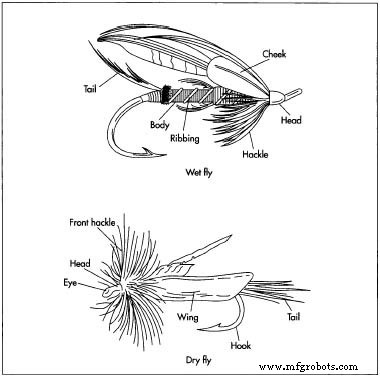
Construction principles hinge on replicating insect segmentation: a long, stiff tail; a body; a hackle (feather “legs”); and wings. Emerger flies have tails submerged below the surface, using iridescent material to mimic egg sacs. Wet flies feature sparse hackles and folded wings, while nymphs, streamers, and bucktails employ soft tails and bodies—often wrapped around lead to adjust sink rates—and marabou or chenille wings to emulate minnows.
The Manufacturing Process
- Essential skills: dexterous hands, patience, sharp vision, creativity, and spatial visualization. Key tools include a Y‑shaped bobbin, fine scissors, a vise (preferably rotary for turning).
- Material selection follows the fly type; for example, the Royal Coachman uses red floss, peacock herl collars, white hair wings, and brown feather hackles. The right‑handed tier mounts the hook in a vise with eye right, bent side left, and threads through the Y‑bobbin.
- The thread is anchored near the hook eye, wrapped along the shank to the bend, and back toward the eye. A tail of 4–6 feather barbules is tied near the hook bend with tight wraps. A peacock herl collar attaches at the tail–body junction, followed by red floss covering ~60% of the shank. A second herl collar frames the body.
- Wings are formed from a tuft of white calf hair; hairs are aligned with a hair stacker, split into two wings, and secured with figure‑eight thread loops.
- Hackles use a tannish brown chicken feather stripped of base barbules. The quill is wrapped around the fly, flaring to expose stiff barbules that touch water surface, supporting the fly via surface tension.
- The head receives 3–5 thread wraps; optional head cement protects the construction. The tier then moves to the next fly—e.g., a Woolie Bugger—adding lead for weight and marabou or chenille for body and hackle to simulate a leech.
Quality Control
Tier judgment—visual acuity, tactile sense, and aesthetic judgment—defines quality. Ultimately, the fly’s worth is validated when a trout, bass, or salmon recognizes it as food.
Byproducts/Waste
Hand‑tying generates minimal waste: tiny scraps of thread, fur, and feathers. Many flies share common supplies, allowing reuse of material scraps.
The Future
Fly fishing remains among the United States’ most popular sports, with growing interest in custom tying. Enthusiasts increasingly pursue the “perfect” fly, crafting their own designs during winter months when streams are still. The art’s future also promises recognition for master tiers, whose works are cataloged in books, museums, and online auctions. Historically significant tiers, such as Carrie Stevens (1882‑1972), marked flies with distinctive bands or labels; collectors value pieces by signature or provenance. As the hobby matures, hand‑tied flies retain cultural and economic value, securing a legacy that rivals even their natural counterparts.
Manufacturing process
- Premium Tungsten Alloy Fishing Sinkers: Advanced Design & Performance
- Rapid Prototyping of a Bike‑Mounted Fishing Rig: From CAD to the Water
- Fishing Lure Design, History, and Manufacturing: An Expert Overview
- The Evolution and Craft of Modern Fishing Rods
- Custom Marine Switchboard Design for the Endeavour V Fishing Trawler
- Unexpected Intruders: How Mice, Bats, and Bearing Defects Threaten Industrial Reliability
- Blockchain Revolution: Enhancing Transparency in Seafood Traceability
- Aerospace Industry Navigates COVID-19: Strategies for Resilience and Recovery
- Crafting the Premier Stand‑Up Fishing Kayak: Light, Durable, Ready for the Water
- The Fishing Industry Explained: From Catch to Consumer