



The Evolution and Manufacturing of Baby Strollers: From Cradleboards to Modern Prams
Background
For centuries, parents have devised ingenious ways to transport their infants. Native American cradleboards, Inuit caribou‑skin hoods, and Papuan nets are just a few examples of traditional carriers that balanced comfort, safety, and mobility. In the 1700s, England introduced the first baby carriage—large, dog‑pulled, and heavily built—which paved the way for the modern stroller.
Today’s strollers range from reclining models that allow a baby to lie down to upright designs for active parents. Many are collapsible, convertible into car seats, or even attachable to bicycles as prams. These innovations reflect over 300 years of iterative design aimed at enhancing convenience and safety.
Research from Henry Ford Hospital in Detroit shows that jogging with a pram or stroller increases runners’ heart rates by 3–5% and oxygen consumption by 2%. Women burned 4–21 extra calories per 30‑minute jog, while men burned 4–41, depending on the stroller’s make.
History
English architect William Kent introduced the first baby carriage in 1733 for the Duke of Devonshire’s child. It resembled a shell and was intended for dog or Shetland pony pull. The concept spread beyond royalty, with Charles Burton developing a human‑powered carriage in 1848, later gaining royal patronage in London, including Queen Victoria and Queen Isabel of Spain.
In 1906, Parisian designer E. Baumann launched the first collapsible carriage—named “The Dream”—to address storage challenges in cramped homes. The first pram emerged in Landau, Germany, post‑World War I, featuring four wheels, dual facing seats, and an interchangeable hood or sunshade.
Modern prams are aerodynamic, often with bicycle‑type wheels. Three‑wheeled models resemble race cars, popular among joggers, while lightweight units can attach to bicycles, enabling active parents to exercise while carrying their children.
Raw Materials
Stroller frames are typically made from aluminum or steel. Seats and hoods are upholstered in cloth, while handles and wheels combine rubber and plastic components.
The Manufacturing Process
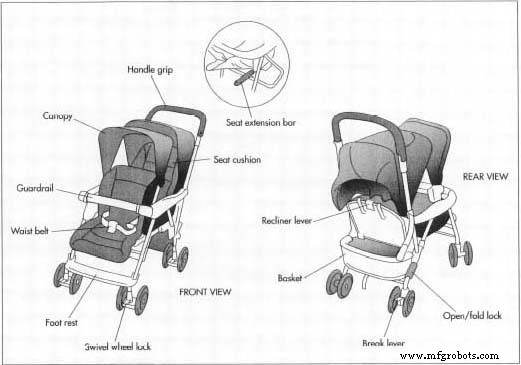
Strollers are assembled on a dedicated production line. A typical collapsible, upright stroller follows these stages:
The Frame
- Steel or aluminum tubing is bent by a press into frame components.
- Components are dipped in an antioxidizing solution to prevent rust and improve paint adhesion.
- They receive a powder‑coat finish—an industry‑standard automotive process—ensuring durability.
- After a pre‑heat cycle, a powder resin coat is applied and baked to lock the finish.
- Frame parts are assembled using rivets, screws, or bolts.
The Seat and Hood
- Large swaths of fabric are cut by a cutting die, producing 10–20 pieces simultaneously.
- Stitching is performed on high‑capacity mechanical sewing machines.
- Trim and finishing details are added in a subsequent stitching pass.
Final Production
- The seat and hood are attached to the frame.
- Wheels are affixed to the assembled frame.
- Finished strollers are bagged in polybags and boxed for shipping.
Quality Control
Safety is paramount. All U.S. strollers must meet ASTM Standard 833‑97. Suppliers certify each component’s compliance before delivery to manufacturers, ensuring rigorous testing for structural integrity and crash safety.
The Future
As Americans embrace an active lifestyle, strollers continue to evolve. Innovations aim to reduce weight, enhance maneuverability, and incorporate smart technology—such as integrated GPS, biometric sensors, and adaptive suspension—to meet the demands of modern families.
Manufacturing process
- Embracing Cloud Confidence: Key Insights for 2017 IT Strategy
- Designing Baby Products: Ensuring Safety, Compliance, and Market Success
- Pacifier: Design, Safety Standards, and Manufacturing Insights
- Baby Carrier: History, Design, and Safety of Infant Carriers
- The Science and Market of Baby Wipes: Materials, Manufacturing, and Future Trends
- Baby Formula: Science, Production, and Future Outlook
- Build a Budget‑Friendly Raspberry Pi Baby Crying Detector – DIY Guide
- Porsche Design Unveils the P'4911: A Carbon Fiber Baby Stroller for Luxury Parents
- Build a Two-Legged Arduino Robot: Baby Dino DIY Guide
- Navigating Retirement: How Baby Boomers' Knowledge Transfer Shapes Organizational Success