



Baby Formula: Science, Production, and Future Outlook
Background
Baby formula is a sophisticated dairy substitute engineered to replicate the complex nutrition of human breast milk. Since the early 19th century, products like oleomargarine and filled cheese have used blends of fats, proteins, and carbohydrates produced with the same technology that creates real dairy. Advances in homogenization, fluid blending, and continuous batching since the 1940s have greatly refined formula production, making infant formulas more consistent and nutritious.
Until the early 1990s, infant formula was sold only as a pharmaceutical product. Pediatricians were the primary recommenders, but federal antitrust actions in 1992 shifted the industry toward direct marketing, including mail campaigns and TV/print advertising. In the United States, the industry generates about $3 billion annually, with another $1 billion in international sales. While formula provides a reliable nutrition source, leading authorities such as the World Health Organization (WHO) recommend exclusive breastfeeding for the first six months and continued breast milk through at least the second year. Mis‑mixing or improper administration can expose infants to health risks, and establishing a formula routine can make a return to breastfeeding challenging.
Design Principles
The core objective in formula design is to match the physical and nutritional characteristics of breast milk as closely as possible. Milk is a natural emulsion—a fine dispersion of fat droplets in water—containing proteins, sugars, minerals, salts, and trace elements. Infant formulas aim to replicate these properties using a combination of dairy and non‑dairy ingredients. Typically, formula design falls into one of three categories:
Milk‑Based Formulas
These start with cow milk as a base, which most infants tolerate well. The base is fortified with additional nutrients to meet infant requirements.
Animal or Vegetable‑Fat‑Based Formulas
Infants sensitive or allergic to cow milk may benefit from formulas that incorporate vegetable fats (often soybean‑derived) and limited cow‑milk components. Hydrolyzed proteins are frequently used to reduce allergenicity.
Non‑Milk‑Based Formulas
Specialty formulas designed for infants with severe sensitivities to both cow and soy milk, or with specific medical conditions, are available. These are typically more expensive and require rigorous quality controls.
Formulas are offered in three formats: powder, liquid concentrate, and ready‑to‑feed. Powder and liquid concentrate are cost‑effective but require careful mixing with sterile water. Ready‑to‑feed eliminates mixing steps, reducing contamination risk and ensuring precise nutrient delivery.
Raw Materials
Proteins
Protein sources include cow milk, soybeans, and, less commonly, nuts or fish. Soy protein can be used as a concentrate or isolate; isolates reduce carbohydrate content that may cause flatulence. Hydrolyzed proteins are employed when allergenicity is a concern.
Fats and Carbohydrates
Infant formulas strive to match the fatty‑acid profile of breast milk, including essential omega‑3 fatty acids such as eicosapentaenoic acid (EPA) and docosahexaenoic acid (DHA). Triglycerides derived from egg yolk phospholipids or added fatty‑acid precursors (alpha‑ and gamma‑linolenic acids) support brain and eye development, though they are less efficient than breast‑milk sources.
Diluents
For milk‑based formulas, skim milk often serves as the diluent; for milk‑free formulas, purified water is used.
Minerals
Essential minerals such as calcium, phosphate, sodium, potassium, chloride, magnesium, sulfur, copper, zinc, iodine, and iron are added. Iron is critical for infant development; concerns that iron fortification causes gastrointestinal issues are largely unfounded. Generally, formula‑fed infants may experience more GI symptoms than breast‑fed peers.
Vitamins
Fortification includes vitamins A, B12, C, D, E, thiamine, riboflavin, niacin, pyridoxine, pantothenate, and folacin.
Emulsifiers/Stabilizers
Emulsifiers such as mono‑ and diglycerides, along with thickeners like natural starches and gums (e.g., carrageenan), maintain homogeneity and prevent separation of oil and water phases during storage and transport.
The Manufacturing Process
The manufacturing method varies with formula type. Below is a general procedure for a ready‑to‑feed, milk‑based formula.
1. Ingredient Mixing
- Primary ingredients are blended in large stainless‑steel tanks. Skim milk is added and heated to 140 °F (60 °C). Fats, oils, and emulsifiers follow, with additional heating and agitation to achieve the desired consistency.
- Heat‑sensitive minerals, vitamins, and gums are incorporated at stages that preserve their integrity.
- After mixing, the batch may be stored briefly or transported via pipeline to pasteurization equipment.
2. Pasteurization
- Pasteurization eliminates bacteria, yeasts, and molds. Typical parameters are 185–201.2 °F (85–94 °C) held for ~30 seconds.
- Common methods include indirect heating through a heat‑exchanger tube or direct heating followed by steam or hot‑water preheating.
- Post‑pasteurization, the batch may undergo homogenization for further refinement.
3. Homogenization
- High‑shear mixing reduces fat and oil particle size, enhancing emulsion stability and uniformity.
4. Standardization
- The finished product is tested for pH, fat concentration, and nutrient levels. If any parameter falls below specification, the batch is reworked before packaging.
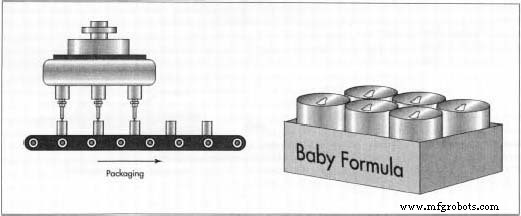 Conventional liquid filling equipment used in the food and beverage industry packages ready‑to‑use baby formula.
5. Packaging
- Liquid formula is filled into metal cans with crimped lids using standard filling lines.
6. Sterilization
- Filled cans undergo a secondary heat‑cool cycle to eradicate residual microorganisms.
- Finished products are boxed, stored, and shipped under controlled conditions.
Quality Control
Quality assurance operates on three overlapping levels:
- Governmental standards: The U.S. Food and Drug Administration (FDA) regulates infant formula as a special diet food, publishing a monograph that specifies nutrient lists, labeling, and packaging requirements.
- Industry standards: The International Dairy Federation sets manufacturing and quality benchmarks for dairy substitutes.
- Company standards: Leading producers, such as Martek (suppliers of triglycerides), monitor production continuously—30 checkpoints around the clock—to maintain excellence.
The Future
Future advances in formula manufacturing will be shaped by both scientific innovation and market dynamics. The global infant formula market could reach $80 billion, with current worldwide sales at $4 billion—just 5% of potential volume. Emerging research has identified a breast‑milk fatty acid critical for neural and ocular development that is absent from most formulas; its inclusion could represent a significant leap forward. However, industry growth remains sensitive to public perception, and criticism from advocacy groups could influence investment in research and development.
Manufacturing process
- Pacifier: Design, Safety Standards, and Manufacturing Insights
- Baby Carrier: History, Design, and Safety of Infant Carriers
- The Science and Market of Baby Wipes: Materials, Manufacturing, and Future Trends
- Soy Milk: Production, Nutrition, and Quality Standards
- The Evolution and Manufacturing of Baby Strollers: From Cradleboards to Modern Prams
- Milk: Production, Processing, and Nutrition in the United States
- Inside the Milk Carton: Production, Materials, and Sustainability
- Yogurt: History, Production, and Health Benefits
- Milking Machines: Design, History, and Future Innovations
- The Art and Science of Cheese: From History to Modern Production