



The Evolution and Modern Technology of Gasoline Pumps
Background
A gasoline pump delivers fuel directly into a vehicle’s tank. Its design evolved from a simple manual device to a sophisticated, highly automated system as automobiles proliferated. Early motorists filled a car by pouring gasoline from a barrel into a hand‑held canister and then tipping it into the vehicle—an awkward, hazardous process that could result in spills or leaks.
In 1905, Sylvanus Bowser of Fort Wayne, Indiana, introduced the first commercially marketed gasoline pump, the “Self‑Measuring Gasoline Storage Pump.” Bowser’s design adapted his 1885 kerosene pump, featuring a manual suction mechanism and a flexible hose that delivered fuel from a 50‑gallon metal tank housed in a wooden cabinet. By 1901, John Tokheim had launched a glass‑domed pump that allowed consumers to visually verify fuel purity before dispensing, addressing concerns about adulterated gasoline.
Throughout the 1920s, manufacturers produced pumps that shared core characteristics: hand‑operated pistons, glass dispensing domes, dial gauges, and a globe‑shaped head emblazoned with a logo. Initially, gasoline brands were locally produced by small dealers; however, by the late 1920s, major corporations such as Shell and Gulf began marketing branded fuels, shifting customer loyalty from pump design to brand.
The first electric pump appeared in 1923. Subsequent innovations focused on accurate measurement. Replacing the glass globe, pumps incorporated dial readouts, and in 1933 a Fort Wayne company introduced the “variator,” a mechanical calculator that displayed gallons and price on rotating wheels. This concept evolved into the modern digital meters that enable customers to purchase a specific dollar amount without calculating fractional gallons.
Tokheim’s 1975 successor introduced electronic measurement: rotating wheels were replaced by internal circuitry that calculated volume and price, displaying the result on a small screen. Today’s pumps largely retain this architecture but add features such as debit‑card readers, electronic odometer integration, and vehicle‑specific data collection.
Raw Materials
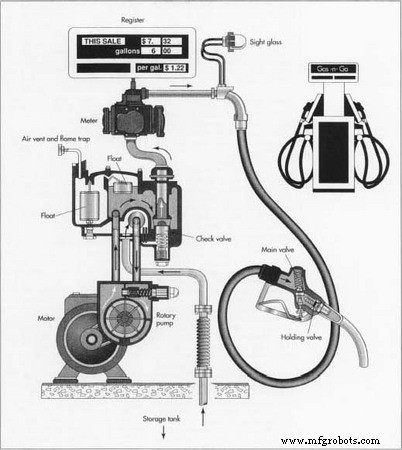
Every pump comprises three fundamental subsystems: hydraulics, electronics, and the outer housing.
- Hydraulics: Typically cast from iron or aluminum, these components are molded, machined, or stamped into shape. Synthetic rubber is employed for seals and gaskets.
- Electronics: Printed circuit boards and plastic housings house micro‑processors, sensors, and display modules.
- Housing: Constructed from sheet steel or stainless steel, the enclosure protects the internal mechanisms and provides a mounting platform for hoses and gauges.
Design
Gasoline pumps are largely produced on a semi‑custom basis. While core components remain consistent across models, manufacturers tailor aspects such as hose arrangement, electronic sophistication, and housing aesthetics to meet customer specifications. Engineers draft detailed specifications before production, sourcing specialized sub‑assemblies and re‑tooling machinery as needed.
The Manufacturing Process
Pump production typically involves three stages—hydraulics, electronics, and housing—performed either in‑house or by specialized suppliers.
Hydraulics Production
- The pumping mechanism, usually cast from aluminum or iron, is poured into molds, cooled, and finished by abrasion. Metal sheets are stamped, tubes are bent, and smaller parts are welded into larger assemblies. Skilled workers collaborate in cells of 4–50 to maintain consistent quality.
Electronics Assembly
- Electronic controls—responsible for volume displays, pricing, and payment processing—are fabricated on printed circuit boards. Components are soldered by hand or automated, then cured in an oven. The completed module is integrated into the pump head.
Housing Fabrication
- Sheet steel panels are cut, painted with corrosion‑resistant coatings, and cured. The hydraulic and electronic assemblies are mounted, hoses are attached, and all parts are sealed with gaskets. The housing is welded or hinged, then inspected, painted again if necessary, and finally tested before shipment.
Quality Control
Inspection occurs at every stage. Sub‑contracted parts are tested upon arrival; raw materials are verified for gauge and integrity. Leak tests—using water or pressurized air—ensure hydraulic integrity. Electronic accuracy is verified by calibration, and a dielectric withstand test checks the electrical insulation. Independent laboratories such as Underwriters Laboratories conduct additional certification, while FCC standards govern radio‑frequency‑enabled pumps.
The Future
Modern pump development concentrates on three fronts:
- Environmental compliance: Advanced leak‑detection sensors and vapor‑capture systems reduce emissions without sacrificing flow rate.
- Data integration: Automated odometer reading and fleet‑management systems record fuel usage, cost, and mileage—streamlining operations for commercial fleets.
- Automation: Robotic pumps, first field‑tested in 1997, allow vehicles to be fueled without driver intervention, provided the car is equipped with a dashboard transmitter and a modified tank cap. Although adoption remains niche, these systems promise a two‑minute fill‑up experience.
Ongoing research explores low‑frequency magnetic‑induction communication between nozzle antennas and vehicle‑mounted units, enabling real‑time data exchange for both fleet and individual consumers. When fully integrated, these innovations will transform fueling from a manual chore into a seamless, data‑driven transaction.
Manufacturing process
- Gas Lanterns: Evolution, Design, and Modern Manufacturing
- Natural Gas: From Extraction to Distribution – A Comprehensive Overview
- Helium: Properties, Production, and Global Supply
- Industrial Full‑Face Gas Mask Production & Quality Standards
- Heat Pump Technology: Design, Manufacturing, and Future Trends
- Gasoline: Production, Refining, and the Road Ahead
- Detecting Gas Pump Card Skimmers: A Raspberry Pi Dashboard Scanner
- Understanding Multistage Pumps: Function, Uses, and Benefits
- Understanding Submersible Pumps: How They Work and Their Key Benefits
- Decoding 'N' in Pump Calculations: Its Role and Significance