



The Globe: From Ancient Models to Modern Manufacturing
Background
Globes are divided into two primary categories: terrestrial and celestial. Terrestrial globes present a spherical map of the Earth, while celestial globes use the planet as an imaginary center to map the stars in a spherical form. A globe is the only “true” map of the world because it preserves the relationships of area, direction, and distance without distortion. The subtle flattening at the poles and the slight bulge at the equator are negligible at the scale of most globes. The globe is mounted on an axle and a stand so it can rotate like the Earth, with the axle tilted 23.5°—exactly the Earth's axial tilt relative to its orbital plane.
Terrestrial globes come in several variants: physical globes display Earth as seen from space, often highlighting natural landforms and sometimes sea floor features; political globes color nations and major cities; relief globes show topography; and digital globes embed satellite imagery on CD-ROM or online platforms.
History
The ancient Greeks were the first to create globes, rejecting flat‑earth theories and proving the Earth’s sphericity. Crates of Aegina is credited with the first globe around 150 B.C. The Romans continued this tradition; the Farnese Globe (25 A.D.) survives today, crafted from local marble.
In 1492, German geographer Martin Behaim produced the earliest surviving terrestrial globe. Behaim’s work was timely, likely influencing Christopher Columbus’s confidence to sail westward. The most influential cartographer, Gerardus Mercator (1512‑1594), developed the eponymous Mercator projection, which preserves angles and made navigation easier by allowing straight‑line courses between any two points. Mercator also pioneered the world atlas and, with Myrica Frisius, built globes in Louvain (1535‑37).
Raw Materials
Early globes were solid, crafted from glass, marble, wood, or metal. Hollow globes—common since Mercator’s era—were made from thin metal sheets such as copper. Modern globes are almost always hollow, utilizing lightweight yet durable materials: cardboard, plastic, metal, or crystal. Cardboard globes use recycled fibers; plastic globes can be illuminated, with internal light sources. Specialty items include paper jigsaw globes with foam backing for puzzle enthusiasts, plastic globes with snap‑on continents for children, Waterford crystal globes for décor, and inflatable globes for educational play.
In the United States, only two companies manufacture traditional globes: The George F. Cram Company (since 1867, globes since 1929) and Replogle Globes Inc. Cram’s processes remain largely unchanged: fiberboard or cardboard globes are laminated for durability, while illuminated globes are made of heat‑resistant plastic. Recycled cardboard, injection‑molded plastic, and specialized tapes (e.g., “Equator tape”) are used to join hemispheres, attach axes, and house electrical components.
Design
Globes are typically sold in two standard sizes: 12‑inch (30.5 cm) diameter—about the size of a basketball—and 16‑inch (40.6 cm) diameter. Roughly 80% of globes sold are the 12‑inch model. Color schemes vary: children favor blue oceans, while adults prefer antique or off‑white tones. Manufacturers update product lines based on teacher feedback, décor trends, and market demand. Stand and pedestal designs follow current interior styles, from dark and light wood to Southwestern or wrought‑iron finishes.
While physical globes rarely change—geological shifts are too slow to affect a 12‑inch globe (1 inch ≈ 660 miles)—political boundaries evolve. Over the past five years, three political changes have affected global globes: two in Africa and one in Europe. Manufacturers can update artwork instantly via computer, relying on authoritative sources such as the U.S. Department of the Interior’s Office of Geographic Names, the State Department, embassies, the Library of Congress, and state agencies (e.g., Louisiana’s Mississippi Delta data).
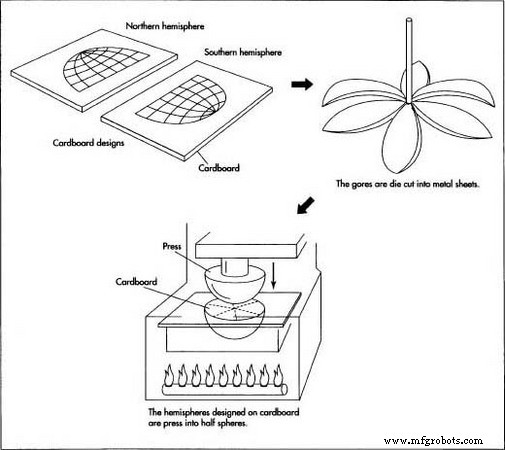
Once the globe pieces are die‑cut, they are pressed together to form half‑spheres, one for each hemisphere.
The Manufacturing Process
- The process begins with a flat representation of the world. Detailed artwork, curated by researchers and cartographers, is printed onto cardboard sheets: one for the Southern Hemisphere and one for the Northern Hemisphere.
- Gores—tapered triangular segments—are die‑cut from the printed sheets using specialized machinery, producing a pinwheel‑shaped layout that will later converge into a sphere.
- Segments are carefully aligned so adjacent gores match seamlessly when assembled.
- Each half‑sphere is formed by heat and pressure: a forming press heats the cardboard to ~300 °F (149 °C) for 90 seconds, then presses the material into a curved shape. The two halves are glued together, and Equator tape covers the seam.
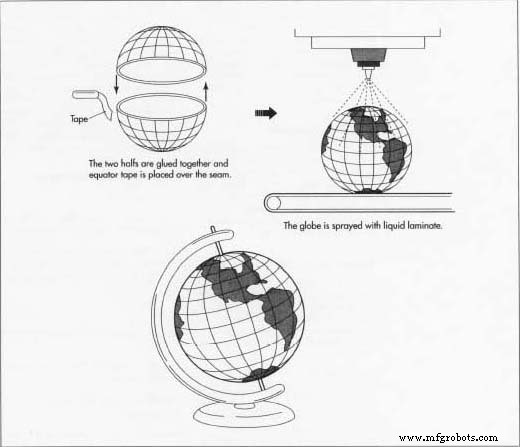
The globe is then laminated for durability. - A liquid laminate is sprayed over the completed sphere to enhance gloss, resist fingerprints, and protect the surface.
- Finished globes are mounted on a variety of stands—plastic, brass, or other materials—and, for illuminated models, equipped with bulbs, sockets, switches, and cords. They are then packaged for sale or shipment.
Illuminated Globes
Illuminated globes follow a similar assembly path but use a different base material. Flat plastic sheets are printed with both hemispheres, vacuum‑formed into hemispheres at thousands of degrees, then sent to an injection‑molding facility where plastic hardens inside the shell. A cavity is left in Antarctica for the bulb and socket. After gluing and taping the hemispheres, the globe can withstand several dribbles on a concrete floor before breaking. Advantages include enhanced readability and greater durability, while the smooth surface precludes relief topography.
Quality Control
All production steps are overseen by ISO 9000‑certified technicians trained to uphold rigorous standards. Each station includes inspection points; technicians reject any flawed product regardless of where the defect occurs.
Byproducts/Waste
Globe manufacturing generates minimal waste. Cardboard scraps from die‑cutting are recycled. Manufacturers also produce related items such as maps, but these are considered by‑products rather than waste.
The Future
The globe remains a vital educational and reference tool. Future innovations focus on interactivity—globes that vocalize country names upon touch, display real‑time time zone data, and integrate with corporate communication tools. Digital globes, described in a companion article, further expand the medium by combining physical form with online datasets. As global awareness grows, the globe’s role as a symbol of interconnectedness and geographic literacy endures.
Manufacturing process
- What is VMC Machining? An Expert Overview of Vertical Machining Centers
- Expert Guide to Aluminum Laser Marking: Precision, Durability, and Industry Applications
- MIG vs. TIG Welding: Selecting the Right Arc Welding Technique for Your Project
- Comprehensive Guide to Laser Marking: Types, Benefits, and Applications
- Key Considerations for High‑Volume Swiss Machining
- CNC Prototyping Guide: Precision, Speed, and Cost‑Effective Production
- Expert Shaft Manufacturing: Precision Processes & Custom Solutions
- The Globe: From Ancient Models to Modern Manufacturing
- Technology's Role in Delivering a Vaccine Across the Globe
- DIY Persistence of Vision (POV) Globe: LED Art with Arduino Mega