



The Complete Guide to Modern Furniture Polish: History, Ingredients, and Manufacturing
Background
Furniture polishes—pastes, creams, or lotions—clean, protect, and add shine to wooden furnishings. Historically, these products were crafted from natural waxes such as beeswax and carnauba wax. Early formulations required hot irons and hand‑buffing, leaving a heavy residue that needed periodic stripping. Today, advanced blends of natural waxes, oils, and petroleum‑based ingredients combine with synthetic polymers to deliver a single‑step finish that cleans old film residue while depositing a fresh protective layer.
In the United States, aerosol furniture polish dominates the market, with sales exceeding 80 million units annually. However, emerging legislation is tightening the range of propellants allowed in these products, prompting manufacturers to innovate safer, more compliant formulas.
Wood’s susceptibility to aging—drying, cracking, and staining—has long motivated the use of oils and balms. Early records show linseed and cedarwood oil being applied to furniture surfaces, while twelfth‑century Italy favored tung and perilla oils for floor polish. Beeswax became widespread in the fourteenth century, but its need for hot application limited its use. The discovery of carnauba wax in 1797 provided a harder, higher‑melting wax that delivered shine without excessive buffing. The late nineteenth century saw the introduction of carnauba blends with candelilla, esparto, and other plant waxes.
The early twentieth century introduced petroleum chemistry into polish formulations. Paraffin waxes, mineral waxes (e.g., montan wax), and inexpensive solvents such as kerosene and naphtha expanded the ingredient palette. In 1929, chemists marketed the first self‑polishing wax emulsion—a carnauba‑based mixture suspended in soap and water—though it suffered from streaking and water‑solubility issues. Over the past few decades, synthetic polymer emulsions, particularly silicone‑based systems, have replaced many traditional waxes, offering superior gloss, lubricity, and water resistance. Aerosol sprays remain the most popular delivery method because they enable effortless application over large surfaces.
Raw Materials
The primary components of furniture polish include polishing agents, solvents, and emulsifiers. Auxiliary ingredients such as preservatives, colorants, and fragrances enhance performance and sensory appeal.
Polishing Agents
Polishing agents—waxes, polymers, and oils—improve a furniture surface’s condition. Waxes come from vegetable, animal, or mineral sources:
- Vegetable waxes: Carnauba (palm leaves), candelilla (Mexican plant), sugar‑cane wax, cotton wax, and others.
- Animal/ insect waxes: Beeswax (unique physical properties), shellac (lac insect of Ficus religiosa), and historically, spermaceti (sperm whale).
- Mineral waxes: Ozokerite, paraffin, microcrystalline, oxidized microcrystalline, Fischer‑Tropsch, and montan waxes.
- Polymers: Methyl acrylate, ethyl acrylate, butyl acrylate, vinyl acetate, styrene, vinyl chloride, and acrylonitrile.
- Oils: Vegetable, petroleum, and silicone oils to enhance shine.
Solvents
Solvents dissolve or soften water‑insoluble ingredients. Common choices include mineral spirits, turpentine, and naphtha. Selection criteria also encompass flammability and toxicity.
Emulsifiers/Surfactants
Surfactants bridge oil and water phases, forming stable creams, pastes, or lotions. They are essential for a consistent emulsion.
Propellants
Liquefied gases such as propane and butane—both highly flammable—dispense aerosol polishes. Regulatory changes are increasingly restricting these propellants.
Other Ingredients
Additional components include abrasives, colorants, fragrance, preservatives, and corrosion‑inhibiting agents that raise pH to protect the metal can. Polishes may be formulated as pastes, creams, liquids, aerosol sprays, or non‑aerosol pump sprays.
Design
Formulating furniture polish requires balancing multiple properties: gloss, spreadability, buffability, flexibility, mechanical strength, water‑proofing, and stain resistance. A single ingredient rarely delivers all these attributes. For instance, a 20 % carnauba paste offers excellent gloss but is gritty and difficult to spread. Adding mineral waxes or silicone polymers can improve flow while maintaining shine.
Manufacturers also consider the intended wood type, existing surface finish, dust attraction, and spill resistance. Safety and regulatory compliance—particularly regarding toxicology and propellant choice—must be integral to the design process.
The Manufacturing Process
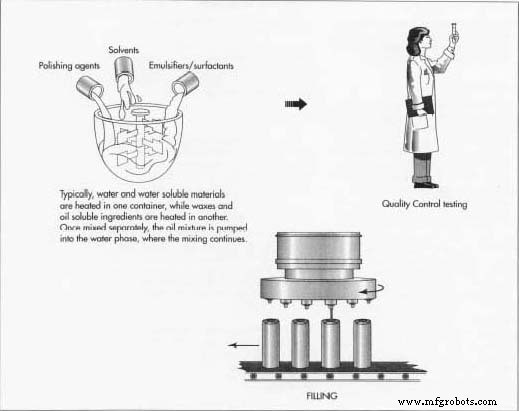
Production of aerosol furniture polish involves four core steps: compounding the wax emulsion, filling the primary container, pressurizing/gassing the can, and final finishing operations.
Compounding the Wax Emulsion
- Oil‑phase ingredients (waxes, oils, polymers) are heated in a stainless‑steel vessel with jacketed cooling/heating control. Water‑phase ingredients are heated separately.
- When both phases reach 158–176 °F (70–80 °C), a turbine mixer blends them under high shear until a homogeneous emulsion forms.
- Cooling follows, during which preservatives, dyes, and fragrance are added.
- The finished batch is assayed for solids, pH, and other quality parameters before storage or transfer to filling lines.
Filling the Primary Container
- Aerosol cans—typically tin‑coated steel or aluminum—are fed onto a conveyor to a filling head equipped with a hopper that delivers a precise volume of emulsion.
- Immediately after filling, the valve may be crimped and sealed in place, preparing the can for gassing.
Pressurizing/Gassing the Can
- Propellant (propane or butane) is injected under pressure using either the under‑cupping method—shooting gas around the valve cup—or pressure filling—injecting through the valve stem after crimping.
- All equipment is pneumatically operated and properly grounded to eliminate spark risks.
Final Operations/Finishing Steps
- During or immediately after filling, each can is coded with batch data for traceability. This is vital for recalls if a raw‑material issue arises.
- Can caps and plastic overcaps prevent accidental valve activation and leakage.
- After quality checks—including leak tests in heated water baths—cans are packed in cardboard cartons, palletized, and shipped to distribution centers.
Quality Control
Quality assurance occurs at multiple stages:
- Raw materials are tested against specifications before use.
- Batch analysis measures water content, pH, solids level, and preservative activity.
- Post‑fill, spray characteristics and valve performance are verified. Cans undergo bursting‑strength tests to meet U.S. regulatory limits.
The Future
Technological advances—particularly in silicone polymers—will continue to enhance polish performance. Regulatory trends are the most significant driver of change, with stricter limits on propellants and solvents shaping formulation strategies. Manufacturers may pivot to safer aerosol propellants, non‑aerosol pump sprays, or entirely new delivery systems to stay compliant while meeting consumer demand for high‑gloss, long‑lasting finishes.
Manufacturing process
- Titanium: Key Properties, Applications, and Industrial Uses
- Castanets: History, Craftsmanship, and Performance
- The History, Production, and Future of Glue: From Ancient Adhesives to Modern Innovations
- Thread: Types, History, Production, and Quality Control
- Acetylene: Production, Uses, and Handling – A Comprehensive Overview
- Comprehensive Overview of Asbestos: From Ancient Uses to Modern Health Risks
- The History, Design, and Manufacturing of Dice: From Ancient Tools to Modern Gaming
- Plywood: History, Production, and the Path Ahead
- Tin: From Bronze Age to Modern Industry – Uses, Production, and Future
- Silver: History, Properties, and Modern Applications