



Playing Cards: History, Design, and Modern Manufacturing
Background
Playing cards are flat, rectangular pieces of layered pasteboard used worldwide for games of skill and chance. Their origins date back to the twelfth century, evolving from divination tools and chess derivatives. Modern decks are produced through lithography, photolithography, or gravure, and future innovations promise even faster, more flexible manufacturing.
History
Scholars debate the precise origins of playing cards. Some trace them to India, where chess inspired early decks, while others point to Egyptian divination artifacts. The first documented use appears in the Orient in the 12th century. By the 13th century, cards arrived in Europe via the Middle East, first appearing in Italy or Spain and spreading rapidly across the continent.
Early European decks mirrored modern ones, featuring 52 cards with four suits—swords, cups, coins, and polo‑sticks—and face cards: king, deputy king, and second deputy king. The 15th century saw inconsistent designs until France introduced the now‑standard suits of spades, hearts, diamonds, and clubs around 1480.
Production improved with hand‑stenciled coloring, making early decks expensive and reserved for the elite. The 15th century German innovation of wood‑block printing increased output, while the 16th century copper‑plate engraving further reduced costs. The early 1800s saw color lithography revolutionize card production, a trend that continues with digital printing today.
Design
A standard deck contains 52 rectangular cards (≈2.5 × 3.5 in / 6.35 × 9 cm) with rounded corners. Each card is a pasteboard made of layered paper, featuring red and black face designs across four suits: clubs, spades, hearts, and diamonds. Every suit has thirteen cards—three face cards (king, queen, jack) and ten numbered cards from ace to ten. Face cards are double‑ended, so orientation is irrelevant when fanned.
The upper left corner of each card bears an index number and suit symbol, ensuring quick identification in gameplay. Most decks include two jokers. Card backs showcase unique patterns that identify the manufacturer; colors vary from red and blue to any custom design. Symmetry in back patterns guarantees a single orientation, though specialty decks may feature asymmetrical artwork.
Cards serve diverse purposes: parlor games (bridge, rummy, gin), gambling (poker, blackjack), board game components, teaching aids, and more. Non‑standard decks—tarot (78 cards, 22 with symbolic imagery), trick decks, and novelty cards—offer specialized uses such as divination, magic, or themed entertainment.
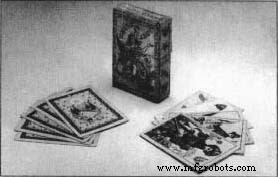 Union playing cards printed during the American Civil War. (From the collections of Henry Ford Museum & Greenfield Village.)
Playing cards likely circulated in China as early as the 7th century and were known in India around the same time. By the 13th century, Europe embraced the game; British manufacturers sought protection from imported cards, while German printers pioneered block‑printing by the late 1400s. The French deck’s motifs—spade, club, diamond, heart—remained largely unchanged, though court card portraits evolved to reflect cultural tastes. The Union Playing Cards, for instance, replaced European royalty with Union generals, rallying patriotic sentiment.
Raw Materials
Cards can be crafted from paper or plastic. Traditional decks use layered paper—multiple sheets glued together for durability. High‑end decks may use polymeric films such as cellulose acetate or vinyl, which provide greater resistance to wear. Paper cards are typically of lower quality and wear faster than their plastic counterparts.
The Manufacturing Process
The production cycle comprises printing, cutting, and assembly. Lithography remains the most common printing method.
Printing the Pasteboards
- Printing plates are created from camera‑ready artwork or digital files. Each color requires a separate plate; the plate is coated with light‑sensitive material, exposed, and developed to form oil‑and‑water repellant layers that guide ink application.
- During printing, plates are mounted on cylinders. A water roller first coats the plate, then an oil‑based ink roller transfers ink only to the non‑water‑resistant areas. A rubber roller picks up the ink and applies it to the paper sheet.
- Multiple colors can be layered sequentially. After printing, the sheets receive a clear polymer coating for a glossy finish and added durability.
- Each sheet now displays the entire deck on one side and the card back on the other.
Cutting and Stacking
- Precision cutters trim the printed sheets into uniform cards. Cards are then sorted and stacked into complete decks.
Corner Punching and Packaging
- Stacks pass through a corner‑punching station that rounds all four corners, ensuring a consistent feel.
- Decks are transferred to a packaging line, inserted into boxes, sealed, shrink‑wrapped, and stacked on pallets for shipment.
Quality Control
Quality begins with raw materials: paper thickness, color consistency, and ink viscosity are verified. Plate tests confirm print quality before mass production. Random sheets are inspected for ink defects, and line inspectors monitor each step to guarantee flawless decks.
The Future
Upcoming advances focus on novel card designs, new base materials, and three‑dimensional features. Computer‑direct printing will eliminate plate creation, enabling rapid, on‑demand personalization of decks. These innovations promise to keep the mature card market fresh and engaging.
Manufacturing process
- The Greeting Card Industry: History, Production, and Future Trends
- Apacer Launches Global CV110‑SD & CV110‑MSD High‑Performance Flash Cards
- Automated Trading Card Inventory: Raspberry Pi, Lego, and AWS Rekognition
- Coaching Cards: A Proven Tool for Sustaining Change Management Success
- MEP National Network: How Cobots Empower Manufacturing Equality
- Slow-Paying Businesses Risk Supplier Relationships and Market Stability
- I/O Cards Explained: How They Work and Why They Matter
- Interactive Nextion HMI Project Using Arduino Mega and Sensors
- Okaloosa Manufacturing: Thriving in Florida’s Business-Friendly Environment
- Enhance Workplace Safety with Intelligent Material Handling Robots