



Pickles: From Ancient Roots to Modern Production
Background
Pickles are cucumbers preserved in a brine of vinegar, salt, and a blend of spices. The process typically starts with natural bacterial fermentation before the final vinegar soak. Although pickling dates back millennia, the snack remains beloved today, with more than 5 million lb (2.27 million kg) sold each day worldwide.
History
Food preservation by pickling is a time‑honored technique. The earliest documented pickles appeared roughly 4,000 years ago in India, where native cucumbers were brined and fermented. Ancient Egyptians and Greeks praised pickles for their nutritional value and healing properties. During the Roman Empire, pickles spread across Europe, and by the 16th century, they were a staple on trans‑Atlantic ships, valued for their durability and flavor. The first commercial pickle line launched in 1820 when Nicholas Appert began selling jarred pickles. Modern automation has streamlined the process, yet the fundamental principles—fermentation, vinegar preservation, and spice blending—remain unchanged.
Raw Materials
The core ingredient is the cucumber, chosen for its straight shape, thin skin, predictable wart pattern, and optimal size. Special seed varieties are cultivated to meet these criteria, ensuring consistency across batches. While cucumbers dominate, pickles can also feature onions, peppers, olives, pears, peaches, and even fish or meat—each requiring a tailored brining regimen.
Vinegar (acetic acid) constitutes the bulk of the pickle liquid, imparting the signature sour bite and acting as a natural preservative. It is produced via a two‑step fermentation: sugars or starches become alcohol, which is then oxidized by Acetobacter to vinegar. The source of the vinegar—apple, malt, rice, or corn—can subtly influence flavor.
Complementary ingredients shape texture and taste. Sugar balances acidity and helps retain firmness; salt enhances flavor and further inhibits spoilage. Popular spices include dill weed (the classic aromatic), allspice, cinnamon, cloves, fennel, fenugreek, nutmeg, and pepper. Herbs such as basil, marjoram, mint, tarragon, and thyme add complexity, while garlic and onions contribute depth. Manufacturers often maintain proprietary spice blends for each pickle variant.
Optional additives ensure visual appeal and stability. Natural colorants like turmeric caramel (for a warm hue) and chlorophyll (for green) standardize appearance. Sulfur dioxide prevents discoloration, while firming agents such as lime or alum maintain crispness. Surfactants (e.g., polysorbate) help blend ingredients evenly.
The Manufacturing Process
Full cucumber pickling can take up to 42 days, encompassing four main stages: harvesting, preservation, pasteurization, and final processing. Automation dominates once cucumbers arrive at the plant.
Harvesting
- Harvested cucumbers are loaded into large bins and, if shipped long distances, refrigerated to preserve freshness.
- At the receiving station, cucumbers undergo a cleaning cycle that removes stems, blossoms, dirt, and other debris. Thorough washing is critical because residual bacteria can compromise the final product.
- After cleaning, cucumbers are inspected for spoilage and sorted by size before being chilled until processing.
Preservation
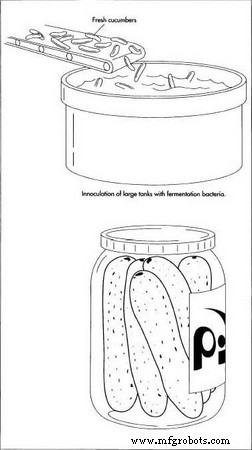
- Three primary methods exist: traditional fermentation, direct pasteurization, and refrigeration with acidification. Fermentation remains the most common, involving large airtight tanks (up to 40,000 lb or 18,160 kg of cucumbers) filled with a 10 % salt brine.
- During a five‑week fermentation, halophilic bacteria convert sugars to carbon dioxide. Tanks are periodically degassed to prevent pressure buildup, producing pickles that can last for months.
- Pasteurization skips fermentation by heating cucumbers to high temperatures, killing native bacteria and extending shelf life to a few months.
- Refrigeration with vinegar offers a rapid turnaround but yields a shorter shelf life.
Processing and Packaging
- After fermentation, the brine is drained and cucumbers are rinsed to remove excess salt.
- Conveyor belts transfer the cucumbers to slicers that cut them into slices, chips, or dice, depending on product specification.
- Cut pieces are then placed in glass jars—or cans, plastic bottles, or pouches—by automated packing lines that ensure consistent fill volumes.
- The pre‑mixed pickle liquor (vinegar, salt, sugar, spices) is injected; any required spices may be added prior to filling.
- Jars are sealed and sent to the pasteurization stage.
Pasteurization and Sealing
- To eliminate spoilage organisms, pickles are exposed to high heat for a set duration, killing acid‑tolerant bacteria and deactivating enzymes.
- Vacuum sealing removes air, creating the familiar “pop” when a jar is opened. Steam is introduced just before capping; as it cools, it condenses, forming a vacuum.
- After sealing, jars receive labels with freshness dates and are boxed, palletized, and shipped to retailers.
Quality Control
Robust quality assurance starts in the field. Workers evaluate cucumbers for spoilage; any defective produce is discarded. Manufacturers set strict size, firmness, and cleanliness specifications. During production, laboratory tests monitor key parameters: acidity (pH), sugar content, salt levels, and overall brine composition. These tests, governed by FDA regulations, ensure consistency and safety.
The Future
Ongoing research by seed companies and universities focuses on engineering superior pickling cucumbers—larger, more abundant, and resistant to pests and diseases—using biotechnological and grafting techniques. Crop scientists are also developing “fan‑ring” methods that yield more fruit per plant. Concurrently, manufacturers experiment with new flavor profiles by tweaking the brine composition and employing diverse fermentation cultures. Such innovations promise fresher, tastier, and more sustainable pickles for the next generation of consumers.
Manufacturing process
- What is VMC Machining? An Expert Overview of Vertical Machining Centers
- Expert Guide to Aluminum Laser Marking: Precision, Durability, and Industry Applications
- MIG vs. TIG Welding: Selecting the Right Arc Welding Technique for Your Project
- Comprehensive Guide to Laser Marking: Types, Benefits, and Applications
- Key Considerations for High‑Volume Swiss Machining
- CNC Prototyping Guide: Precision, Speed, and Cost‑Effective Production
- Pickles: From Ancient Roots to Modern Production
- MIT Startup Pickle Launches Rapid Trailer‑Unloading Robot to Accelerate E‑Commerce Deliveries
- Ranpak Invests in Pickle Robot to Accelerate Automated E‑Commerce Packaging
- Efficient Acid Regeneration from Spent Hydrochloric Pickle Liquor