



The Art and Science of Photographic Processes: From Daguerreotypes to Modern Film
Background
A photograph is created by a photochemical reaction that records light on a surface coated with silver halide crystals. The silver ions (Ag+) are reduced to elemental silver (Ag) when exposed to light, forming clusters that scatter light and reproduce the original image’s tones. This principle—first noted by Fabricius in 1556—remains the foundation of high‑quality silver‑based photography, even as digital imaging has advanced.
Early experiments by Schultze in 1727 and later by Louis‑Jacques Mandé Daguerre in 1837 produced metallic silver images on silver‑coated copper plates, known as daguerreotypes. While these images were strikingly detailed, their long exposure times limited practicality.
William Henry Fox Talbot’s 1841 calotype process solved this by creating a latent image that required only a brief exposure, later developed chemically to produce a negative. His work introduced continuous‑tone photography, though early prints darkened over time. John Frederick William Herschel later devised the fixation process, converting unexposed silver halide to silver thiosulfate that could be washed away, stabilizing the image.
The next leap came with the use of sensitizing agents such as sulfur and gold to boost crystal sensitivity. Gelatin emerged as an ideal binder, and in 1888 George Eastman coated gelatin‑dispersed silver halide onto celluloid sheets, creating the first practical photographic film. Eastman’s commercial rolls of 35‑mm film revolutionized photography and laid the groundwork for modern production.
Raw Materials
Film
Modern photographic film consists of multiple layers—typically up to 15—each serving a specific optical or chemical function. The base layer is a flexible plastic, often cellulose triacetate or polyethylene terephthalate, chosen for strength and chemical stability. Silver halide crystals are grown in a controlled solution, then mixed with gelatin, washed, and chilled to produce a light‑sensitive emulsion.
After coating the emulsion onto the plastic, the film is cooled to gel, then dried. Additives such as carbon pigments, dyes, or colloidal silver fine‑tune light absorption and reflectance. The final gelatin overcoat seals the layers, protecting the emulsion during handling and exposure. Film sensitivity is measured by the ASA (now ISO) rating: a lower number indicates less sensitivity (e.g., ASA 100 for bright light or flash), while higher numbers (200–400) are suitable for indoor or overcast conditions.
Finished rolls are wound onto spools and packaged in light‑proof containers to preserve their latent image until exposure.
Developing and Printing Materials
Developers contain reducing agents (e.g., hydroquinone), restrainers (bromide ions), and preservatives (sodium sulfite) to control silver grain growth, prevent over‑exposure, and maintain stability. Printing paper is coated with light‑sensitive emulsions similar to film, with grades that vary in gloss and texture.
Printing requires an enlarger to project the negative onto paper, followed by development, toning, and drying steps. Ancillary equipment—trays, measuring glassware, thermometers, timers, and drying screens—ensures precise processing.
The Manufacturing Process
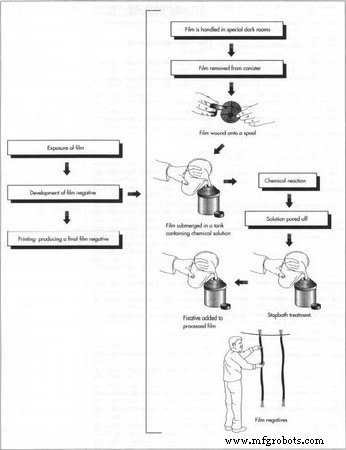
Producing a photographic image involves three core stages: exposure, development, and printing. Though alternative formats like Polaroid or slide film exist, the following outlines the traditional 35‑mm workflow.
Exposure
- Film is loaded into the camera and exposed through the lens, which focuses light onto the silver halide grains.
- The aperture (lens opening) and shutter speed control light intensity and duration, shaping exposure effects.
- Exposure creates a latent negative image: light‑exposed areas darken, while unexposed areas remain light.
Development
- After exposure, the film is handled in a darkroom lit only with safe red light to preserve its sensitivity.
- It is submerged in a developer bath that amplifies the latent image, followed by a stop bath (dilute acetic acid) to halt development.
- A fixer locks the image by dissolving unreacted silver halide, then the film is thoroughly washed and dried.
- Processed negatives are stored in a clean, dark environment until printing.
Printing
- Printing turns a negative into a positive image. An enlarger projects the negative onto light‑sensitive paper.
- Paper is then developed, toned (if desired), and fixed using the same chemistry principles applied to film.
- Final prints can be mounted on cardboard or other backing for display or distribution.
- Reprints can be made from either the original negative or a high‑quality positive.
Quality Control
Throughout film production and processing, meticulous quality control is essential. Emulsion coatings must be free of streaks and uniform in thickness; deviations can lead to image artifacts. Chemical concentrations, temperature, and timing are tightly regulated to prevent over‑ or under‑processing, which can cause ghosting or exposure errors. Maintaining developer temperatures within ±5 °F ensures consistent grain development and prevents unwanted pattern formation.
The Future
While photographic chemistry has reached a mature plateau, innovations continue. Kodak’s recent cartridge‑based system allows a single camera to capture multiple formats—panoramic or standard—without changing film stock. Automated processing units now offer one‑hour development services. Nonetheless, the long‑term future of photography may pivot toward digital imaging, which offers near‑instant capture, advanced manipulation, and comparable quality to chemical prints. Digital workflows are already integrating with traditional printing to provide hybrid solutions that combine the tactile richness of silver prints with the convenience of digital file management.
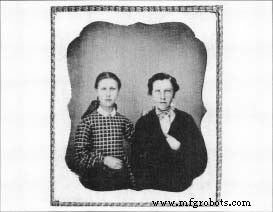 An example of a daguerreotype photograph (Henry Ford Museum & Greenfield Village, Dearborn, Michigan).
Manufacturing process
- Gas Lanterns: Evolution, Design, and Modern Manufacturing
- Laser Pointer: Design, Manufacturing, and Safety Overview
- Flashlight: From Inception to Modern Innovation
- The Kaleidoscope: From Brewster’s Science to Modern Design
- Semiconductor Lasers: Precision Light Generation for Modern Technology
- Silver: History, Properties, and Modern Applications
- Traffic Signals: Engineering, History, and Future Innovations
- From Fire to Filament: The Evolution and Production of the Modern Light Bulb
- Optical Fiber: Technology, Production, and Future
- Building an Arduino LIDAR System with VL6180X and Servo Motor