



Traffic Signals: Engineering, History, and Future Innovations
Background
Traffic signals—commonly called stoplights—manage vehicle flow at intersections by visually indicating when to stop, slow, or proceed. They can also signal permissible turns. Some are operated manually or on simple timers, allowing a fixed sequence between roads, while others employ sophisticated electronic controllers that adjust phases in real time based on traffic density and time of day. Traffic engineers rely on these devices to reduce congestion and enhance safety for drivers and pedestrians alike.
The first illuminated signal appeared in London in 1868, featuring manually operated gas lamps and semaphore arms. Shortly thereafter it exploded, tragically killing a policeman. The first electric signal arrived in Cleveland in 1914, adding a buzzer to warn drivers of upcoming changes. New York City installed the first three‑color (green, yellow, red) signal in 1918, and Los Angeles combined lights with a gong and semaphore signs.
A modern system consists of three subsystems: the signal light stack, supporting poles or arms, and the electronic controller. The stack typically contains three vertically arranged lights—green at the bottom, yellow in the middle, red at the top—to aid color‑blind drivers. Each light features a Fresnel lens, often hooded with a visor, to focus the beam and improve visibility in bright conditions. The controller, housed in a weather‑proof box, orchestrates the light sequence and may incorporate road‑borne sensors to detect vehicle flow.
Raw Materials
The housing or body of each signal stack is usually made from corrosion‑resistant aluminum; some manufacturers use molded polypropylene. Lens material can be tinted glass or plastic. Long‑life lamps—typically high‑intensity discharge or LED—are mounted within polished metal reflectors. Visors are fabricated from aluminum or molded plastic. Supporting poles are galvanized steel or fiberglass for strength and durability. Controllers reside in steel or aluminum enclosures, housing switches, relays, and timers sourced from specialized component suppliers. Wiring is copper with heavy neoprene or plastic insulation.
The Manufacturing Process
Traffic signals are assembled in a manufacturer’s plant before being installed on site.
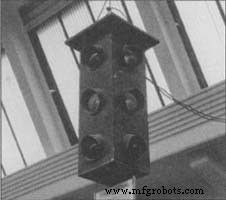 Installed in Detroit in 1920, this was the nation’s first three‑color, four‑way traffic light. (From the collections of Henry Ford Museum & Greenfield Village.)
Early 20th‑century streets were not designed for automobiles, which shared roads with horse‑drawn carriages, bicycles, and pedestrians. Initial traffic control relied on police officers using hand signals, leading to frequent confusion. In the 1920s, inventor Morgan Garrett introduced an automatic system featuring a semaphore‑style arm and an intermediate position equivalent to modern yellow, allowing drivers to anticipate changes. Garrett’s design was later acquired by General Electric, which produced electric, three‑light, four‑way signals.
Making the Signal Stack
- Housing, lens door, and bulb door are die‑cast using a high‑pressure steel mold. Molten aluminum is injected at ~2,000 psi, cooling in ~15 seconds. The process yields ~30 parts per hour.
- After cooling, parts are trimmed with a stamping die, inspected, and burrs removed. Doors are machined for precise fit and assembled with hinge pins and spring latches. Painted stacks are then cleaned, painted, and dried in an oven.
- In the final assembly area, lamps, holders, reflectors, and lenses are installed. Stainless‑steel fasteners secure the components, and weatherproof gaskets seal lenses. Wiring routes through the hollow housing to the mounting point.
Making the Controller
- The controller housing is cast or fabricated, then trimmed, machined, and painted. Inside, mounting points hold the control boards. Manufacturers may assemble the electronics in‑house or outsource to specialized suppliers.
Making the Supports
- Supports are cast, spun, or fabricated into hollow structures with built‑in junction boxes. Decorative details can blend signals with local architecture, and some installations hang stacks from steel cables across the intersection.
Installation
- Underground conduits connect the controller to each signal support, and wires are pulled through. Power is routed to the controller. If road sensors are installed, they connect to the controller as well. Supports are bolted, and signal stacks are mounted. Wiring is connected across all components. Each light is fine‑tuned, controller timers are set per engineering specifications, and the system undergoes multiple test cycles.
Quality Control
Manufacturing follows standard inspections and statistical quality controls common in industrial production. Installation is reviewed by an agency electrical inspector, ensuring compliance with the National Electrical Code and all relevant federal, state, and local ordinances. A registered professional engineer must approve plans to confirm that traffic control devices meet national standards.
The Future
Advances in computing will make traffic signals increasingly intelligent. Remote activation allows emergency vehicles to command green lights in their direction. Citywide networks of interconnected controllers can synchronize traffic flow, reduce congestion, and reroute vehicles during peak hours. Emerging technologies include speed‑warning devices and real‑time incident detection to enhance safety and efficiency.
Manufacturing process
- Gas Lanterns: Evolution, Design, and Modern Manufacturing
- Laser Pointer: Design, Manufacturing, and Safety Overview
- Flashlight: From Inception to Modern Innovation
- The Kaleidoscope: From Brewster’s Science to Modern Design
- Semiconductor Lasers: Precision Light Generation for Modern Technology
- The Art and Science of Photographic Processes: From Daguerreotypes to Modern Film
- From Fire to Filament: The Evolution and Production of the Modern Light Bulb
- Smart Traffic Light: Adaptive Street Lighting Powered by IoT
- Smart Traffic Light Control System with Real-Time Data
- Build a Realistic Traffic Light Simulator with Arduino UNO