



Flashlight: From Inception to Modern Innovation
Background
A flashlight is a portable, battery‑powered illumination device. Most units feature one or more dry‑cell batteries housed within a handle that also serves as the battery compartment. The flow of electricity from the batteries to the front‑end bulb is controlled by a switch located between the battery pack and the lamp assembly.
History
Humans have long sought practical, portable light sources. Early solutions—torches and candles—gave way to lanterns as knowledge of animal and mineral oils grew. The first battery‑powered flashlight emerged in 1898, when Joshua Lionel Cowen, founder of the American Eveready Battery Company, adapted a decorative plant‑lighting fixture into a handheld lamp. Cowen’s concept was refined by Eveready salesman Conrad Hubert, who produced the world’s first commercial flashlight. Since then, technological advances—LEDs, rechargeable cells, and specialty designs—have produced hundreds of flashlight styles, from consumer household units to tactical lights for police, firefighters, and the military.
Design
The most common household flashlight features a tube‑shaped handle containing standard batteries and a threaded head assembly that holds the bulb. Industrial and professional models use heavier‑gauge materials for durability and deliver brighter, more focused beams suitable for demanding applications. Camping lanterns, which are larger and often powered by high‑capacity batteries, typically employ fluorescent tubes for energy efficiency, though these produce a softer, less directional light and are heavier to carry. Novelty flashlights aimed at children are lightweight, often molded from plastic, and decorated with popular cartoon or book characters. Specialty lights—such as snake‑lights or key‑chain illuminators—are designed for specific tasks, offering flexibility or compactness where needed.
Key design considerations include light output, durability, operating environment, battery life, and power source. Rechargeable flashlights can be plugged into an outlet for overnight charging, while LED models consume minimal power and can run for hundreds of hours on standard batteries, far surpassing incandescent counterparts.
The Manufacturing Process
Plastic Housing
- Components are typically injection‑molded from polystyrene or other robust polymers. Plastic pellets, plasticizers, and colorants are melted and injected under high pressure (up to 2,500 tons) to fill precision molds, often forming internal and external threads in the same operation.
- After injection, molten plastic is cooled via water channels, solidifying the part as pressure is released. Thermoplastic polymers allow re‑melting of scrap, minimizing waste. Subsequent trimming, polishing, and finishing steps prepare the housing for assembly.
Light Source
- Incandescent bulbs remain the most common source: a metal filament sealed in glass, heated by electrical current to emit visible light. The filament is mounted on a glass bead and encased in a cylindrical envelope that directs the beam.
- Manufacturers also use fluorescent bulbs—common in lanterns—and LEDs, which emit light at low current and are paired with polished aluminum reflectors to focus the beam.
Switch and Controls
- Simple flashlights employ a slide or toggle switch that connects battery terminals to the lamp wiring. Advanced models may use flexible metal strips or electronic circuitry for multi‑mode operation.
Assembly
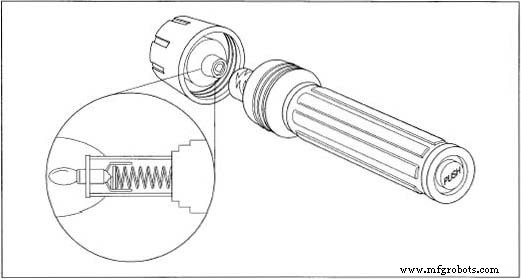
- Depending on production volume, units are assembled on conveyor lines or by hand. Small models may have batteries inserted during assembly, while larger units may be shipped without batteries for end‑user installation. The lamp assembly is secured to the casing threads, and the unit is then ready for testing.
Packaging
- Finished flashlights are placed in clear plastic blister packs or clam shells, then attached to cardboard display cards or boxed for shipment.
Quality Control
Flashlights undergo rigorous testing to confirm functional reliability. Inspections verify bulb alignment, switch integrity, and battery‑compartment sealing to prevent moisture ingress while allowing venting of gases generated during operation. Temperature rating (TI to T6) is evaluated by accredited labs such as Factory Mutual Research Corporation, Underwriters Laboratories, and Demko.
Hazardous Environment
Flashlights intended for hazardous or confined spaces must meet stringent safety standards. According to the National Electrical Code, hazardous locations are classified into Class I (flammable gases), Class II (combustible dust), and Class III (ignitable fibers). Additional “groups” define atmospheres containing acetylene, hydrogen, gasoline vapors, metal dusts, or grain dusts. Each product undergoes individual testing before factory release.
The Future
Manufacturers continue to push boundaries: self‑powered models featuring patented Freeplay Generators store kinetic energy in carbon‑steel springs, converting manual winding into electrical output. New materials and smarter electronics enable automatic shut‑off to conserve battery life, while advanced molding techniques allow for ever more diverse novelty designs.
Manufacturing process
- Gas Lanterns: Evolution, Design, and Modern Manufacturing
- Laser Pointer: Design, Manufacturing, and Safety Overview
- The Kaleidoscope: From Brewster’s Science to Modern Design
- Semiconductor Lasers: Precision Light Generation for Modern Technology
- The Art and Science of Photographic Processes: From Daguerreotypes to Modern Film
- Traffic Signals: Engineering, History, and Future Innovations
- From Fire to Filament: The Evolution and Production of the Modern Light Bulb
- Optical Fiber: Technology, Production, and Future
- Building an Arduino LIDAR System with VL6180X and Servo Motor
- MIT Engineers Chip‑Scale Nano Flashlight, Paving Way for Advanced Viral Sensors