



From Fire to Filament: The Evolution and Production of the Modern Light Bulb
Background
Until the early 19th century, fire was humanity’s primary illumination source. Torches, candles, oil, and gas lamps offered limited brightness and posed significant indoor fire hazards. The first electric lighting experiments were conducted by English chemist Sir Humphry Davy, who demonstrated in 1802 that an electric current could heat a thin metal strip to white heat, producing visible light. This breakthrough sparked the development of incandescent electric light, while the arc lamp—an electric arc between two carbon electrodes—was used mainly for outdoor illumination.
Creating a commercially viable incandescent lamp hinged on discovering a filament material that could sustain white heat without rapid oxidation. Davy identified platinum as the only metal that could maintain white heat over extended periods, but its high cost and the lack of a vacuum to protect it limited practical use. The solution lay in developing a vacuum environment that removed air from the bulb, preserving the filament.
Thomas A. Edison entered the race in the 1870s, initially scrutinizing competitors’ failures before refining his own designs. He experimented with platinum, carbon, and eventually carbonized cotton thread, which proved economical and efficient. In 1879, Edison’s lamp, featuring a carbon filament housed in a vacuum‑sealed glass bulb, ran for 2 days 40 hours—an impressive endurance that marked the first commercially practical incandescent light.
Although incandescent bulbs remain the earliest and most familiar type of light bulb, several other technologies serve diverse applications: tungsten halogen lamps, fluorescent tubes, mercury vapor lamps, neon lamps, metal‑halide lamps, and high‑pressure sodium lamps. Each uses distinct materials and gases to optimize brightness, color rendering, and energy efficiency.
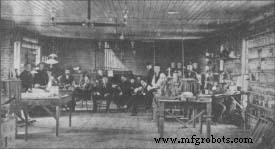 Thomas A. Edison (center, with cap) with workers in his laboratory in Menlo Park, New Jersey. The photo was taken in 1880.
By the 1870s, over twenty inventors had produced incandescent electric lights, but it was Edison’s systematic research laboratory—established in 1876 in Menlo Park—that pioneered the team‑based “invention factory” model. With a growing staff, Edison tackled every component of the lighting system, from generators to wiring to bulbs, laying the groundwork for modern R&D practices employed by GE, Westinghouse, and others.
Raw Materials
Focusing on incandescent bulbs, the evolution of filament materials—from platinum and carbon to tungsten—revolutionized the industry. Tungsten filaments can endure temperatures above 4,500 °F (2,480 °C) and, thanks to their low vapor pressure, offer extended lifespan and lower production costs. Tungsten is drawn from a tungsten–binder mix into a fine wire, wound onto a steel mandrel, then annealed and acid‑etched to release the mandrel, forming the filament’s characteristic coil.
The bulb’s lead‑in wires are typically made of nickel‑iron alloy (known as “dumet”) and are coated in a borax solution to improve adhesion to glass. The glass envelope itself is filled with a mixture of argon and nitrogen gases, which mitigate filament oxidation and prolong service life. The base—originally the “Edison screw” made of brass with plaster of Paris insulation—has evolved to an aluminum exterior and glass‑insulated interior for greater strength and durability.
The Manufacturing Process
Light bulbs now cover a wide range of applications—from street lighting to automotive headlights and handheld flashlights. Each bulb’s size and wattage determine its luminous output in lumens, yet all incandescent bulbs share three core components: filament, bulb, and base. While early production was manual, modern manufacturing is highly automated.
Filament
- Welding a tungsten–binder mixture into a fine wire via the drawing process, then winding it around a metal mandrel to form a coil.
- Annealing the coil to soften the wire and achieve a uniform structure before dissolving the mandrel in acid.
- Attaching the coiled filament to lead‑in wires through hooks or spot‑welding, preparing it for assembly.
Glass Bulb
- Glass casings are produced by a ribbon machine that melts a continuous ribbon of glass and extrudes it through precise nozzles to create thousands of bulbs per hour.
- Once formed, the casings are cooled, cut, and coated with silica to reduce glare from the glowing filament.
- The bulb’s interior is evacuated and filled with an argon‑nitrogen mixture, and the company’s emblem and wattage are stamped on the exterior.
Base
- The base is molded with screw‑thread indentations to fit standard light fixtures, ensuring secure electrical contact when inserted.
Assembly
- Filament, lead‑in wires, and bulb are mounted together by automated machines, creating the stem assembly.
- The bulb is evacuated again, filled with the gas mixture, and the base is slid onto the glass envelope, sealing the components without additional adhesives.
- Each bulb undergoes quality tests before packaging and shipping to consumers.
Quality Control
Manufacturers test bulbs for lifespan and structural integrity. Selected units are fastened into life‑test racks and operated at significantly higher power levels than normal use to simulate accelerated aging. Results are collected at every plant and by independent laboratories, with most household bulbs achieving 750–1,000 hours of service, depending on wattage.
The Future
Incandescent bulbs, while simple and reliable, are highly inefficient—approximately 95 % of the electricity they consume is lost as heat. In an era of energy scarcity and sustainability demands, this inefficiency makes them increasingly impractical. Alternatives such as fluorescent tubes already dominate industrial lighting and are gaining traction in domestic settings. Compact fluorescent lamps (CFLs) can be screwed into standard fixtures and use 75 % less energy while lasting up to twenty times longer than incandescent bulbs.
Emerging technologies, like radio‑wave bulbs that generate ultraviolet light through mercury vapor excited by radio waves, further reduce energy consumption—using only 25 % of the power of traditional incandescent lamps—and can last over a decade. These bulbs are also fully compatible with existing incandescent sockets.
Manufacturing process
- Amber: From Ancient Resin to Scientific Treasure – History, Properties, and Modern Uses
- The Guillotine: History, Design, and Legacy
- The Kaleidoscope: From Brewster’s Science to Modern Design
- Silicon: Properties, Production, and Market Outlook
- The Ukulele: From Portuguese Roots to Modern Craftsmanship
- The Complete Guide to the U.S. Chicken Industry: History, Production, and Quality Control
- Compost: The Ultimate Soil Enrichment Solution
- Gelatin: From Ancient Protein to Modern Applications – Production, Uses, and Safety
- The Evolution and Manufacturing of Modern Pin‑Tumbler Locks
- Arduino Web-Controlled Light Bulb: Step-by-Step Guide