



Pottery: From Ancient Craft to Modern Production – A Comprehensive Guide
Background
Pottery is the art of shaping clay into functional or decorative vessels that are then dried, fired, and finished—often with glaze—to achieve a vitreous, water‑resistant surface. Clay itself is a natural mineral deposit that has weathered rock over millions of years. Unlike raw clay, a pottery body is a carefully balanced mix of clay and additives that tailor its workability and firing characteristics.
Artists and manufacturers employ a variety of techniques: hand‑building, wheel throwing, jiggering, mold pouring, or cutting. Each method offers a distinct texture and form, reflecting the skill and creativity of the maker.
Firing is the decisive step that turns the fragile, porous clay into a durable product. By applying a liquid glaze before firing, the surface chemistry changes, and the glaze fuses to the body, producing a vitreous finish that can hold water and resist liquids.
History
Pottery dates back to the earliest human settlements. The first vessels—pinch pots and coil pots—were fired at low temperatures, resulting in fragile, porous items. Early potters refined their craft by burnishing surfaces and using incisions for decoration, producing objects for daily use and religious symbolism.
In the ancient Near East, clay was employed for both domestic and construction purposes as early as 5000 B.C. By 4000 B.C., Egyptian potters had advanced to finer clays and higher‑temperature kilns that prevented blackening. Chinese artisans produced black pottery by 3500 B.C., and by 1000 B.C., the wheel and sophisticated glazes were commonplace, often used in funerary rites.
Throughout the first millennium B.C., Greek, Iberian, Roman, and Japanese cultures produced renowned pottery, each contributing distinctive styles and techniques to the global heritage of ceramics.
The eighteenth century marked a shift toward industrial production. British manufacturers began experimenting with new clay bodies, glazes, and factory‑based production, enabling mass distribution of consistent, high‑quality wares. Mold‑based mass production soon followed, allowing for the rapid creation of uniform items.
Raw Materials
The primary mineral in ceramic bodies is kaolinite, giving clay roughly 40 % aluminum oxide, 46 % silicon oxide, and 14 % water. Primary clays, found in situ, are dense and pure; secondary clays, transported by water or glaciers, are lighter and finer. Additives—such as sand, grog, or organic matter—modify plasticity, shrinkage, and firing behavior.
Manufacturers typically receive clay as a dry powder or pre‑hydrated mix. Large factories purchase bulk quantities and blend them on the day of production to meet specific formulation requirements.
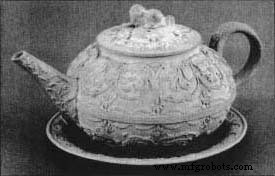 A stoneware teapot by Jonah Wedgwood & Co., Staffordshire, England.
(From the Henry Ford Museum & Greenfield Village, Dearborn, Michigan)
A stoneware teapot by Jonah Wedgwood & Co., Staffordshire, England.
(From the Henry Ford Museum & Greenfield Village, Dearborn, Michigan)
The iconic teapot exemplifies nineteenth‑century innovation. Josiah Wedgwood revolutionized the industry by standardizing designs, improving glazes, and creating a reproducible product line that met the growing tea‑culture market.
Design
In modern factories, art directors collaborate with marketers to conceive market‑ready products. They may revive classic forms—such as brightly coloured Fiesta Ware—or develop entirely new designs. Once a concept is approved, a clay modeler creates a prototype, which a mold maker translates into a plaster master for jiggering or slip casting.
The Manufacturing Process
Mixing the Clay
- Clay arrives in powder form and is moistened with water in a large blunger tank. A typical production batch weighs 100,000 lb (45,400 kg) and contains roughly 30 % water.
- The slurry is then filter‑pressed, removing excess water to produce a “cake” with about 20 % moisture.
- The cake is chopped in a plug mill, aerated, and formed into cylinders ready for molding.
Jiggering
- Jiggering is the fastest method for producing hollowware. A wet cylinder is placed in a plaster mold; a metal arm forces the clay against the interior, forming the vessel. The greenware is then removed, dried, and sent to the next stage.
- Once dried, a cleaning machine trims rough edges. A conveyor belt leads to tunnel dryers that reduce moisture to <1 % before glazing and firing.
Slip Casting
- Slip casting creates intricate shapes. A pourable slip fills a two‑part plaster mold; excess is drained, and the slip stiffens. The mold is opened when the greenware is firm enough, then cleaned and dried.
Glazing
- Glaze application can be a waterfall pour, spray, or hand‑flush for deep hollowware. Typical glaze thickness is 0.006–0.007 in (0.015–0.017 cm). Decorative techniques include screen printing, decals, and hand‑painting.
Firing
- Modern tunnel kilns, powered by natural gas, fire thousands of pieces simultaneously. At 2,300 °F (1,260 °C), a batch remains in the kiln for about 5 hours, enabling rapid throughput.
- Glazes transform into a glass‑like coating during firing, rendering the pottery virtually impervious to liquids. Single‑color production often requires only one firing; multi‑glaze items may undergo bisque and glaze firings.
- After firing, unglazed bottoms are polished on a machine, then the pieces are boxed for shipment.
Quality Control
Every step of production is monitored. Raw clays and glazes are tested for composition, viscosity, and color consistency. Kiln temperatures are logged with heat cones and thermocouples, ensuring precise firing schedules. Skilled technicians visually inspect each stage to eliminate defects.
Byproducts / Waste
Pottery production generates minimal hazardous waste. Clay scraps and off‑cuts can be remixed for reuse. Glazes are formulated to be lead‑free, and FDA testing confirms the absence of cadmium and lead. All raw glazes are safe to handle.
Manufacturing process
- What is VMC Machining? An Expert Overview of Vertical Machining Centers
- Expert Guide to Aluminum Laser Marking: Precision, Durability, and Industry Applications
- MIG vs. TIG Welding: Selecting the Right Arc Welding Technique for Your Project
- Comprehensive Guide to Laser Marking: Types, Benefits, and Applications
- Key Considerations for High‑Volume Swiss Machining
- CNC Prototyping Guide: Precision, Speed, and Cost‑Effective Production
- Expert Shaft Manufacturing: Precision Processes & Custom Solutions
- Pottery: From Ancient Craft to Modern Production – A Comprehensive Guide
- Moulding Sand: Properties, Types & Production in Foundry Casting
- Clay Brick: Definition, History, and Modern Construction Uses