



Carpet: A Journey Through History, Materials, and Modern Production
Background
Carpet—distinct from a rug—is a permanent textile covering that extends from wall to wall. The earliest homes were lined with animal skins, grass, or reed mats. As spinning of cotton and wool became commonplace, woven mats of these fibers largely replaced earlier materials. By 3000 B.C., Egyptians sewed bright woolen cloth onto linen and placed it on their floors.
Nomadic peoples were pioneers in carpet weaving. Their thick, portable rugs were laid over the sandy floors of tents. Early looms were simple: two forked branches joined by a crosspiece supported the warp, while a wooden bar flattened the weft. The Pazyryk carpet, found in a tomb in the Alti Mountains, is the earliest hand‑loom carpet dated to 500 B.C.
Carpet weaving reached its zenith in Turkey, Iran, India, and China, where artisans used cotton, linen, or hemp as the foundation and wove wool or silk piles. A knot was tied in the pile thread and then beaten into a tight row. Some of the finest hand‑made carpets contain up to 2,400 knots per square inch (372 knots per cm²). Natural dyes—madder, indigo, genista, woad, ocher—gave these carpets their brilliant hues; alum was sometimes added to fix the color, and a few weavers incorporated gold or jewels.
While Europe imported ready‑made carpets from the Middle East for centuries, local production began with Moorish weavers brought to France around 1300 A.D. By 1600, guilds flourished in Aubusson and Savonnerie. England followed suit, and by 1700 the towns of Wilton and Axminster were chartered carpet‑making centers. Early European techniques included the “Brussels weave” of uncut loops and the Wilton cut‑pile method. In 1801 Joseph M. Jacquard introduced punch‑card looms, allowing up to six yarn colors per pass; the technique was adopted for carpet looms in 1825.
The first U.S. carpet factory was established by William Sprague in Philadelphia in 1791. His English‑inspired looms produced 27‑inch (69‑cm) runners that could be sewn into larger carpets. By 1800, 7–9 m of carpet could be made in a day. Erastus Bigelow opened a mill in 1825 in Clinton, Massachusetts, and invented the power loom in 1839, doubling production. He also created the first broadloom in 1877. Over time, power looms evolved to produce 82 m of high‑quality carpet daily.
At the start of the 20th century, carpet manufacturing was revolutionized in Dalton, Georgia, by entrepreneur Catherine Evans Whitener. Tufting—punching yarn into a backing to create loops—enabled rapid production. Dalton’s factories initially produced bed‑spreads and later tufted rugs, using cheap cotton before switching to synthetic yarns. Today, carpet accounts for 72 % of all flooring, with tufted carpet making up 91.5 % of production; Dalton supplies over 70 % of the world’s carpet.
Raw Materials
A finished carpet consists of dyed pile yarns sewn into a primary backing, a secondary backing for strength, adhesive, and usually a cushion for comfort.
Seventy‑seven percent of pile yarns are synthetic polymers; the remainder is wool, which is reserved for high‑end woven carpets. Common synthetics include nylon (66 % of all carpet), acrylic (15 %), polyester (under 15 %), and polypropylene (under 5 %). Pile yarns are dyed with organic dyes or, occasionally, organometallic complexes.
Both backings are primarily woven or non‑woven polypropylene; some secondary backings still use jute. Adhesives are almost always synthetic rubber latex. The most common padding is rebond urethane, though polyurethane, vinyl, horsehair, or jute are also used. A plastic top sheet is often added to protect the surface.
The Manufacturing Process
Because tufting dominates U.S. carpet production, this section focuses on that method.
Preparing the Yarn
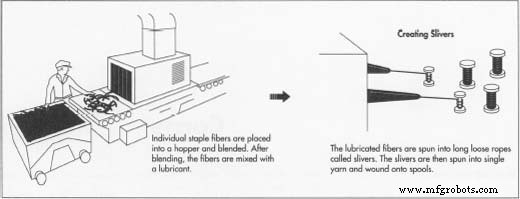
- Synthetic yarn arrives as staple fibers (average 18 cm) or bulk continuous filament. Staple fibers are blended in a hopper, carded into slivers, spun into single yarn, then twisted into two‑ply yarn suitable for tufting. The yarn is steamed, heat‑set at 132–138 °C, cooled, wound onto tubes, and delivered to the tufting machines.
Dyeing the Yarn
- Yarn may be dyed before or after tufting. Typical methods involve immersing 227–455 kg of fiber in pressurized vats or passing it continuously through a dye bath. Alternative techniques use printing rollers or knitting the yarn onto a form for selective dyeing. All dyed yarn is steamed, washed, and dried.
Tufting the Carpet
- Yarn is fed from a creel through a nylon tube to the tufting needle. The needle pierces the backing, pushing yarn into a loop. Sensors control needle depth to set loop height. A looper holds the loop while the needle retracts; the backing is shifted forward, and the needle repeats. For cut‑pile, a knife on the looper trims the loop. Modern machines operate up to 1,200 needles across a 12‑foot width, stitching hundreds of rows per minute. One machine can produce several hundred square yards of carpet daily.
Dyeing the Tufted Carpet
- For solid colors, rolls of carpet are sewn together, then submerged in a heated vat with dyes and chemicals for up to four hours. Excess dye is washed off, the carpet is steamed, dried, and rolled.
- Printed carpets are produced by passing a white carpet under a series of screens. Color is squeegeed through the screen, and the carpet is advanced 36 inches to the next screen for a new color. Up to eight colors can be applied in sequence.
- Alternatively, embossed cylinders apply color through raised patterns, one cylinder per color. After dyeing, the carpet is steamed, washed, dried, and rolled to the finishing department.
Finishing the Carpet
- The dyed carpet edges are sewn into a continuous belt, then coated with latex on the underside. A secondary backing receives a latex coating as well. Both layers are fed onto a marriage roller, forming a sealed sandwich. The carpet is then cured in an oven.
- After curing, the carpet is steamed, brushed, vacuumed, and trimmed to remove any protruding tufts. It is rolled into 120‑foot (37 m) lengths, packaged in durable plastic, and shipped to warehouses or retail stores.
Quality Control
Every tufted carpet undergoes inspection for missing tufts. A technician re‑tufts any holes with a single‑needle gun. The carpet’s dimensions, tuft height, and static shock potential are verified.
Flammability testing is required by most states. A 9 × 9 in (23 × 23 cm) specimen is placed on a steel plate with an 8‑inch hole. A methenamine tablet is ignited; if the char does not reach the hole circumference in seven of eight trials, the carpet passes.
Wear resistance is measured by subjecting a specimen to 20,000–50,000 revolutions of a steel ball with rubber studs. A well‑performing carpet should appear new after this test.
Colorfastness is evaluated by exposing the carpet to a simulated sunlight source and rating the loss of color after a specified exposure time.
Pile density is determined by extracting the synthetic yarn, dissolving it in a solvent, drying, and weighing the residue to confirm it matches the specified mass per unit area. Nylon is typically dissolved in hydrochloric acid and dried at 77 °F (25 °C).
Backing strength is tested by pulling the primary and secondary backings in a vise until failure. Delamination strength is measured by the force required to separate the secondary backing from the primary.
Customers also play a role in maintaining quality: choosing carpets rated for expected traffic, vacuuming regularly, and scheduling professional deep cleaning at least annually.
Manufacturing process
- What is VMC Machining? An Expert Overview of Vertical Machining Centers
- Expert Guide to Aluminum Laser Marking: Precision, Durability, and Industry Applications
- MIG vs. TIG Welding: Selecting the Right Arc Welding Technique for Your Project
- Comprehensive Guide to Laser Marking: Types, Benefits, and Applications
- Key Considerations for High‑Volume Swiss Machining
- CNC Prototyping Guide: Precision, Speed, and Cost‑Effective Production
- Expert Shaft Manufacturing: Precision Processes & Custom Solutions
- The Evolution of Vacuum Cleaners: From 19th-Century Sweepers to Modern Allergy‑Focused Models
- Carpet: A Journey Through History, Materials, and Modern Production
- Digital Cutting Solutions for the Carpet Industry – OMNI CNC