



The History, Production, and Future of Ketchup: From Ancient China to Modern Kitchens
Background
Ketchup is a staple condiment in American cuisine, prized for its tangy flavor and versatility. Whether topping burgers, hot dogs, fries, or enriching sauces, meatloaf, beans, and stews, it has become indispensable. In the mid‑1990s, U.S. sales exceeded $400 million annually.
The sauce traces its roots to ancient China, where a fish‑brine called “ke‑tsiap” served as a foundational flavoring. Neighboring regions developed their own “kechap” variants, combining fish brine with herbs and spices. In the late 17th century, English sailors returning from Malaysia and Singapore were inspired to recreate the sauce. Unable to source all exotic ingredients, early English cooks improvised with cucumbers, mushrooms, nuts, and oysters.
A century later, New England seafarers returned from Mexico and the Spanish West Indies with tomato seeds, creating the first tomato‑based ketchup. The sauce quickly gained popularity for codfish cakes, meats, and other dishes.
Homemade ketchup required laborious, day‑long preparation: tomatoes were cooked in iron kettles over wood‑burning stoves, demanding constant stirring to avoid scorching. The process of cleaning preserving kettles was equally demanding. Commercial production began in the late 19th century, alleviating this burden for home cooks.
H.J. Heinz Co. pioneered mass‑market ketchup, introducing the iconic narrow‑neck glass bottle that remains the industry standard. The design minimized air contact, reducing darkening, and allowed consumers to see the product. Initially sealed with cork, wax, and foil, screw caps replaced them by the early 20th century. The 1980s saw the rise of plastic squeezable containers, which offered greater convenience and safety, and by the 1990s recyclable plastic became standard in response to environmental concerns.
Raw Materials
The core ingredients are tomatoes, sweeteners, vinegar, salt, spices, flavorings, onion, and/or garlic. Sweeteners typically include granulated cane or beet sugar; some producers use dextrose or corn/glucose syrup. White vinegar, often 100‑grain distilled, provides preservation. Spices such as allspice, cassia, cinnamon, cayenne, cloves, pepper, ginger, mustard, and paprika are common; whole spices are preferred for a milder, richer flavor. Modern manufacturers may use pre‑mixed or encapsulated spices for convenience, though they carry higher costs. Quality is paramount across all forms.
Brand formulas differ mainly in spice and flavoring proportions. Thicker textures require higher ratios of sugar and spices relative to tomato juice. Manufacturers adjust formulations to accommodate natural variations in tomato acidity and sugar content caused by growing conditions and cultivars.
The Manufacturing Process
Developing Quality Tomatoes
- 1. Producers select premium tomato varieties that excel in color, flavor, texture, and yield. Consistency is critical; even minor variations can alter the final product’s taste and hue.
Preparing Tomatoes
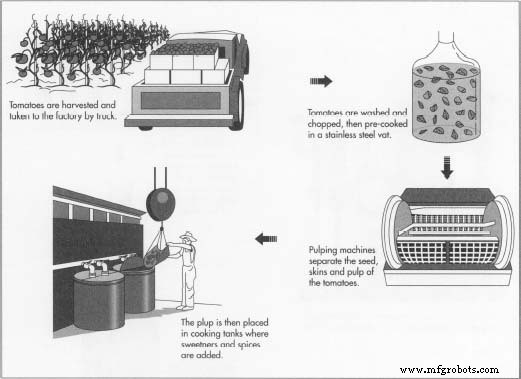
- 2. Harvesting occurs mechanically between June and July. Fruits are transported via water‑filled flumes, which cleanse them and protect against bruising. USDA or state inspectors grade the tomatoes to meet initial standards. They are sorted, washed, chopped, and pre‑cooked (scaling) in stainless‑steel vats to eliminate bacteria.
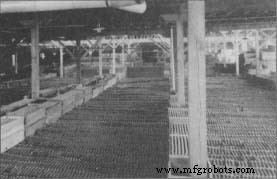 By the 1920s, ketchup operations were highly mechanized. (Henry Ford Museum & Greenfield Village)
The evolution of ketchup is inseparable from its marketing history. H.J. Heinz Co., founded in 1844, pioneered prepared food manufacturing and modern advertising.
Henry John Heinz began his career assisting his mother in garden work along the Allegheny River. By his teens, he operated a small processing plant, bottling horseradish in clear glass to highlight purity. He later launched “Heinz 57 Varieties” in 1892, inspired by a street sign, and distributed over 100 million pickle‑shaped pins at the 1893 Chicago World’s Columbian Exposition.
Heinz’s ventures extended beyond food. In 1898, he purchased the Iron Pier in Atlantic City, transforming it into the Heinz Ocean Pier, a free public attraction that operated until 1945, showcasing products, souvenirs, and entertainment.
Pulping
- 3. Chopped and pre‑cooked tomatoes enter pulping machines (cyclones) that separate seeds, skins, and stems. The resulting pulp and juice are filtered through screens and further processed into ketchup; excess paste may be stored for seasonal use.
Adding Ingredients and Cooking
- 4. The pulp is heated to boiling in cooking tanks or kettles. Foaming—common with fresh pulp— is mitigated using anti‑foaming agents or compressed air. Precise amounts of sweetener, vinegar, salt, spices, and flavorings are incorporated. Most spices are added early; volatile oils and vinegar are introduced later to minimize evaporation. Onions and garlic can be blended directly or added separately. Sugar is added toward the end to avoid burning. The mixture cooks for 30–45 minutes, stirred by rotating blades, and temperature is tightly controlled to achieve proper absorption without over‑cooking.
Finishing
- 5. After cooking, the ketchup passes through a finisher that removes excess fiber and particles via screens, yielding a smoother consistency. It then enters a holding tank.
- 6. Optionally, the ketchup is milled at higher temperatures and pressures to further refine texture.
Removing Air
- 7. De‑aeration prevents discoloration, bacterial growth, and air pockets that could hinder sealing.
Filling
- 8. To avoid contamination, ketchup is transferred to filling machines at ≥190 °F (88 °C). Containers—ranging from 14‑oz. bottles, No. 10 cans, pouch packs, room‑service sizes, to single‑serve packets—are filled and sealed immediately to preserve freshness.
Cooling
- 9. Cooling prevents flavor loss from “stack burning” that can occur if ketchup remains hot post‑cooking. Containers are cooled in cold air or water.
Labeling and Packing
- 10. Finally, containers are labeled and coded with ingredient lists, production date, location, and shelf‑life. A final inspection precedes shipping. The entire process—from tomato to finished bottle—typically spans two to three hours.
Quality Control
Historically, preservatives such as benzoate of soda, borax, salicylic acid, and formaldehyde posed health risks and were banned by the Pure Food Laws of 1906. In 1940, the U.S. government defined the “Standard of Identity” for ketchup as tomato‑based, ensuring transparency on labels.
Quality assurance involves sampling at multiple production stages. Tomato growers must comply with EPA and FDA regulations on fertilizers and pesticides, increasingly favoring natural options. All equipment in contact with the product undergoes rigorous inspection.
Oxidation can darken ketchup; de‑aeration mitigates this during manufacture. However, once opened, oxidation may still occur. Although acidity preserves the sauce, manufacturers recommend refrigerating opened jars to maintain color, flavor, and quality.
Consistency is measured by tomato‑solid concentration; about one‑third of ketchup’s acidity and sugar depend on solids. Grades A–C adhere to specific concentrations. Physical consistency, or body, reflects the sauce’s ability to suspend liquid. The Bostwick Consistometer, endorsed by USDA, sets Grades A and B at flow rates <4 in (10 cm) in 30 seconds at 68 °F (20 °C).
The Future
Ongoing research focuses on breeding tomato hybrids that deliver superior color, flavor, and firmness while resisting disease and rot, reducing reliance on chemical pesticides.
In the 1990s, consumer demand for healthier options spurred the development of low‑calorie, low‑salt ketchups. The popularity of Spanish salsas also influenced manufacturers to create salsa‑style ketchups with lower sugar content.
Packaging technology continues to evolve, driven by consumer demand for safer, more convenient, and recyclable containers.
Manufacturing process
- What is VMC Machining? An Expert Overview of Vertical Machining Centers
- Expert Guide to Aluminum Laser Marking: Precision, Durability, and Industry Applications
- MIG vs. TIG Welding: Selecting the Right Arc Welding Technique for Your Project
- Comprehensive Guide to Laser Marking: Types, Benefits, and Applications
- Key Considerations for High‑Volume Swiss Machining
- CNC Prototyping Guide: Precision, Speed, and Cost‑Effective Production
- Expert Shaft Manufacturing: Precision Processes & Custom Solutions
- The History, Production, and Future of Ketchup: From Ancient China to Modern Kitchens
- Elevate Your Spaghetti Sauce with Expert‑Approved Organic Spices & Herbs
- Spicy Organic: 40+ Years of Premium Organic Spices, Sustainable Sourcing & Global Impact