



Stained Glass: History, Craftsmanship, and Contemporary Revival
Background
Glassmaking dates back over 5,000 years, and the earliest records of stained glass appear in European Christian churches by the third or fourth century AD. The art truly blossomed in the 12th‑century Gothic cathedrals, and today only about 10% of stained‑glass panels remain in religious buildings. The remaining 90% adorn residential homes, commercial spaces, lamp shades, Christmas ornaments, and even hobbyist projects.
Stained glass enjoyed fluctuating popularity. The 12th and 13th centuries are considered its Golden Age. During the Renaissance, painted glass largely displaced it, and by the 18th century medieval methods were almost forgotten. The late‑19th century saw a renaissance in Europe, producing a surge of new stained‑glass windows.
In America, the movement began with William Jay Bolton, who created his first church window in New York in 1843. After a brief stint, he returned to England, leaving a void until Louis Comfort Tiffany and John La Farge revived the craft around the 1890s. American architects and glassmakers then studied European medieval windows, bringing back traditional techniques and inspiring new designs.
A leaded stained‑glass piece consists of 1/8‑inch (3.2 mm) thick glass segments joined by grooved lead cames, soldered at the joints. The entire assembly is secured with metal saddle bars and reinforced with tee‑bars. Faceted glass differs: large slab panels (up to 8 inches square or larger) are set in concrete, epoxy, or plastic matrices rather than lead.
Raw Materials
Glass originates from silica (sand), an alkali (potash or soda), and lime or lead oxide. Color comes from metallic oxides. Copper oxide yields ruby, blue, or green hues; cobalt produces most blues; chromium and iron oxides give greens; uranium, cadmium sulfide, or titanium create golden tones; selenium produces yellow; and gold imparts ruby shades.
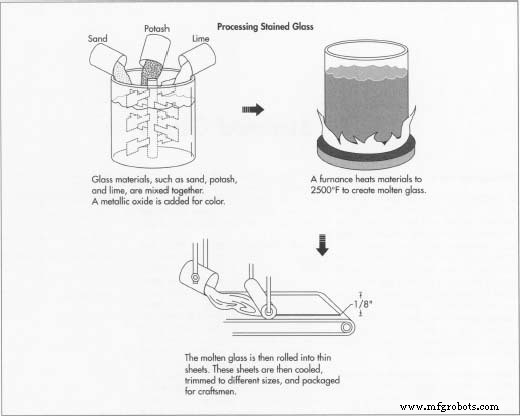
Manufacturing Process
Modern stained glass retains medieval methods. For leaded windows, molten glass is captured at one end of a blow pipe, formed into a cylinder, cut, flattened, and cooled. Artisans adjust the process to create variations such as flashed glass (a thin white base with a colored overlay) or Norman slabs (four‑sided bottle‑shaped glass rolled into thin slabs). Cathedral glass is rolled into uniform 1/8‑inch sheets, while marine antique glass offers a bubbly texture.
Processing the Glass
- Large‑scale manufacturers blend raw materials—alkaline fluxes, stabilizers—into precise batches. The mixture melts at 2,500°F (1,371°C). For cathedral glass, molten glass is poured into rollers that produce 1/8‑inch sheets, then annealed in a lehr furnace. Each run yields dozens of color variations; manufacturers typically produce 8–10 runs daily, offering hundreds of hues and textures.
Creating the Window Pattern
- Artists first craft a miniature design, then scale it to the actual window size. A full‑size black‑and‑white drawing—called a cartoon—guides the cutting. From the cartoon, a cutline (lead‑line template) and a pattern drawing (carbon copy) are produced. These serve as precise guides for glass placement and lead binding.
Cutting and Painting
- Glass pieces are selected, cut to shape using diamond or steel wheels, and painted with vitrifiable paint. The paint fuses to the glass when fired, allowing subtle color blending. Painted sections are fired again to lock in the design.
Glazing and Leading
- Lead cames are fitted along the cutline, holding each glass segment in place. The cames are soldered at joints and the assembly is waterproofed. After thorough inspection, the panel is packaged for shipment.
Finishing
- Joints are soldered, the panel sealed, and the completed window inspected for light transmission. Once approved, it is shipped to the installation site, where reinforcing bars secure it in place.
Faceted Glass
- Faceted panels begin similarly with a cutline and pattern. Thick glass slabs are cut with a double‑edged hammer, then faceted by chipping round depressions. Instead of lead, a concrete or epoxy matrix holds the pieces. The assembly is cured, cleaned, and shipped.
- Production of a full window can take 7–10 weeks, with costs ranging from $500 for simple panels to higher amounts for complex, large works. Customers may select pre‑existing patterns to reduce costs, customizing shapes or central images as desired.
The Future
Over the past two decades, glass studios in the United States have surged, especially in Ohio, where the number of studios grew from fewer than six to over 100. The Stained Glass Association of America now lists 500 studio owners and 300 manufacturers, with a quarterly publication reaching 6,000 readers. Internationally, restoration projects are thriving, and the home and hobby markets continue to expand, with niche magazines boasting circulations of 15,000. Stained glass is firmly established as a respected art form, and innovative designs will keep evolving.
Manufacturing process
- Pyrex: The Evolution, Composition, and Manufacturing of Borosilicate Glass
- The Timeless Art of Glass Christmas Ornaments: History, Craftsmanship, and Modern Innovation
- Lead Crystal: History, Craftsmanship, and Future of a Timeless Glass
- Fiberglass: Production, Materials, and Industry Outlook
- Automobile Windshields: From Ancient Glass to Advanced Laminates
- The Science and Craft of Modern Mirrors
- Key Properties and Applications of Glass Fiber
- Expert Classification of Fiberglass Fabric for Advanced Applications
- Acrylic Explained: Properties, Types, and Uses
- Understanding Glass Types and Their Manufacturing Processes