



Automobile Windshields: From Ancient Glass to Advanced Laminates
Background
Glass, a versatile material with a history spanning more than 7,000 years, is the backbone of modern automotive windshields. First crafted in ancient Egypt around 3000 B.C., natural glass forms as a by‑product of volcanic activity. Today, industrial glass is produced from oxides—primarily silica, soda ash, and limestone—yielding categories such as flat (float) glass, container glass, cut glass, fiberglass, optical glass, and specialty glass. Automotive windshields belong to the flat glass segment.
Over 80 firms worldwide manufacture automotive glass. In the United States, leaders include PPG, Guardian Industries, and Libby‑Owens Ford. The Department of Commerce reports that flat glass accounts for 25 % of U.S. production, worth roughly $483 million. In Japan, the figure rises to 30 % of flat glass, valued at about $190 billion (1989). Key Japanese producers are Asahi Glass Co., Central Glass Co., and Nippon Sheet Glass Co. While flat‑glass growth is modest in the U.S. and Japan, Germany anticipates robust expansion driven by the automotive sector.
The first automobile windshields appeared around 1905 with the introduction of safety glass—heat‑tempered to resist shattering. These were replaced by laminated glass, a multilayer structure with a plastic interlayer sandwiched between two glass sheets. In many jurisdictions, including the U.S., laminated glass is mandated for safety. The material’s ability to flex under impact and fragment into small, blunt pieces dramatically reduces injury risk to occupants.
Raw Materials
Glass is a complex oxide network. Key constituents include silica (SiO2), sodium oxide (Na2O), and calcium oxide (CaO). Source materials—sand, soda ash (Na2CO3), and limestone (CaCO3)—are blended and melted. Soda ash serves as a flux, lowering the melting temperature, while lime enhances hardness and chemical durability. Windshield glass often incorporates additional oxides such as potassium oxide (K2O) from potash, magnesium oxide (MgO), and aluminum oxide (Al2O3) from feldspar.
The Manufacturing Process
- 1. Batch Preparation – Raw ingredients are weighed precisely, mixed with a small amount of water to prevent segregation, and may include cullet (recycled glass) to reduce energy consumption.
- 2. Float Glass Formation – The batch is melted and poured onto a molten tin bath in a float chamber. The tin’s perfectly flat surface imparts an identical flatness to the glass. Temperatures range from ~1,835 °F (1,000 °C) at the inlet to ~1,115 °F (600 °C) at the exit, allowing the glass to harden just enough to be drawn into a furnace.
- 3. Annealing (Lehr) – The glass moves through a lehr furnace, where it cools gradually to ~395 °F (200 °C) before reaching ambient temperature. This stress‑relief process hardens the glass, preparing it for cutting.
Cutting and Tempering
- 4. Cutting – A diamond scribe marks precise cut lines; the glass is snapped along these lines. Automated systems, guided by cameras and optoelectronic sensors, ensure accuracy.
- 5. Shaping and Tempering – The cut sheet is heated in a furnace until it sags into a mold. It is then rapidly heated to ~1,565 °F (850 °C) and quenched with cold air jets, creating compressive stresses on the surface and tensile stresses inside. The result is tempered glass that fractures into small, blunt shards.
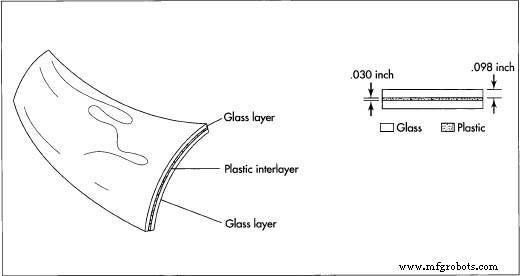
A finished automotive windshield is a laminated unit: two thin glass layers (~0.03 in or 0.76 mm each) sandwich a ~0.098‑inch (2.5 mm) plastic interlayer. This construction offers superior impact resistance while remaining thin enough to preserve vehicle design integrity.
Laminating
- 6. Lamination – Tempered glass sheets are bonded with a plastic interlayer inside an autoclave that applies heat and pressure. The interlayer often contains a UV‑blocking tint, providing additional protection. Upon breaking, the plastic holds the shards together, maintaining visibility.
Assembly
- 7. Encapsulation – The laminated unit is positioned in a mold cavity, and molten plastic is injected to form a frame that encapsulates the glass. The finished assembly is shipped to vehicle manufacturers, where a polyurethane adhesive secures it to the body.
Quality Control
Manufacturers monitor raw material quality, melting temperature, furnace atmosphere, and glass level. Photoelectric sensors automatically inspect for defects during formation, while laser scanners measure dimensions and curvature post‑formation. Compliance with ASTM standards ensures chemical durability, impact resistance, and strength. SAE International also defines performance criteria specific to automotive windshields.
The Future
Despite recent industry volatility, long‑term demand for flat glass remains robust as vehicle production rebounds. Modern designs call for larger, more aerodynamically shaped windshields, increasing the glass area per vehicle. Consequently, researchers are developing advanced coatings—angle‑selective glazing, optical switching films, and polymer multilayer solar‑control films—to manage heat load and reduce HVAC demand.
Innovations include a polymer multilayer film that doubles as a de‑icing element, allowing visible light transmission up to 90 %. Silver‑coated glazes can reject up to 60 % of solar energy, cutting infrared absorption by 56 %. Bi‑layer windshields, composed of a single outer glass sheet (~0.08–0.16 in) bonded to a 0.254‑inch polyurethane layer, offer UV resistance, self‑healing scratches, reduced weight, and improved anti‑fog performance.
Recycling is gaining traction. A new cost‑effective process removes laminated plastic layers, enabling glass reuse in applications such as glassphalt for road repair. Legislative initiatives, such as the Municipal Solid Waste and Hazardous Waste Research Act of 1992, aim to identify and eliminate barriers to automotive component recycling.
Manufacturing process
- Pyrex: The Evolution, Composition, and Manufacturing of Borosilicate Glass
- Windshield Wipers: Design, History, and Manufacturing Insights
- Electric Vehicles: A Sustainable Revolution in Transportation
- The Timeless Art of Glass Christmas Ornaments: History, Craftsmanship, and Modern Innovation
- Lead Crystal: History, Craftsmanship, and Future of a Timeless Glass
- Fiberglass: Production, Materials, and Industry Outlook
- Stained Glass: History, Craftsmanship, and Contemporary Revival
- From Ford’s Assembly Line to the Future of Electric Vehicles: The Evolution of Automobile Manufacturing
- The Science and Craft of Modern Mirrors
- A Comprehensive Guide to Automobile Engine Types