



Sunscreen: Science, Production, and the Future of Sun Protection
Background
The modern image of healthy skin no longer celebrates a deep tan. Extensive research links sun exposure—especially ultraviolet (UV) radiation—to skin cancer, premature wrinkles, and other dermatologic issues. While protective clothing remains the most effective barrier, high‑quality sunscreens are essential for comprehensive protection.
Solar radiation comprises infrared, visible, and ultraviolet light. Only UV light is harmful to humans. UV is subdivided into UVA, UVB, and UVC. UVA penetrates the skin’s surface, reaching about 1 mm depth, and can damage cellular membranes and the immune system. It’s associated with skin cancer, photoaging, and wrinkling. UVB causes the painful redness and burns we associate with sunburn; it also contributes to skin cancer and can harm the eyes. UVC is largely absorbed by the atmosphere and is not a threat. Broad‑spectrum sunscreens protect against both UVA and UVB.
There are two primary types of sunscreen: chemical absorbers that penetrate the skin and physical blockers that sit on the surface. Both are rated by Sun Protection Factor (SPF), which measures how much longer protected skin can tolerate UVB exposure compared to unprotected skin. For example, an SPF 15 lotion allows a person who would burn in 10 minutes to stay in the sun for 150 minutes before burning.
Historically, UVB was blamed for all skin cancers, but recent studies show UVA also plays a critical role. Although many sunscreens now contain UVA filters, the FDA does not set a formal UVA protection standard; SPF only reflects UVB protection. FDA approval is required for any new sunscreen, involving rigorous testing and a fixed formulation and SPF rating.
Development and Testing
Today’s sunscreen market is highly segmented. Formulations are tailored to specific user groups—athletes, children, the elderly, etc.—with features such as water‑resistance, sweat‑proofing, or skin‑soothing ingredients. For instance, athlete sunscreens aim for eight‑hour protection and a dry feel to avoid compromising grip, while children’s sunscreens often include aloe vera and vitamin E for gentle care.
During development, chemists create prototype formulations using synthetic and natural ingredients. Initial batches of 10 gal (38 L) are produced in stainless‑steel vats, tested, and refined before the FDA application. FDA testing includes SPF determination per FDA guidelines, safety assessment, and water‑resistance evaluation.
Raw Materials
Typical sunscreens blend synthetic and natural components tailored to the desired SPF and consumer needs. Avobenzone (Parsol 1789) remains the most widely used UVA filter worldwide. Other UVA blockers include benzophenone and oxybenzone. Historically, PABA was common but was replaced by Padimate‑O due to irritation concerns. Additional synthetic filters such as octyl methoxycinnamate and menthyl anthranilate also provide broad‑spectrum protection.

Titanium dioxide is a natural mineral that scatters UV light and is prized for its broad‑spectrum efficacy. Although less opaque than zinc oxide, it delivers similar whitening at higher SPFs. Antioxidants like vitamins E and C, rice bran oil, sesame seed oil, and green tea are often added to stabilize oils and enhance skin benefits. Many newer formulas also include soothing agents such as aloe and chamomile.
The Manufacturing Process
Sunscreen can be produced, bottled, and shipped from a single facility or distributed across multiple sites. Below is a typical fully automated workflow.
Formulating the lotion
- 1. Water is purified via reverse osmosis, producing salt‑free water for the formulation.
- 2. Ingredients are sourced, weighed, and blended with the purified water according to a detailed recipe. The original 10‑gal batch is scaled to commercial volumes, and a vat sheet records precise measurements.
Making the containers
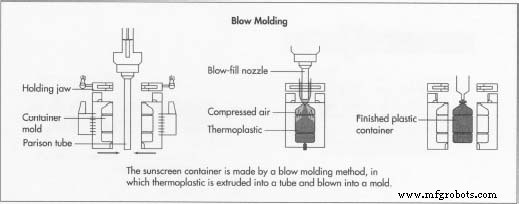
- 3. A blow‑molding facility fabricates the plastic bottles. Thermoplastic resin is extruded into a tube (parison), inserted into a mold, and expanded with compressed air to form the final shape.
- 4. Bottles are then printed or stamped with logos and product information. Metal foil embossing can add a distinctive visual cue.
Filling the containers
- 5. Stainless‑steel tanks up to 1,000 gal (3,784 L) store the lotion. In a sterile fill room, a conveyor system feeds bottles to a pressure filling machine that dispenses a measured amount of sunscreen through a retractable nozzle.
Capping the containers
- 6. Most caps are applied automatically along the line; pump caps that enable easy dispensing require manual assembly.
Shipping
- 7. Finished bottles are boxed in groups of 12, pelletized, and shrink‑wrapped onto a skid for distribution.
Byproducts and Waste
Recycled plastic scraps from the molding process are regrind and reused. Containers with printing defects are repurposed by other companies, for example into patio furniture.
The Future
Biotechnology is unlocking nature’s own sunscreen mechanisms. Researchers at the Weizmann Institute of Science isolated a protein from the Dead Sea alga Dunaliella bardawil that redirects excess sunlight away from photosynthetic cells. Similarly, the human pigment melanin offers broad‑spectrum protection. Advances in fermentation now allow inexpensive, scalable melanin production, and micro‑sponge encapsulation delivers it precisely to the skin’s surface.
Ongoing research into natural and synthetic UV filters, antioxidant blends, and biodegradable packaging promises to make sunscreens safer, more effective, and environmentally friendly.
Manufacturing process
- Understanding the Skin Effect: Impact on AC Conductors and RF Applications
- The Art and Science of Tattoos: History, Techniques, and Care
- Innovative Needle‑Free Injection Systems: Advancing Safe and Pain‑Free Medication Delivery
- Professional Hair Removal: Depilatories, Epilatories, and Manufacturing Insights
- Temporary Tattoos: From Artistry to Advanced Manufacturing
- Artificial Skin: Advanced Tissue Engineering for Burns, Wounds, and Future Regenerative Therapies
- CT (CAT) Scanners: Evolution, Design, and the Future of 3‑D Medical Imaging
- Safe and Effective Fiberglass Splinter Removal Using Tape
- Integral Skin Foam: Advanced Dual-Layer Polyurethane Technology
- Innovative Electronic Skin Mimics Human Pain Sensing in Real Time