



The Evolution and Artistry Behind the Modern Necktie
Background
Neckwear dates back over 30,000 years, when early humans adorned their chests with beads and bangles. Throughout history, people have worn wood, metal, pearls, feathers, glass, or cloth around their necks. A widespread medieval belief that illnesses entered through the throat may explain the enduring popularity of protective neckcloths, while soldiers historically felt more secure with a neck covering in battle.
The first modern neckties, known as cravats, appeared in the seventeenth century. According to legend, Croatian mercenaries who had recently defeated the Turks celebrated with Louis XIV in Paris. The Sun King was so impressed by the soldiers’ colorful silk scarves that he adopted the style, and the term kravate—from Croatian—gave the accessory its name. The cravat quickly spread to England after exiled Charles II returned from France, and it has remained a staple of men’s fashion ever since.
For nearly two centuries, the “stock tie”—a well‑knotted front that was actually fastened at the back—served as an alternative to the cravat. It fell out of favor by the early twentieth century, when the modern necktie emerged and became the industry standard. Today, 95 million ties are sold annually in the United States, generating more than $1.4 billion in retail sales, according to MR Magazine and the 1992 Handbook of the Neckwear Association of America.
Raw Materials
Neckties are crafted from a range of fibers, including silk, polyester, wool and wool blends, acetate, rayon, nylon, cotton, linen, and ramie. Silk accounts for roughly 40 % of the market; raw silk is mainly imported from China and, to a lesser extent, Brazil. Domestic weavers purchase natural silk yarn and have it finished and dyed by specialists. Advances in textile technology now allow microfiber polyesters—producing a rich, soft fabric that mimics silk—to be blended with natural or synthetic fibers, expanding the spectrum of textures and finishes.
Design
The design of a necktie is a collaborative process between weavers and manufacturers. Because production runs are typically limited to specific patterns and colors, tie weaving is regarded by many as an art form.
Much of the industry’s design work takes place in Como, Italy. When a new design is commissioned, time is devoted to ideation, sample production, and order placement. In most cases, weavers work from a catalog of proven designs that have enduring appeal. They use computerized silk‑screening, a high‑speed method that replaces labor‑intensive hand‑screening, to apply vibrant colors and patterns. Designers adjust color palettes each year, tailoring background and foreground hues, width, and length to market demand.
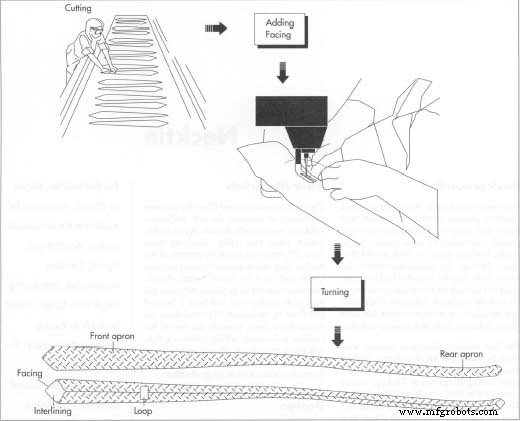
The manufacturing journey begins with cutting 40‑yard bolts of cloth. Workers then use a sewing machine to join the tie’s three bias‑cut sections in the neckband area, attach the facing (a crisp, luxurious layer of silk, nylon, rayon, or polyester), and sew the tie’s ends. The tie is initially inside out; interlining is stitched to the shell, after which the tie is turned right‑side out. Manufacturers may provide input on color and pattern, and those with large orders can commission custom designs from weavers.
Once finalized, the design is sent to mills that imprint it onto 40‑yard bolts of silk. These bolts are then shipped to the United States for finishing.
Key components of a high‑quality tie include the outer shell, the interlining (both cut on the bias), and the facing or tipping. These are assembled with a resilient slip‑stitch that allows the tie to flex when tied and recover from repeated knotting. The material quality and construction determine the tie’s drape, shape retention, and wrinkle resistance.
A well‑cut lining is essential; it shapes the tie and dictates its wearability. Proper coordination of blend, nap, and weight between the lining and shell is critical. Lightweight shells may pair with heavier interlinings, while heavier shells require lighter interlinings to achieve the desired hand and recovery. Most interlining manufacturers use a color‑coded stripe system (one stripe lightest, six stripes heaviest) to streamline inventory and production.
Standard ties range from 53 to 57 inches in length. Extra‑long ties—ideal for taller men or those with larger necks—measure 60 to 62 inches, while student ties fall between 48 and 50 inches.
The Manufacturing Process
Cutting the Outer Fabric
- Operators spread 40‑yard bolts on a long cutting table. Skilled hand‑cutting maximizes yield, especially when working with patterned fabrics. For random designs, operators stack between 24 and 72 plies; for patterned panels, stacks are arranged to preserve the design.
Adding the Facing
- Using a chain stitch, operators join the tie’s three bias‑cut sections and attach the facing (three‑quarter or full, extending 6–8 inches or to just below the knot). A quarter‑to‑half inch of the shell is turned under to form the point, then machine‑hemmed.
Piece Pressing
- High‑quality ties undergo pocket or piece‑pressing to flatten the neck joint, eliminating bulk and ensuring a smooth fit.
Interlining
- Slip‑stitching with resilient nylon thread secures the interlining to the shell. Most ties use a semi‑automated Liba machine, which closely replicates hand‑stitching. Hand‑stitched ties, reserved for premium lines, offer superior resiliency and drape.
The slip‑stitch technique leaves a subtle, evenly spaced seam on the reverse, a tiny knot at the front apron, and a thread that allows the tie to glide freely.
Turning the Lining
- A turning machine or manual rod (≈9½ inches) pulls the tie right‑side out. For silk ties, the lining is hand‑tucked into the long end’s corner, then trimmed to fit the point. In other ties, the lining may not reach the bottom corner.
- The final element is the loop, which holds the thin end while worn and displays the manufacturer’s label.
The Future
Recent disruptions in China’s raw silk supply, coupled with advances in textile science, underscore the benefits of man‑made fibers. Synthetic yarns—produced domestically and typically yarn‑dyed—offer reliability and versatility. Microfiber polyester or nylon (denier ≤ 1) can be blended with natural or other synthetic fibers to create fabrics that feel silky yet outlast traditional materials. Air‑textured, false‑twist, or fully‑drawn flat yarns produce a rich, soft hand that rivals natural silk, positioning them as the next frontier in necktie production.
Manufacturing process
- What is VMC Machining? An Expert Overview of Vertical Machining Centers
- Expert Guide to Aluminum Laser Marking: Precision, Durability, and Industry Applications
- MIG vs. TIG Welding: Selecting the Right Arc Welding Technique for Your Project
- The Evolution and Craftsmanship of Artificial Flowers: From Silk to Modern Perma‑Stem
- Silk: From Ancient Threads to Modern Textiles
- The Evolution and Artistry Behind the Modern Necktie
- Improved Osteoinductivity with rhBMP‑2-Loaded Silk Fibroin Scaffolds for Bone Tissue Engineering
- Efficient Oxidation and Nano‑Dispersion of Bombyx mori and Antheraea pernyi Silk Fibers for High‑Performance Membranes
- The Critical Connection: Technology and People in Retail Success
- Exploring PLA Finishes: Matte, Glossy, and Silk for FDM 3D Printing