



The History and Production of Postage Stamps: From Hill’s Reform to Modern Printing
Background
The modern postage stamp was born from Sir Rowland Hill’s 1837 pamphlet, Post Office Reform: Its Importance and Practicability. Hill challenged the distance‑based rate system and proposed weight‑based fees paid in advance via adhesive stamps. The United Kingdom quickly adopted his vision: the first adhesive stamp, the penny black featuring Queen Victoria, was issued in 1840. It covered postage for letters up to ½ ounce (14 g) regardless of distance. To discourage postmarking without stamps, the UK doubled the fee for un‑stamped letters at delivery.
Brazil followed in 1843, as did several Swiss cantons, and the United States authorized its first five‑ and ten‑cent stamps in 1847, launching them on July 1 of that year. By 1860, more than 90 nations, colonies, or districts were issuing stamps.
Early stamps were monochrome; the U.S. didn’t produce multicolored stamps until 1869, and such varieties became common only in the 1920s. The penny black and similar issues were initially separated by scissors—perforation didn’t arrive until 1854 in England and 1857 in the U.S. Despite occasional larger stamps, the penny black’s original dimensions (0.75 × 0.875 inches / 1.9 × 2.22 cm) remain the industry standard.
Initially, stamp production was handled by mints or currency printers, but the unique paper types and printing pressures demanded a distinct craft. Over time, stamp printing has mirrored advances in printing technology, now employing the finest industrial methods available.
In the United States, a Citizens’ Stamp Advisory Committee, meeting with Post Office staff, decides which stamps to issue, their denominations, and release dates. Suggestions come from all over the country, often with sketches or photographs. Once a design is approved, an artist is commissioned to create or refine it. The decision to print in‑house or outsource to qualified contractors is then made. The Bureau of Engraving and Printing (BEP) traditionally handles high‑volume stamps, but since the late 1980s, several external firms—typically 10‑15—meet Post Office standards.
Specifications cover color, size, design, and printing process. If a stamp is contracted out, a “request for proposal” is advertised in the Commerce Business Daily, a U.S. government publication listing contracts open to non‑government firms. After printing, samples are sent to the International Bureau of the Universal Postal Union in Switzerland, where they are marked as specimens and distributed to member nations to help postal workers recognize legitimate foreign postage.
Additional specifications may include phosphor tagging—an invisible mark read by special machines to aid automated sorting—and use of chalked paper to prevent cancellation removal. When a chalked paper stamp is wet, its image blurs as the cancellation is wiped, signaling invalidity to postal workers.
Raw Materials
Stamps are now printed on continuous rolls rather than sheet paper. The two most common types of paper are laid and wove. Laid paper has ribbed lines, while wove is smooth. The U.S. currently uses only wove paper. Watermarks—subtle designs created by varying paper‑roll pressure—were common elsewhere but have been unused in the U.S. since 1915.
The Manufacturing Process
The process begins with paper delivery, already coated with adhesive. Two primary printing methods are employed: intaglio (including gravure) and offset lithography. Often, a stamp’s specifications call for both.
Intaglio (Engraving)
- Master Die Creation – An engraver cuts the stamp design in reverse onto a master die. This meticulous handwork can take several weeks to perfect.
- After hardening, the engraved image is transferred to a soft steel transfer roll, creating a positive relief. Multiple impressions can be made from a single roll.
- The transfer roll then presses onto a printing plate, leaving a reverse groove pattern. The plate is hardened and inked automatically, with a doctor blade removing excess ink from non‑groove areas.
- When the inked plate presses onto paper, the grooves transfer ink, producing a positive image of the original design.
- For multicolor stamps, selective inking applies each color using rubber pads that touch only the designated areas of the plate.
Offset Lithography
- A photochemical image is etched onto an aluminum plate. The plate alternates between ink and water: ink adheres to the image, while water repels ink from non‑image areas.
- The inked image transfers to a rubber blanket, which then presses onto paper, creating the final stamp.
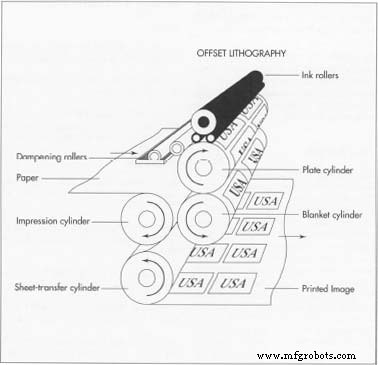
Perforation
- Perforations can be made during printing by a perforating machine that punches holes through a grid of pins, or afterward by rouletting—a wheel with pins rolls across the paper to create a row of holes.
- Although originally manual, rouletting is now automated.
Quality Control
Inspection occurs at every stage, performed by plant operators and dedicated inspectors who remove errors before stamps proceed. Despite sophisticated machinery, occasional defects arise—misfed paper, clogged inking, pressure variations, humidity changes, or misaligned color plates. These errors are largely prevented by roll‑fed paper systems and rigorous quality checks, but a few survive, giving rise to the collectible “error stamp” market.
The Future
Postage meters, first developed in New Zealand in 1902 and adopted by the U.S. a decade later, have dramatically reduced stamp usage. Meters allow businesses to print postage directly, with the U.S. market now dominated by meter‑based mail for more than half of all outgoing mail. Yet stamps remain popular for commemorative issues—World War II, Elvis Presley, Princess Grace of Monaco—showing that the traditional adhesive stamp continues to capture public imagination.
Manufacturing process
- What is VMC Machining? An Expert Overview of Vertical Machining Centers
- Expert Guide to Aluminum Laser Marking: Precision, Durability, and Industry Applications
- MIG vs. TIG Welding: Selecting the Right Arc Welding Technique for Your Project
- Comprehensive Guide to Laser Marking: Types, Benefits, and Applications
- Key Considerations for High‑Volume Swiss Machining
- CNC Prototyping Guide: Precision, Speed, and Cost‑Effective Production
- Expert Shaft Manufacturing: Precision Processes & Custom Solutions
- The Evolution and Craftsmanship of Rubber Stamps: From Invention to Modern Use
- The History and Production of Postage Stamps: From Hill’s Reform to Modern Printing
- TTO vs Hot Stamp Printing: A Professional Guide to Choosing the Right Technology