



Power‑Feed vs Hand‑Feed Drilling Machines: Which One Suits Your Workshop?
Modern workshops rely on two primary drilling configurations: power‑feed and hand‑feed machines.
A drilling machine creates holes in a workpiece, and the feed method determines how the drill bit is advanced—either by the machine’s motor or by the operator.
Hand‑feed machines are compact, bench‑ or floor‑mounted, and powered by an electric motor. The operator manually controls the drill bit via a hand lever or wheel, offering fine sensitivity for delicate tasks.
Power‑feed machines, in contrast, are larger and robust, designed for medium‑to‑heavy‑duty work. Their motorized feed delivers consistent pressure and speed, reducing operator fatigue and boosting productivity.
Both setups can perform drilling operations such as boring, countersinking, counterboring, and reaming, but their suitability varies with job complexity and material hardness.
Let’s explore the key differences between power‑feed and hand‑feed drilling machines in detail.
For a comprehensive overview of drilling machines, see our detailed guide.
Hand‑Feed Drilling Machines
A hand‑feed drilling machine—often called a sensitive drill—is manually operated. The operator directly manipulates the drill bit into the workpiece using a hand lever or wheel.
Compact and straightforward, hand‑feed machines excel at light‑duty tasks, offering a tactile feel that helps with precision drilling on small workpieces.
They are commonly used for precision work requiring minimal pressure and are prevalent in workshops and tool rooms.
These machines come in bench‑mounted or floor‑mounted variants, all driven by electric motors that turn a drive belt on a pulley connected to the spindle.
Typically, hand‑feed drills can handle holes up to ½ inch in diameter. The drill head moves vertically along the column, allowing the operator to set the depth by loosening and locking the chuck.
For an in‑depth look at milling machines, check our detailed guide.
What are Power‑Feed Drilling Machines?
A power‑feed drilling machine uses a motorized feed mechanism to advance the drill bit automatically. The feed rate is adjustable to match material hardness and the specific operation.
These machines are larger and more robust than hand‑feed types, making them ideal for medium‑ to heavy‑duty tasks. Automatic feeding ensures consistent pressure, higher productivity, and less operator fatigue.
Power‑feed drills are common in mass‑production settings and industrial applications. They can drill large holes and handle hard materials, making them perfect for repetitive tasks.
In a maintenance workshop, a power‑feed machine is often chosen for medium‑duty work or when large drills are required.
They feature a motor‑driven feed that can be set at a preset depth, allowing precise cuts per spindle revolution—sometimes to the thousandths of an inch.
Power‑feed drills are essential for drills or cutting tools over ½ inch in diameter, which demand more force than hand power can provide.
Speed ranges from about 50 rpm to 1,800 rpm. Slower speeds are used for operations like counterboring, countersinking, and reaming.
These machines typically have a 17‑inch to 22‑inch center drilling capacity. They are usually floor‑mounted and can handle up to 2 inches, mounting into tapered Morse sockets. T‑bolts and clamps secure larger workpieces to the table or base, while smaller parts are held in a vise.
Power transmission in a drilling machine involves an electric motor driving a V‑belt and pulley stack to transmit torque to the spindle. Adjusting the mechanism allows different spindle speeds.
For a deeper dive into drilling fundamentals, refer to our detailed guide.
Diagram
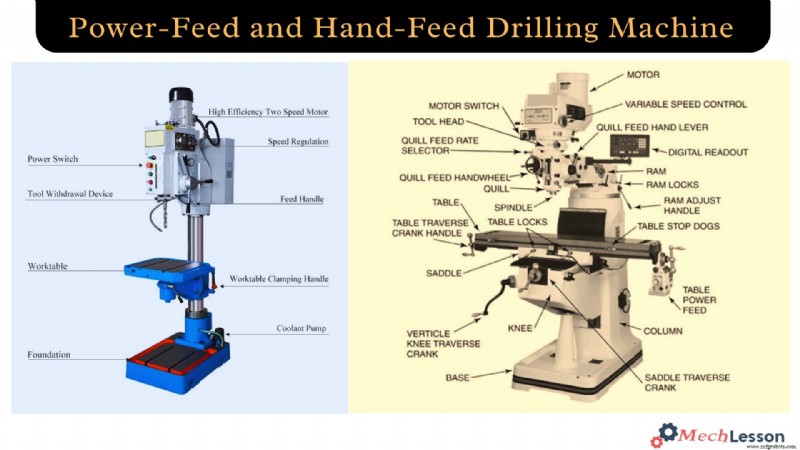
Difference Power‑Feed and Hand‑Feed Drilling Machine
| Feature | Hand‑Feed Drilling Machine | Power‑Feed Drilling Machine |
|---|---|---|
| Operation | Manual | Automatic |
| Precision Control | High (operator‑controlled) | Moderate to high |
| Suitable for | Light‑duty work | Medium to heavy‑duty work |
| Feed Control | Hand lever | Motor‑driven, adjustable |
| Speed | Slower | Faster |
| Common use | Workshops, repair shops | Factories, production lines |
For a comprehensive look at boring machines, visit our detailed guide.
Conclusion
Hand‑feed drilling machines provide unmatched precision and tactile control, making them ideal for delicate, light‑weight tasks. Power‑feed machines, on the other hand, deliver speed, consistency, and reduced operator fatigue, making them the go‑to choice for industrial and repetitive drilling operations. Selecting between them hinges on the job’s complexity, material, and production volume.
FAQs:
Which is better for accuracy, hand‑feed or power‑feed?
Hand‑feed machines typically offer higher accuracy for small, delicate jobs because the operator has direct control over the feed.
Can power‑feed drilling be manually operated?
Some power‑feed models include a manual override, but their primary function is automated feeding.
Which machine is more suitable for mass production?
Power‑feed drilling machines are preferable for mass production due to their speed and automation.
Are hand‑feed drilling machines outdated?
No. Hand‑feed machines remain indispensable in small workshops and for precision work.
Manufacturing process
- Smart Bus Stop Architectural Model Featuring Automatic Sunshade
- Build Your Own RC Monster Truck: The Badland Brawler Powered by Arduino
- Build a Real-Time Gyroscope Game with Arduino Nano & MPU-6050 Sensor
- Smart Cube: The Next-Gen Home Control Hub
- Fishing Lure Design, History, and Manufacturing: An Expert Overview
- Geodesic Dome: Design, Construction, and Applications
- 7 Clear Indicators Your Alternator Is Failing
- Key Piston Components and Their Functions in Internal Combustion Engines
- Understanding Vertical Metal Band Saws: Features, Operation, and Benefits
- High-Performance 2.8” TFT Shield for Arduino Nano – 320×240 SPI Display