



C++ Default Function Arguments: How They Work & Best Practices
C++ Default Function Arguments
Explore how to assign default values to function parameters in C++, with step‑by‑step examples and practical guidelines.
In C++, function parameters can be given default values. When a call omits an argument, the compiler substitutes the default. If an argument is supplied, the default is ignored.
How Default Arguments Work
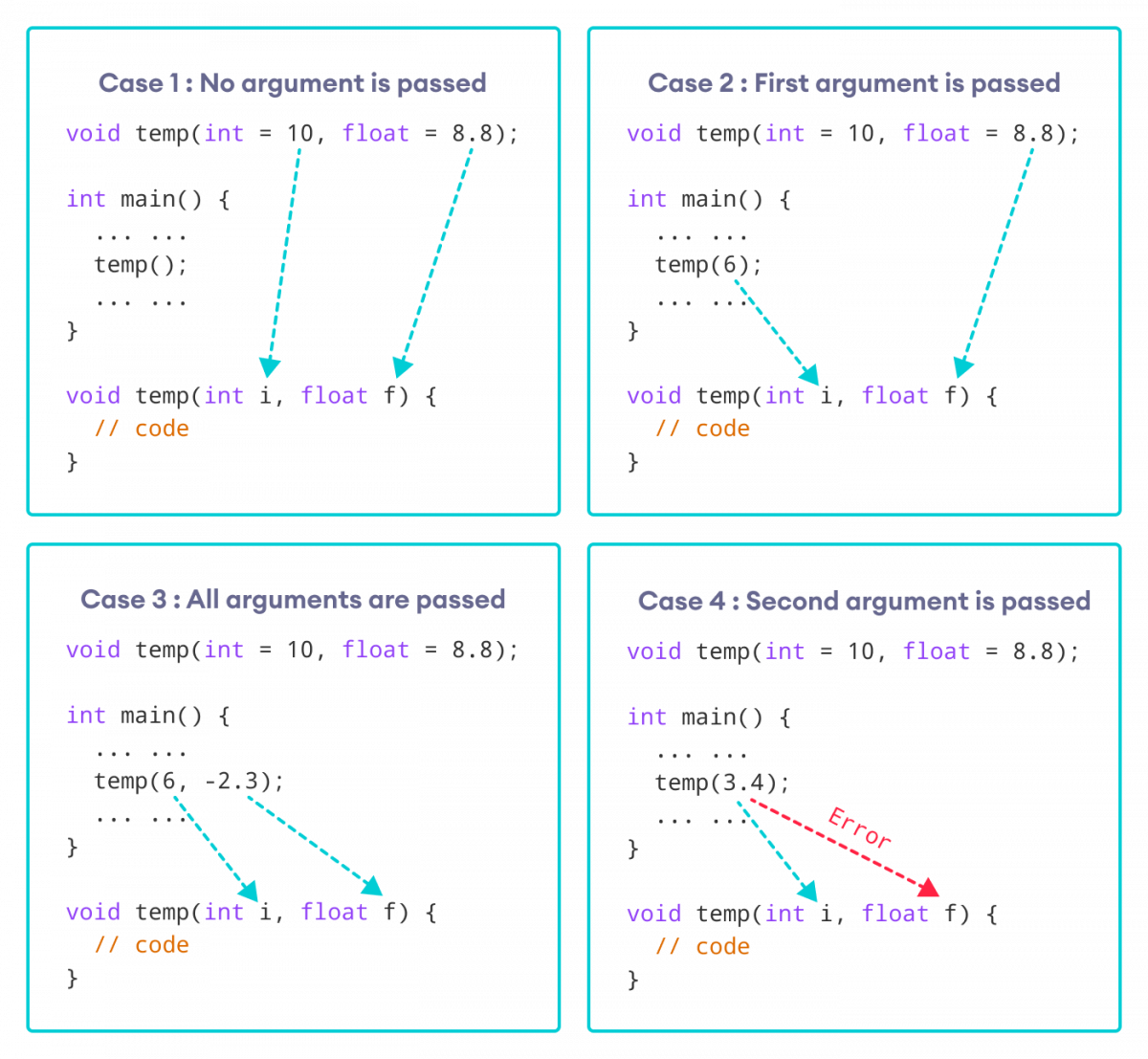
Consider the following illustration:
temp()uses both defaults.temp(6)overrides the first parameter; the second remains default.temp(6, -2.3)provides values for both, overriding both defaults.- Calling
temp(3.4)mistakenly passes a double to an int parameter. The compiler truncates the value to3, demonstrating that argument types must match the declaration order.
Example: Using Default Arguments
#include <iostream>
using namespace std;

// Prototype with default arguments
void display(char = '*', int = 3);

int main() {
    int count = 5;

    cout << "No argument passed: ";
    display();   // uses '*', 3

    cout << "First argument passed: ";
    display('#');   // uses '#', 3

    cout << "Both arguments passed: ";
    display('$', count); // uses '$', 5

    return 0;
}

void display(char c, int count) {
    for(int i = 1; i <= count; ++i) {
        cout << c;
    }
    cout << endl;
}
Output
No argument passed: ***
First argument passed: ###
Both arguments passed: $$$$$
The program behaves as follows:
display()uses the defaultsc='*'andcount=3.display('#')overrides only the first argument; the second remains default.- When both arguments are supplied, defaults are ignored.
Defining defaults directly in the function definition is also valid and often clearer:
#include <iostream>
using namespace std;

void display(char c = '*', int count = 3) {
    for(int i = 1; i <= count; ++i) {
        cout << c;
    }
    cout << endl;
}

int main() {
    int count = 5;

    cout << "No argument passed: ";
    display();

    cout << "First argument passed: ";
    display('#');

    cout << "Both arguments passed: ";
    display('$', count);

    return 0;
}
Key Points to Remember
- After a parameter receives a default value, every following parameter must also have a default. For example:
// Invalid void add(int a, int b = 3, int c, int d); // Valid void add(int a, int c, int b = 3, int d = 4); - When defaults are specified in the definition rather than the prototype, the definition must precede any call. Otherwise the compiler will issue an error.
C++ Function Overloading: A Practical Guide
Mastering C++ Recursion: Concepts, Examples, and Best Practices
C Language
- Mastering C++ Operators: A Complete Guide with Practical Examples
- C++ Function Overloading: A Practical Guide
- How to Pass Arrays to Functions in C++: A Practical Guide
- Four Proven Patterns for User‑Defined Functions in C
- C++ Programming Basics: What Is C++ and Why It Matters
- Top 15 C++ Online Courses to Master the Language (2024 Update)
- Function Pointers in C: Practical Examples and Best Practices
- Mastering Variable Arguments in C: A Practical Guide
- Master C++ Web Programming with CGI
- Fanuc Decimal Point Programming: Overview & Parameter Settings