



Inside the Toyota MR-50: How the Georgetown Plant Targets a 50% Maintenance Reduction
"Maintenance Reduction 50 Percent" is an ambitious target, but Toyota’s track record of eliminating waste makes it a realistic goal.
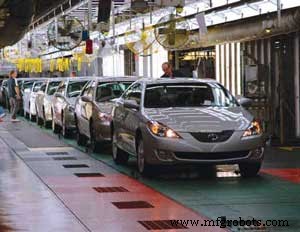
The Georgetown, Ky., plant manufactures the Camry sedan, Avalon sedan, and Solara coupe and convertible.
How do your plant’s metrics compare? For context, Toyota’s recent performance highlights include:
- Ranked 3rd among the world’s most respected companies (PwC & Financial Times).
- Ranked 5th on Fortune’s list of most admired companies, top among automakers.
- Ranked 6th in Harris Interactive’s best‑brand study.
- Ranked 10th in Harris’s corporate reputation survey, again first among car makers.
- Achieved 10% corporate growth in 2005.
- Held 13% of the global auto market share in 2005.
- Held 13.3% of the U.S. market share last year.
- Projected production of 9.06 million units in 2006, surpassing General Motors.
Yet perhaps the most striking figure is 50 – the percentage target for maintenance reduction.
Seven Deadly Wastes
After years of continuous improvement, Toyota identified seven primary wastes that impede productivity:
- Over‑production
- Waiting
- Excess conveyance
- Over‑processing
- Excess inventory
- Unnecessary motion
- Defects and corrections
Maintenance Reduction 50 Percent (MR‑50) is the latest initiative aimed at cutting waste across Toyota’s manufacturing network.
While the phrase “maintenance reduction” can trigger alarm, the initiative is about smarter, leaner maintenance practices, not budget cuts or workforce reductions.
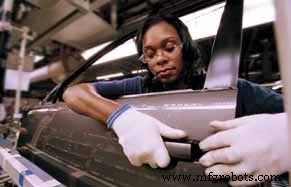
Toyota Motor Manufacturing, Kentucky (TMMK) employs ~7,000 workers.
Setting High Expectations
High expectations are embedded in Toyota’s culture. Former TMMNA president Teruyuki Minoura noted that “pressure fosters wisdom.”
Atsushi Niimi, TMMNA president (2002‑2005), championed the Global Body Line project, reporting a 50% cost and space savings in 2004.
Given this legacy, maintenance leaders at the Georgetown plant were prepared when the company set a 50% reduction target for the next few years.
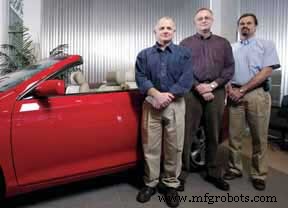
Maintenance leaders Ed Welch, David Absher, and Bruce Bremer.
“MR‑50 is just an acronym,” says Welch, the plant’s maintenance manager. “It’s a challenge and a focus.”
Absher explains that the goal covers every machine and activity: “We aim to cut maintenance tasks by 50% across the board.”
This is not about arbitrary budget cuts; it’s a systematic plan balancing current demands with long‑term vision.
Key Facts About TMMK
Site: Toyota Motor Manufacturing, Kentucky, Inc. (TMMK), Georgetown, Ky. HQ: TMMNA headquarters, Erlanger, Ky.
Employment: ~7,000 total, 710 in maintenance.
Size: 7.5 million sq ft across 1,300 acres.
Products: Camry sedan, Avalon sedan, Solara coupe/converter; engines, axles, steering components, machined parts, dies.
Production 2005: 492,889 vehicles (351,883 Camry) and 498,908 engines.
Milestone: Production began July 1988; 6 millionth vehicle produced June 2005.
Integrating Toyota Production System Principles
Bremer, the facility engineering manager, aligns MR‑50 with TPS fundamentals: eliminating waste (muda) and fostering continuous improvement.
Welch says, “Where’s the muda? Is it overtime? Reduce it. Are indirect material costs higher than benchmarks? Find the cause and cut it.”
Absher adds, “We aggressively pursue goals; if we don’t hit the target, we analyze why and push further.”
MR‑50 is not a maintenance‑only initiative. “Everyone is involved,” Absher emphasizes. “We’re a plant of 7,000 people, all tasked with identifying and eliminating waste.”
Kaizen Culture in Action
Traditional plants often rely on historical processes. Toyota counters this with kaizen: continuous, company‑wide improvement driven by frontline insight.
Chief Engineer Taiichi Ohno stated, “If workers don’t seek daily improvements, the system fails.”
Kaizen events—cross‑functional teams working for weeks—address high‑priority problems, from ergonomics to equipment reliability.
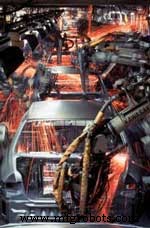
Toyota embraces predictive technologies, such as Intelligent Maintenance Systems (IMS).
Absher says, “Kaizen is about thinking ahead, not just doing the job.”
Overcoming Traditional Maintenance Challenges
Many U.S. plants struggle to apply TPS tools to maintenance. “We’ve had to translate production tools into maintenance contexts,” Welch notes.
At TMMK, a quality‑circle project on a single compressor achieved a 50% maintenance reduction, sparking the MR‑50 initiative across the company.
Toolbox for MR‑50
Maintenance‑Focused Kaizen: Uses data (downtime, energy, reliability, cost) to target high‑impact issues like spare‑parts duplication, servo‑driver wear, and electrical fault response.
Absher highlights a 66% reduction in bus‑duct fault response time after a structured kaizen event, cutting average downtime from 2.7 hours to 0.9 hours.
Technology: Toyota collaborates with the University of Cincinnati and University of Michigan on IMS research. Current pilots focus on air‑compressor efficiency, robot health, and bearing monitoring.
Welch notes that predictive maintenance’s cost‑effectiveness will dictate broader adoption.
Five‑Whys: A root‑cause tool that iteratively asks “Why?” to uncover fundamental issues. Used alongside reliability‑centered maintenance to prioritize resources.
Heijunka: Originally a production scheduling technique, it levels maintenance workloads to reduce overtime and idle time. Small, repeatable tasks replace large, infrequent ones.
Benchmarking: Continuous comparison with top plants, suppliers, and industry peers to identify best practices and close gaps.
Genchi Genbutsu: Hands‑on observation—standing on the floor for an entire shift—to spot waste and maintenance problems firsthand.
The Toyoda Precepts
Published in 1935, these precepts underpin Toyota’s management philosophy:
- Contribute to national development by working together, faithfully fulfilling duties.
- Lead through continuous creativity, curiosity, and improvement.
- Be practical and avoid frivolity.
- Show kindness and generosity; foster a warm, homelike atmosphere.
- Express reverence and gratitude for all endeavors.
Total Productive Maintenance (TPM)
TPM shifts routine maintenance to operators, freeing technicians for proactive work. At TMMK, operators handle lubrication, filtration, calibration, and minor repairs, while robotic welders perform tip changes.
Absher observes, “Skilled work has evolved with technology; operators now manage more complex tasks safely.”
Visual Controls and Quality Circles
Visual controls—color‑coded gauges, status panels—provide immediate feedback, reducing reaction time and preventing breakdowns.
Quality circles—small groups of production, maintenance, and facilities staff—regularly review processes, eliminating waste and enhancing performance.
Results and Outlook
While no single tool can achieve the 50% target, a combination of kaizen (12%), TPM (8%), IMS (5%), 5‑S (4%), and others steadily moves the plant toward MR‑50.
“You don’t need to be a manufacturing super‑hero to drive change,” Welch reminds. “Ask ‘Why?’ and apply kaizen tools to the problems you see.”
Embracing Toyota’s blend of people, process, and technology can transform maintenance outcomes, boost reliability, and elevate plant performance.
Discover how Toyota’s Georgetown plant is cutting maintenance by 50% using kaizen, TPM, and predictive tech.
Equipment Maintenance and Repair
- UTI Students Gain Exclusive Access to Volvo's Future Technology
- Preventing Machine Failures: Overcoming the “Tomorrow” Mentality in Lubrication Maintenance
- The Value of Point P: A Strategic Focus for Reliability & Maintenance
- Toyota’s TIEM Plant Earns Company of the Year Award from Columbus Chamber
- The Brain Behind Autonomous Cars: How AI Drives Modern Vehicles
- TIBCO Explores Manufacturing Innovation in the Anomaly Economy
- Understanding the FDA’s Final Rule on Unique Device Identification (UDI)
- Understanding Dopants and Wire Recrystallization in Tungsten and Molybdenum
- Swanton Welding Company: Expert Metal Fabrication & ISO‑Certified Solutions
- Steel Detailing Unveiled: A Step‑by‑Step Construction Guide