



Optimizing Coupling Lubrication for Reliability and Longevity
In an ideal world, a single component would encompass all necessary features, but reality forces us to assemble multiple parts on site. When these parts join, alignment is never perfect.
Couplings transmit torque between shaft sections. Even with meticulous adjustment, residual misalignment remains, and flexibility is essential to protect bearings and shafts from premature wear. Proper lubrication is the key to coupling performance and durability.
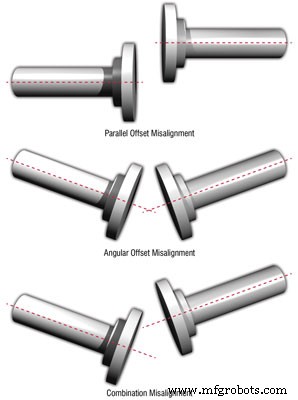
Figure 1. Types of Misalignment
Misalignment manifests as offset or angular displacement along two of the three principal axes (Figure 1). The longitudinal axis is rarely measured, yet errors here can cause excessive thrust loads. Large installations, such as high‑capacity compressors, employ wire‑based alignment, while smaller setups traditionally use rim‑and‑face dial indicators. Laser‑based optical indicators are increasingly favored for their precision and ease of use.
High‑performance maintenance teams also account for thermal expansion. All solids, except water, expand with temperature according to their coefficient of thermal expansion. A shaft aligned at ambient temperature will drift as operating temperatures rise. Pre‑heating or pre‑cooling equipment, or intentional misalignment at room temperature, can mitigate this drift, but a residual offset is inevitable. This misalignment forces shafts to deflect, inducing vibration and uneven loads on bearings, which in turn shortens equipment life.
When couplings are correctly engineered, they absorb misalignment forces, shielding expensive, sensitive components such as bearings—often the most delicate elements in a drivetrain—from excessive stress.
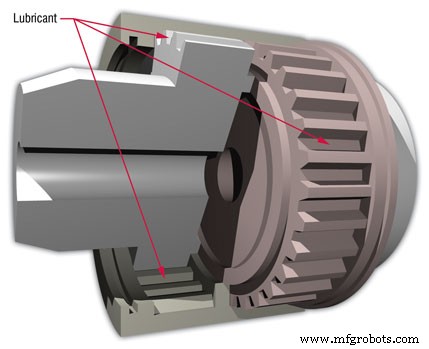
Figure 2. Gear Couplings
TYPES OF COUPLINGS
Couplings are broadly classified into four categories, each with several specific designs. Solid and magnetic couplings do not require lubrication, but are included for completeness. Solid couplings are rigid and do not compensate for misalignment; they simply join shafts to transmit torque. Magnetic couplings drive non‑contact shafts via permanent or electromagnets—common in sealless magnetic drive pumps.
Flexible couplings employ fixed flexible elements—metal, rubber, or plastic discs or bushings—that rotate with the shafts and absorb misalignment without lubrication. Gear, chain, grid, and universal joints, however, rely on lubrication for optimal performance and longevity. Fluid couplings (torque converters and multipliers) use lubricating fluid to transmit torque.
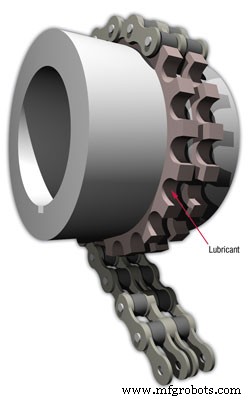
Figure 3. Chain Couplings
FLEXIBLE COUPLINGS
Gear couplings (Figure 2) handle misalignment through the clearance between gear teeth. External teeth on both shafts mate with internal teeth on a housing that contains lubricant. Variants mount teeth on only one shaft, mating with internal teeth on the other. Acceleration or deceleration can cause impacts due to backlash, and misalignment leads to sliding motion during each revolution.
Chain couplings (Figure 3) operate on the same principle. Sprockets on each shaft are linked by a roller chain; clearance in the chain and sprocket assembly accommodates misalignment. Loading patterns mirror those of geared couplings.
External grid couplings (Figure 4) use a corrugated steel grid that flexes under load. Grooved discs on each shaft house the grid, transmitting torque. Sliding motion develops between the grid and grooves as the grid deforms, widening and narrowing with each revolution.
Universal joints accommodate 20–30° of misalignment, depending on design. They are ubiquitous in vehicle drive shafts, allowing wheel movement with suspension travel. The four‑spindled spider connects two shafts ending in yokes or knuckles at right angles; each spider journal is supported by a bearing or bushing within a knuckle, enabling articulation.
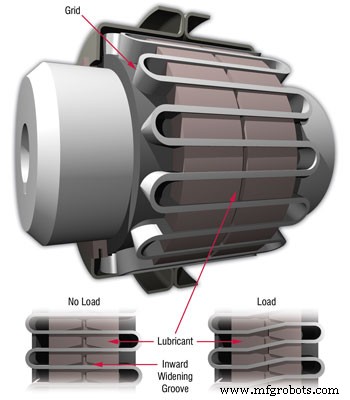
Figure 4. Grid Coupling
FLEXIBLE COUPLING LUBRICANTS
Both oils and greases can lubricate flexible couplings. Most industrial couplings are grease‑lubricated unless specified otherwise. The grease provides an oil film that bleeds from the thickener into the loading zone, protecting components.
Lubricated flexible couplings must resist low‑amplitude relative motion, centrifugal forces on the lubricant, and uneven oil distribution. The small sliding motions inhibit full‑film hydrodynamic lubrication, so high‑viscosity base oils, EP additives, and metal‑wetting agents are recommended to maintain boundary or mixed‑film conditions. High viscosity also reduces leakage.
Centrifugal forces in couplings can reach thousands of times gravity (Gs). Grease formulations are engineered to prevent premature separation of oil and thickener under such forces.
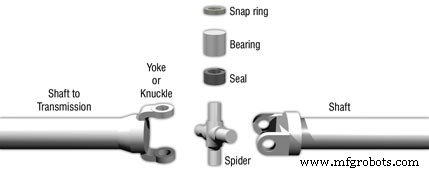
Figure 5. Universal Joint
FLUID COUPLINGS
Fluid couplings transfer torque via fluid motion. Misalignment is accommodated only by the small clearances between moving parts, leaving little margin for error. Nevertheless, fluid couplings effectively absorb shock loading and high starting torques because there is no direct mechanical link between input and output shafts.
Inside a fluid coupling, an impeller on the input shaft accelerates fluid much like a centrifugal pump. The fluid then impinges on the output shaft’s runner vanes, transferring momentum. The runner accelerates toward the input speed but never quite reaches it, resulting in slippage. The minimum input speed required for the output to rotate is called the stall speed. Fluid couplings are ideal for equipment with high static loads, such as steam or gas turbines, where initial stress on the drive shaft must be minimized.
Shock loads on the input side are never transmitted; the input shaft speed remains unrestricted. When the stall speed is exceeded, the output shaft accelerates at a rate limited by its inertia, and any excess energy is dissipated as viscous heat. Torque converters and multipliers are specialized fluid couplings that modify input torque before transmission.
FLUID COUPLING LUBRICANTS
Energy dissipation in fluid couplings can raise fluid temperature rapidly, sometimes exceeding 200 °F within a minute. Oil must resist oxidation, thermal degradation, and maintain a high viscosity index to prevent drastic viscosity changes at temperature spikes.
Typical viscosities range from 2.5 to 72 cSt at 40 °C. For high‑temperature applications, viscosity limits may be specified at 100 °C. Low‑viscosity oils reduce power lost to friction, but must resist foaming from intense agitation and provide rust protection. Hydrocarbon‑based fluids, enhanced with rust‑inhibiting additives, offer superior performance and seal compatibility.
RECOMMENDATIONS
Proper maintenance is essential for any coupling’s lifespan. Verify lubricant levels and quality regularly, and add lubricant to compensate for leakage. Periodically flush and replace lubricant to eliminate degradation products and replenish additives. Gear couplings often require relubrication every six months to a year, depending on application severity and operator experience.
All maintenance must emphasize contamination control. Particulate contamination can cause abrasive wear on sliding contacts. Residual solvents from cleaning can thin lubricants or react with grease thickeners, compromising performance.
Couplings endure best when operational demands are moderated. Reducing shock loading—hard starts and sudden load reversals—is the first line of defense. Alignment, a high‑priority precision function, can be verified using vibration analysis or thermography during operation, and should be rechecked whenever maintenance or repairs occur.
Equipment Maintenance and Repair
- How Predictive Maintenance Drives Efficiency and Cuts Downtime
- From Fixing to Running: Elevating Industrial Maintenance Strategy
- Decoding OEM Lubricant Recommendations: A Practical Guide
- How Disc Couplings Reduce Downtime and Extend Machine Life
- Jaw‑in‑Shear Couplings: Reduce Downtime, Save Time, and Cut Inventory Costs
- How a Maintenance Storeroom Drives Reliability and Efficiency
- Free Lube Basics Seminar – Expert Training in Automatic Greasing
- Exploring the Evolution and Core Technologies of 3D Printing
- Mastering CNC Milling: Precision Metal Fabrication Explained
- What Is a Coupling? Key Functions and Applications in Industrial Machinery