



How Disc Couplings Reduce Downtime and Extend Machine Life
Looking to extend coupling life? Advanced‑design disc couplings are engineered for maximum durability and performance.
These couplings feature discs with precision‑engineered profiles and thicknesses that deliver a higher torque‑to‑outside‑diameter ratio, improved service factors, and up to 50 % greater misalignment tolerance. The result is reduced reaction forces on bearings, leading to virtually unlimited service life when correctly specified.
The advanced‑design variety utilizes high‑grade stainless steels for strength and resistance to hostile environments, and provides the torsionally rigid, no‑backlash operation characteristic of disc couplings. Typical applications are high‑speed machinery where non‑lubricated, low‑maintenance, long‑life couplings are required. Consequently, disc couplings are increasingly replacing other styles in redesigns and retrofits.
BENEFITS OF DISC COUPLINGS
Disc couplings eliminate downtime by offering maintenance‑free operation and continuous inspection while the equipment runs.
Because they have no moving parts and require no lubrication, maintenance costs drop dramatically. There is no need to shut down the motor, remove equipment, or perform labor‑intensive realignments, reducing the risk of damage and safety incidents.
Inspection is plant‑friendly: you can assess wear, condition, and performance without disassembly. A strobe light reveals disc flex and any damage in real time, and many designs allow the disc pack to be replaced without removing either shaft hub.
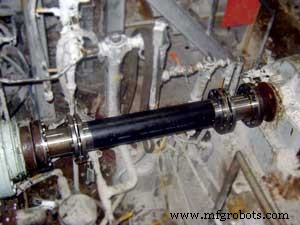
The versatility of disc couplings is shown in a paper plant application.
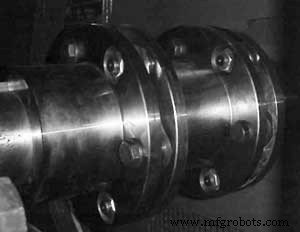
Heavy industry use as shown in a coal pulverizer application.
INSTALLATION TIPS
Proper installation is critical for long life. Mount the hubs and assemble the coupling strictly according to the manufacturer’s catalog and instructions.
Remove burrs, dirt, and grit from shafts and bores to prevent galling of hubs or keys. Avoid concentrated heat that can distort hubs, and tighten locknuts to the specified torque. Loose bolts cause disc bolt hole elongation and eventual failure.
The most common failure mode is fatigue from excessive disc flexure, often caused by poor initial alignment or harsh operating conditions. Alignment must be verified for all three misalignment types: axial, angular, and radial.
- Axial misalignment: Variation in the distance between shafts relative to the coupling’s neutral length.
- Angular misalignment: Effective angle between shafts, measured by the intersection of their extended center lines.
- Radial (parallel) misalignment: Transverse distance between shafts, measured by the overlap of their extended center lines.
Misalignment may arise from machining tolerances, initial setup, movement, settlement, or thermal expansion. In practice, all three types are often present.
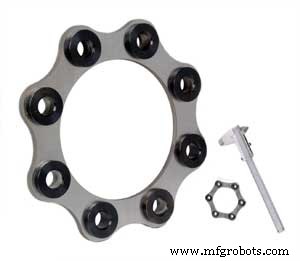
Applications determine disc size. A wide spectrum of sizes is available.
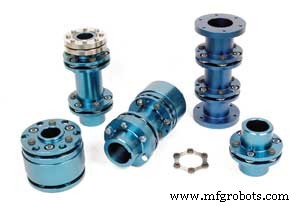
A wide selection of disc coupling configurations are available to fit application requirements.
FLEXIBLE SOLUTION
Disc couplings absorb misalignment through disc deflection. The discs are bolted on a set bolt circle diameter, alternately fastening to the driving and driven flanges. Flexion occurs as bending and twisting between adjacent bolts.
Typically, a single flexible disc handles axial and angular misalignments, while two flexing discs accommodate radial misalignments. The radial misalignment is expressed as the total radial displacement divided by the distance between disc centers, treated as combined angular/parallel misalignment.
The acceptable misalignment depends on transmitted torque and operating speed, due to the coupling’s nonlinear stiffness. Axial thrust from axial misalignment is influenced by the bolting arrangement and speed.
When shaft growth during operation is known, an axial predilection can be introduced by pre‑stretching or pre‑compressing the coupling components during installation, allowing the coupling to operate at its neutral position.
Kevin Remack, Director of Product Management at Lovejoy Inc., manufactures couplings and power‑transmission components. Learn more at www.lovejoy-inc.com, call 630‑852‑0500, or email feedback@lovejoy-inc.com.
Equipment Maintenance and Repair
- Compact Disc (CD): History, Production Process, and Future Trends
- How a Well-Designed PM Program Cuts Downtime in Industrial Plants
- Three Proven Strategies to Drive Reliability Success
- Jaw‑in‑Shear Couplings: Reduce Downtime, Save Time, and Cut Inventory Costs
- Near‑Zero Downtime: Expert Guide to Maintenance Trends and Best Practices
- Optimizing Coupling Lubrication for Reliability and Longevity
- How to Cut Unscheduled Downtime: 2 Proven Strategies
- Can Manufacturers Achieve Zero Downtime? Insights & Strategies
- Reframing Downtime: A Collaborative Approach to Allocation and Analysis
- Prevent Unplanned Downtime in Your Plant: Strategies to Boost Reliability