



Decoding OEM Lubricant Recommendations: A Practical Guide
When a new component is slated for commissioning, the first critical decision is selecting the correct lubricant.
OEM guidance often reads, “Use a high‑quality turbine oil with a viscosity of ISO VG 32.” That statement is a starting point, not a final prescription.
What Is “High Quality”?
The term “high quality” is intentionally vague, but a seasoned technician will interpret it in terms of API base‑oil categories. In the API spectrum, Group II and Group III base oils are refined to remove impurities, offering better performance than Group I and typically commanding a higher price per gallon.
Referencing the comparison chart below (Figure 1), you’ll see the incremental refinement that justifies the cost difference. Because the OEM didn’t specify a synthetic, the implication is that a premium natural base—Group II or Group III—should be chosen.
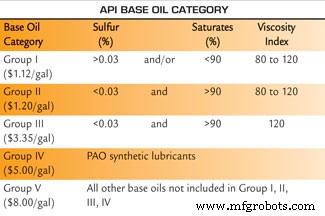
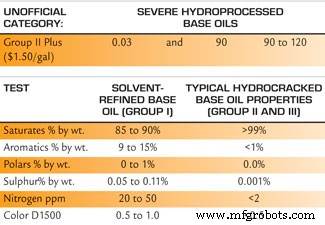
Figure 1 – API Base Oil Groups and Refinement Levels
Clarifying “Turbine Oil”
The OEM’s use of the generic term “turbine oil” signals a lubricant with robust oxidation stability and fortified with rust and foam inhibitors. Most turbine oils on the market are formulated from Group II or Group III bases and contain only the essential additive package needed for high‑temperature, high‑speed applications.
While hydraulic oils may also offer oxidation and rust protection, they often carry additional additives unnecessary for turbine use, potentially affecting cost and performance.
Examining the Environment
OEMs specify a viscosity of ISO VG 32 at 40 °C (104 °F) as a hard requirement. However, this figure is derived under ideal test conditions and may not reflect the ambient temperatures your component will face worldwide. A technician must adjust the lubricant selection to accommodate local operating temperatures, ensuring the oil maintains the target viscosity at the expected extremes.
Conclusion
In summary, the appropriate lubricant is a premium‑quality turbine oil built on a Group II or Group III base, enriched with oxidation, rust, and foam inhibitors, and proven to hold an ISO VG 32 viscosity at 40 °C. Armed with this information, you can confidently source the correct oil and guarantee optimal component performance.
Equipment Maintenance and Repair
- Common Troubleshooting Pitfalls and How to Avoid Them
- Component Failure Analysis: Troubleshooting Techniques for Series and Parallel Circuits
- Advanced Component Failure Analysis: Qualitative Techniques for Troubleshooting Complex Circuits
- Why Filing Maintenance Records at the Component Level Improves Planning Accuracy
- Enhance Your Lubricant Analysis Program for Peak Asset Reliability
- Optimizing Coupling Lubrication for Reliability and Longevity
- What Is an Original Equipment Manufacturer (OEM) and Why It Matters for Industrial Maintenance
- Free Lube Basics Seminar – Expert Training in Automatic Greasing
- Hydraulic Component Wear: 6 Key Causes and How to Prevent Them
- Key Components of a Milling Machine Explained