



How Much Does Your Equipment Really Cost to Operate?
Decisions around energy use and cost savings demand concrete data. Eliminating guesswork and basing choices on measured results can significantly improve your bottom line.
Comparing Two 200‑Horsepower Air Compressors
In a manufacturing plant, two 200‑HP air compressors supplied plant air. Compressor 1 had a slightly higher cubic‑feet‑per‑minute (CFM) rating, so it was designated the primary unit while Compressor 2 served as a “trim” backup.
Because both units share the same horsepower, the expectation was that their electrical operating costs would be nearly identical. A three‑day data‑logger snapshot contradicted that assumption: Compressor 1 averaged just over 50 kW of power, while Compressor 2 was markedly more efficient.
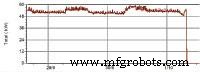
Figure 1. Energy usage graph for a 200‑HP compressor. The quick visual shows an average of ~50 kW over a 72‑hour period, which can be translated into operating cost once the utility rate is known.
Power loggers were installed on each unit for several days, running them independently to eliminate cross‑interference. Compressor 2 proved more energy‑efficient and fully capable of meeting plant demand, thanks to a newer design.
The plant’s rate was $0.07 per kWh. By extracting run‑time and kWh data from the logs, the actual operating costs were calculated in a simple spreadsheet.
Result: Switching the primary role to Compressor 2 generated an estimated annual savings of $29,510—an outcome that would not have emerged from nameplate data alone. A brief investment in power logging delivered a substantial return.
What Is the Cost of Running 50 Grinders During Lunch?
At another facility, management questioned the practice of leaving 50 grinders idling during lunch breaks. The rationale was that the grinders were low‑power loads and that the circulating cutting oil would keep the machines ready for production.
A single grinder’s idle consumption was measured with a digital multimeter equipped with an AC clamp. The result was a negligible $0.55 per grinder per lunch period, totaling $27.50 for all 50 units.
Extrapolated across shift patterns and holidays, the annual savings from shutting the grinders off during lunch were just under $8,000. A simple two‑button procedure—stop before lunch, start after—can unlock this efficiency.
Operational Costs for Larger Motors
Large motors often run continuously, making their operating cost a critical factor. In one plant, a 100‑HP motor pumped water from a holding pond to a cooling system. Continuous operation prompted a review of its annual cost.
Logging the motor’s kilowatt consumption and operating hours revealed near‑full‑load usage. The annual cost was calculated at $33,241, prompting a switch to a more efficient motor and pump assembly.
Relying solely on nameplate data can be misleading; motors rarely operate at their maximum capacity. For instance, a 100‑HP, standard‑efficiency motor at 460 V, three‑phase, running full load for 8,760 h would cost just over $48,000 per year at $0.10/kWh. Real‑world loading patterns can reduce that figure substantially.
Measured data is the only reliable way to assess true operating costs and identify opportunities for savings, such as installing a variable‑frequency drive (VFD).
Figure 2 illustrates data logger readings for the 100‑HP centrifugal pump motor. Over a one‑minute interval, the average power was ~32 kW—well below the expected 80 kW for full load—indicating partial loading and inefficiency. This suggests a VFD could provide significant savings.

Figure 2. Sample power‑logger data imported into a spreadsheet. Average watts were recorded every 10 s.
The Cost of Lighting
Lighting typically represents a substantial portion of a facility’s electricity bill. A 160,000‑sq‑ft industrial site can spend roughly $85,030 annually on lighting alone.
Accurate cost estimates require counting fixtures, noting lamp wattages, and factoring in ballast loads and operating hours. Quick AC‑clamp meter readings of lighting circuits provide immediate data for cost analysis.
A common misconception is that keeping fluorescent fixtures on is always cheaper than turning them off. While a short shutdown can incur a small inrush current, frequent cycling can reduce lamp life. The Department of Energy recommends turning off lights after 15 min of inactivity—shorter in high‑rate regions.
Without measurement, you cannot determine how much forgotten or mismanaged lighting costs. Once quantified, visual signage can raise awareness and encourage energy‑saving habits.
Per‑Hour Cost of Running Equipment
Facility managers often need the hourly operating cost of key machines at various load levels—100 %, 90 %, 80 %, etc. These figures inform decisions such as “Should I use press 5 or press 3 for this batch?”
Energy management hinges on understanding where the electricity goes each month. By logging data for at least one full plant cycle and analyzing it, you can provide precise hourly and annual cost metrics for each piece of equipment.
Data‑driven decisions replace guesswork and enable more effective budgeting and process optimization.
About the author:
Randy Barnett brings 35+ years of industrial electrical maintenance and training. A U.S. Navy Nuclear Power School graduate, he has worked as a journeyman electrician in nuclear and coal‑fired plants, railroads, manufacturing, and construction. Randy is a certified energy auditor and author of "Commercial and Industrial Wiring," "Introduction to Electrical Maintenance," and numerous articles. Contact him at RandyB@americantrainco.com.
Equipment Maintenance and Repair
- How Rubber Is Molded: Processes, Benefits, and Applications
- Comparing Maintenance Employment Costs: Why Outsourcing May Be Cost‑Effective
- Optimal Frequency for Equipment Inspections: A Practical Guide
- Defeating Graffiti: Expert Strategies for Industrial Facility Owners
- How Much Does Lubrication Really Cost? Understanding the True Impact
- Understanding the Mechanics of a Milling Machine
- Mastering Analog Electronics: Essential Knowledge for PCB Design
- Unlocking the Benefits of CNC-Milled Aluminum Enclosures
- Spotting Air Leaks in Your Compressed Air System: Save Money & Boost Performance
- Determining the Horsepower Needed to Run a Hydraulic Pump