



Driving Reliability Through Operations Leadership
 For decades, many plants believed that reliability was solely the purview of a dedicated department. This siloed mindset hinders true operational excellence. Modern, high‑performance facilities recognize that maintenance and reliability must be embedded as integral processes, led by those who own the equipment – the operations teams themselves.
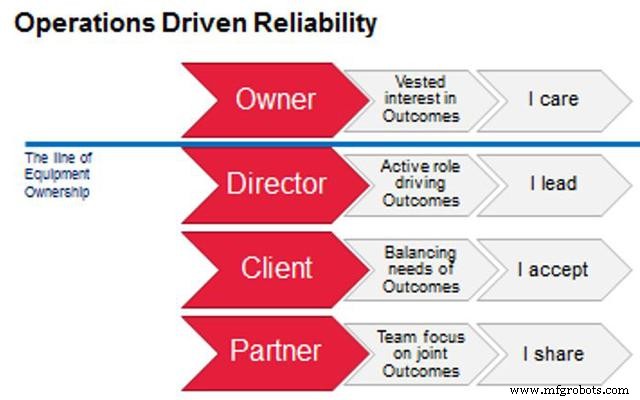
To achieve a truly reliable and efficient operation, every operational function must operate as a cohesive process. Production, maintenance, reliability and technical teams must collaborate, sharing ownership and accountability. In leading organizations, production is not merely the internal client; it is the owner, director and partner of the reliability journey, as illustrated below.
Equipment Ownership
When equipment ownership is clearly understood, best‑practice reliability initiatives flourish. As Charles Bailey, retired VP of Operations at Eastman Chemicals, famously noted, “Reliability cannot be driven by the maintenance organization alone; it must originate from the operating units and be championed by leadership.”
In this model, operations own the equipment and steer reliability. While dedicated reliability teams report to operations, they focus on outcome delivery rather than departmental silos. Their insights inform the owners, driving better outcomes.
Operations must sit at the steering wheel: they know the criticality, the risk, and the losses associated with equipment downtime. Empowered to intervene directly, they can fast‑track fixes, negotiate resource allocations, and align maintenance scope with strategic priorities. Regular approval and constructive feedback further strengthen the service partnership.
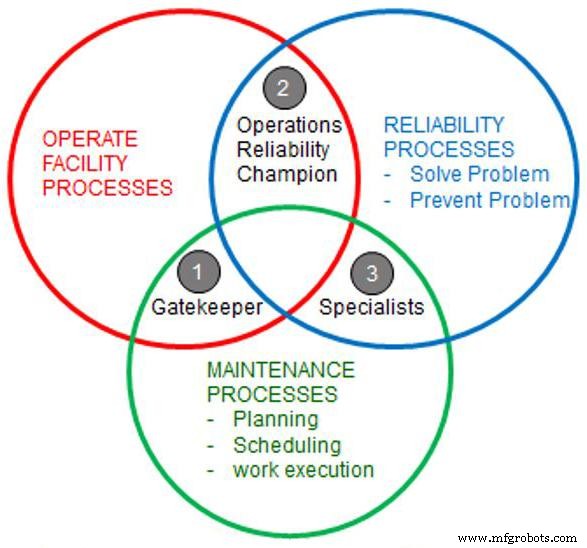
The two pivotal roles in this framework are the Operations Maintenance Gatekeeper and the Operations Reliability Champion (ORC).
The Gatekeeper
Successful organizations implement a disciplined workflow governed by four core principles:
- Maintenance staff do not generate work orders autonomously.
- Equipment owners make decisions on maintenance actions.
- A designated operations gatekeeper orchestrates workflow.
- Only the unit manager can override the gatekeeper.
Gatekeeping establishes a vetted backlog and ensures that maintenance focuses on high‑value, quality execution. The gatekeeper collaborates daily with planners, schedulers and first‑line managers to determine whether a job requires formal planning or can be self‑planned. They provide feedback on notification quality and may decline requests that do not align with profit‑risk objectives.
Ideally, the gatekeeper is an operations professional with intimate equipment knowledge and a history as a first‑line manager. Their authority and confidence are critical for maintaining order, prioritization and cost control.
Operations Reliability Champion
The ORC oversees equipment reliability and other uptime losses, such as quality or process issues. They ask three guiding questions:
- Are our reliability processes targeting the right priorities?
- Who is directing these initiatives?
- How do we track progress?
In progressive plants, reliability professionals do not create work arbitrarily; everyone is focused on a shared goal of problem resolution and prevention. The ORC ensures a healthy problem‑solving culture by chairing reliability engineer meetings, reviewing root cause failure analysis (RCFA) outcomes, and securing management support to eliminate barriers or approve funding.
Additionally, the ORC validates that risk‑based preventive processes are effective. They orchestrate meetings that drive prevention initiatives and align teams toward common objectives.
Ultimately, the ORC owns the losses, mapping every downtime or availability issue to a corrective plan.
Operations‑driven reliability is indispensable for any advanced plant—whether in refining, chemicals, metals, cement or customer‑focused manufacturing. By dissolving silos, it transforms maintenance and reliability from separate departments into essential processes, delivering sustainable results and tangible profit gains.
Equipment Maintenance and Repair
- Reliability: The Comprehensive Guide to Asset Management
- From Maintenance to Reliability: Building a Culture of Predictive Excellence
- Building a Reliability Culture: Ownership, Collaboration, and KPI Success
- Cutting Waste to Boost Equipment Reliability
- Whirlpool’s Reliability Revolution: Elevating Uptime, Productivity, and Profitability
- Raytheon Missile Systems Pursues Reliability Excellence
- Building a Strong Operations‑Maintenance Partnership for Sustainable Production
- Alcoa’s 50‑Year‑Old Smelter Drives Reliability Excellence to Cut Costs and Boost OEE
- The Key to Reliability Success: Culture Change Over Technology
- Reliability‑Centric Sales: Driving Profitability and Reducing Risk