



Optimizing Asset Longevity: Calculating Useful Life and Extending Performance
All physical assets—whether buildings, machinery, vehicles, or inventory—undergo inevitable wear and tear. Understanding how long an asset can reliably serve its purpose is essential for minimizing costly downtime and planning for replacements. By accurately estimating and extending an asset’s useful life, businesses can achieve significant cost savings, enhance safety, and improve financial forecasting.
As the saying goes, a stitch in time saves nine. While decay cannot be entirely avoided, proactive strategies can meaningfully delay it, providing both economic and operational benefits. This guide explores the link between useful life and depreciation, shows how to estimate a realistic useful life, and offers proven tactics for extending the service life of critical assets.
What Is the Useful Life of an Asset?
The useful life of an asset refers to the period during which it can reasonably generate revenue or provide other business benefits. It is a key concept for tangible assets—those with a physical presence such as land, buildings, machinery, furniture, vehicles, tools, and inventory.
Key points:
- A useful life estimate is typically based on a combination of physical wear, economic conditions, and technological obsolescence.
- Assets that are overused, improperly maintained, or exposed to adverse environmental conditions may have shortened useful lives.
- Conversely, preventive maintenance and careful usage can prolong an asset’s operational span.
Useful Life and Depreciation
In accounting, useful life is directly linked to depreciation—the systematic allocation of an asset’s cost over its expected life. When an asset reaches the end of its useful life, it is considered fully depreciated. Depreciation affects the balance sheet, income statement, tax liability, and cash flow, making accurate useful life estimates vital for financial health.
Why Accurate Estimates Matter
Reliable useful life estimates influence several critical business areas:
- Accounting: Depreciation rates shape financial statements and tax calculations.
- Financial Planning: Knowing when major replacements are due informs budgeting and long‑term strategy.
- Maintenance & Safety: Scheduling preventive maintenance based on remaining useful life reduces catastrophic failures.
- Salvage Value: Estimating resale potential at the end of life informs depreciation calculations and investment decisions.
Reaching the end of an asset’s useful life does not mean it becomes worthless. Many businesses recover value through resale, auctions, or repurposing, mitigating financial loss.
Determining the Useful Life of an Asset
Useful life is an estimate, not a precise figure. A conservative approach—assuming at least one year of service—is advisable. Small changes in the estimate can significantly alter depreciation expenses, so diligence is key.
Factors Influencing Useful Life
Consider these internal and external variables when estimating:
- Purchase Condition: New assets typically last longer than pre‑owned ones.
- Usage Patterns: Heavy or sporadic use accelerates wear.
- Climate & Geography: Extreme weather or natural hazards can shorten life.
- Technology: Rapid obsolescence (e.g., computers) reduces useful life.
- Regulatory Compliance: Environmental and safety standards may mandate earlier replacement.
Maintenance professionals should monitor condition and adjust estimates when necessary.
Standard Useful Life Guidelines
In the United States, the IRS provides depreciation tables for most tangible asset classes. Industry bodies such as the Building Owners and Managers Association (BOMA) and RSMeans offer additional benchmarks for real estate and construction assets. These guidelines serve as a starting point; adjust them to reflect your unique circumstances.
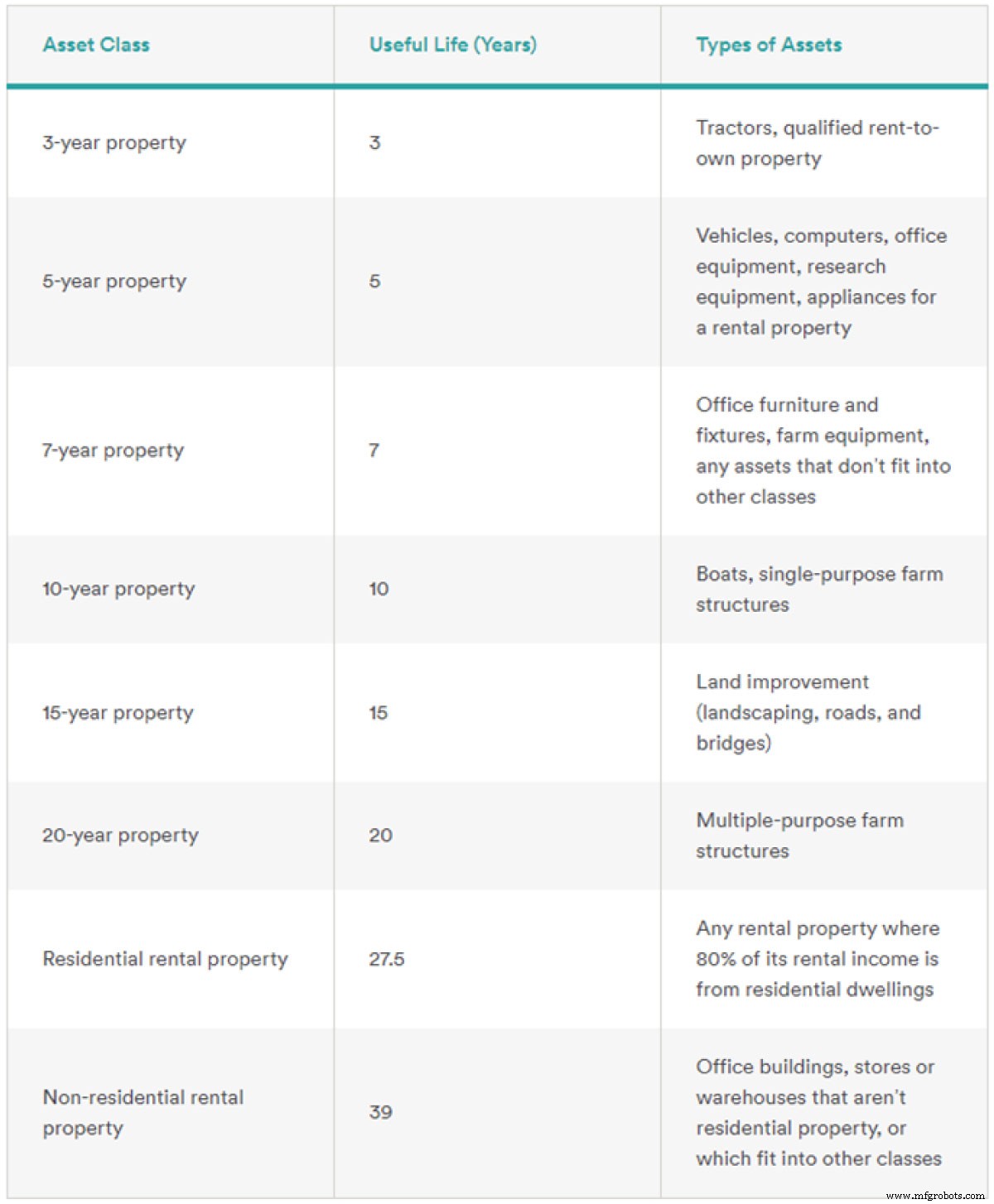
Image source
Calculating Useful Life and Depreciation
Depreciation can be calculated using two main methods: straight‑line and accelerated. Before you begin, gather:
- Asset Cost: Total acquisition cost, including purchase price, transportation, installation, and training.
- Estimated Useful Life: Derived from IRS tables, industry guidelines, or OEM manuals.
- Salvage Value: Expected resale price at the end of service life.
Straight‑Line Depreciation
This method spreads the cost evenly over the useful life, producing a constant annual depreciation expense.
Example: Commercial Building
A new warehouse costs $1,000,000, with land valued at $200,000. The depreciable amount is $800,000. Over a 30‑year life, annual depreciation is $26,666.
Accelerated Depreciation
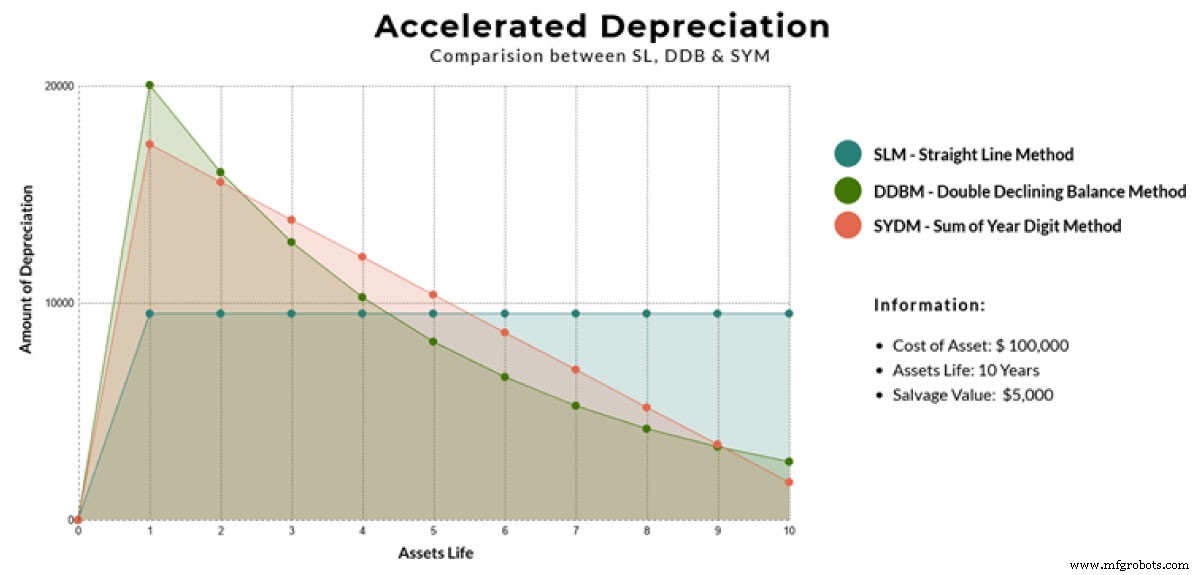
Image source
Accelerated methods (e.g., Double‑Declining Balance, Sum‑of‑Years’ Digits) front‑load depreciation to reflect rapid early‑life value loss, ideal for technology or high‑usage equipment.
Example: CNC Machine
A $200,000 CNC machine has a 10‑year life and a $20,000 salvage value. Straight‑line annual depreciation is $18,000 (9%). Using a 150% accelerated rate yields 13.5% first‑year depreciation of $27,000, decreasing annually as the book value declines.
- Year 1: $27,000
- Year 2: $23,350
- Year 3: $20,190
- …
- Year 10: $7,317
At year 10, the machine’s book value is $46,935, with the difference to salvage ($26,935) expensed in the accounts.
Five Best Practices to Extend Asset Life
- Proactive Maintenance: Implement preventive and predictive maintenance using a CMMS to schedule timely tasks and reduce breakdown risk.
- Operator Training: Provide comprehensive training and onboarding for heavy‑machinery operators to prevent misuse.
- Follow OEM Guidance: Adhere strictly to manufacturer manuals and adjust operating parameters for your environment.
- Right‑Asset Selection: Conduct thorough due diligence during procurement to ensure the asset matches operational needs.
- Use Original Parts: Source spare parts from authorized dealers or vendors to maintain quality and performance.
Some assets, such as fire extinguishers and smoke detectors, have mandatory replacement timelines regardless of condition. Even then, proper maintenance ensures they reach their intended lifespan.
Conclusion: Care for Your Assets, They’ll Care for You
Optimal asset performance hinges on disciplined maintenance and accurate life‑cycle planning. By combining rigorous depreciation calculations with proactive upkeep, businesses can reduce costs, enhance safety, and boost productivity.
Any organization committed to efficiency must prioritize asset care; neglecting it jeopardizes operations and profitability.
Equipment Maintenance and Repair
- How Acid Dyes Work and Their Key Applications
- Strengthening IIoT Asset Tracking: Proven Security Practices
- 12 Essential Maintenance Templates to Streamline Operations and Reduce Admin Burden
- RONA & OEE: The Key Metrics for Asset Utilization & Profitability
- How to Accurately Estimate CMMS Software Costs & ROI
- Asset Utilization Explained: How to Measure and Maximize Returns
- Prolonging PCB Lifespan: Proven Strategies to Reduce Repairs
- Maximizing Machine and Component Longevity: Smart Strategies for Manufacturers
- Mastering Machine Availability: Calculation & Enhancement Strategies
- Proactive Maintenance Explained: Benefits & How It Differs from Reactive Strategies