



How to Accurately Estimate CMMS Software Costs & ROI
At Fiix, the most frequent question we receive is, “How much does a CMMS cost?” A close second is, “What is the ROI of CMMS software?” These are both critical questions—and they’re not straightforward to answer because the cost and value of a CMMS vary widely based on your organization’s specific needs.
This article provides a practical framework for understanding the key drivers that influence CMMS pricing and how to measure the return on investment. If you’re still exploring what to look for in a CMMS, we recommend reading our CMMS Buying Guide first.
Table of contents
- Six factors that influence CMMS costs
- Calculating the ROI of CMMS software
- Why one size does not fit all for CMMS pricing and ROI
Six factors that influence CMMS costs
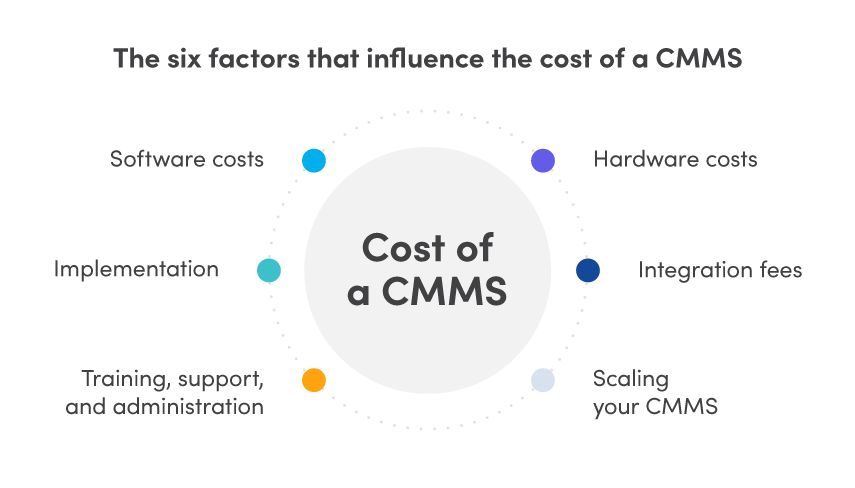
Software subscription fees
Most cloud‑based CMMS solutions charge a recurring subscription fee. Fees are typically billed annually, but monthly or quarterly options are common. The cost scales with the number of users and the tier of functionality you select—higher tiers unlock advanced reporting, customization, and dedicated support.
- How many users will need access?
- Which features are essential for your maintenance workflow?
- What level of vendor support do you require?
Implementation costs
Implementation includes both direct and indirect expenses: configuring the system, migrating existing data, setting up preventive maintenance (PM) schedules, and integrating with other enterprise tools. Most vendors bill by the hour or offer a packaged implementation fee. A detailed scope of work should outline the effort required based on asset count, PM complexity, and inventory size.
Training, support, and ongoing administration
Training and support are often bundled with the subscription, but additional hours may incur an extra charge. The amount of training needed depends on staff familiarity with digital tools and the speed at which you want to reach full productivity. Ongoing administration—adding new users, generating reports, and refining PM schedules—requires dedicated time from your maintenance team.
When budgeting for these services, consider:
- Team proficiency with CMMS interfaces
- Desired ramp‑up time
- Number of active users
- Future expansion plans
Hardware investments
While cloud CMMS is software‑centric, mobile devices—tablets or smartphones—are often required for field technicians. Many vendors provide a dedicated mobile app that works on consumer‑grade hardware. Consult your CMMS provider to identify the devices that deliver the best user experience and return on investment.
Integration fees
Integrating a CMMS with existing systems—such as ERP, SCADA, or production‑line equipment—enhances data flow and cross‑departmental collaboration. Integration costs vary: some vendors include standard ERP connectors in the subscription, while custom integrations may require an additional fee. Identify the systems you need to connect, then discuss the integration options and associated costs with potential vendors.
Scaling your CMMS
As your organization grows, so will your CMMS requirements. Anticipate higher subscription fees if you expect the maintenance team to double over the next five years. Additional training, support, and hardware may also be necessary, especially if you expand to multiple sites. Finally, you may need to move to a higher subscription tier to access advanced analytics, enhanced security, and more robust reporting capabilities.

Calculating the ROI of CMMS software
Estimating ROI is complex because the benefits vary by organization. The following categories outline where a CMMS can deliver measurable value. Use your baseline data to quantify improvements in each area.
Downtime reduction
Unplanned downtime can cost from thousands to millions of dollars annually. A CMMS helps reduce downtime by:
- Quantifying the cost per hour of downtime.
- Tracking downtime before and after implementation.
- Identifying failure patterns and the impact of preventive actions.
Labor cost savings
Streamlining maintenance workflows cuts labor expenses. Key questions to answer include:
- Are fewer unplanned breakdowns leading to reduced overtime or contractor use?
- Has the ratio of planned to reactive maintenance increased?
- Has data entry time decreased with digital reporting?
- Are mobile notifications accelerating task completion?
- Has overall labor productivity improved?
Inventory optimization
A CMMS can lower inventory spend by:
- Reducing emergency parts purchases through scheduled maintenance.
- Setting reorder points to avoid overstock.
- Improving part location visibility to cut labor and downtime.
Asset life and performance
Ensuring timely maintenance extends asset lifespan and boosts performance, resulting in:
- Higher machine availability and throughput.
- Longer asset life, delaying capital replacement.
Remember, ROI varies with your specific operations and objectives.
Business sustainability and success
Beyond the shop floor, a CMMS supports:
- Reduced utility costs through efficient equipment use.
- Simplified audits and compliance with industry regulations.
- Timely product shipments, enhancing customer satisfaction.
Ready to ask your boss for a CMMS? Nail the pitch with this free presentation template
One size does not fit all for CMMS pricing and ROI
CMMS solutions span a wide price spectrum—from free, open‑source options to enterprise suites that run into hundreds of thousands of dollars annually. Each tier offers distinct features, scalability, and value propositions. To choose the right fit, analyze your organization’s unique goals, workflows, and budget constraints. Engage with multiple vendors, request detailed proposals, and evaluate the total cost of ownership—including software, implementation, training, hardware, and integration expenses—against the anticipated ROI.
Equipment Maintenance and Repair
- Cloud vs On‑Premise CMMS: Which System Delivers the Best ROI?
- How to Justify the Cost of a CMMS: Calculating ROI for Maintenance Managers
- 7 Proven CMMS Tips to Accelerate Setup and Boost Productivity
- Asset Utilization Explained: How to Measure and Maximize Returns
- Optimizing Asset Longevity: Calculating Useful Life and Extending Performance
- Calculate CMMS ROI: A Practical Guide to Measuring Maintenance Software Value
- Calculating ROI for Metal 3D Printers: A Practical Guide
- Calculating ROI for the Metal X 3D Metal Printer – A Practical Guide
- Affordable CMMS Software Pricing: What to Expect
- Maximize Facility Efficiency: How CMMS Software Safeguards Value & Reduces Costs