



Reliability‑Centered Maintenance (RCM): A Maintenance Manager’s Blueprint for Cost‑Effective Asset Performance
Ever wonder if your equipment is operating at peak efficiency? Are you looking to boost productivity while trimming maintenance expenses? Reliability‑Centered Maintenance (RCM) offers a proven framework to identify and eliminate the root causes of downtime.
What is Reliability‑Centered Maintenance?
RCM is a systematic evaluation method that pinpoints which maintenance practices deliver the best return on investment for each piece of machinery. It’s not a maintenance technique itself; rather, it is the decision‑making engine that guides you toward the most effective strategy—whether preventive, predictive, or reactive.
When applied correctly, RCM can transform your company’s bottom line. According to EBSCO, businesses that adopt RCM programs report an average return on investment of 63%.
“63% ROI after launching a reliability‑centered maintenance program.” – EBSCO
How to Perform an RCM Analysis
The Society of Automotive Engineers (SAE) standard JA1011 provides a concise set of questions that guide the RCM process. Below, we illustrate these questions using a real forklift case study.
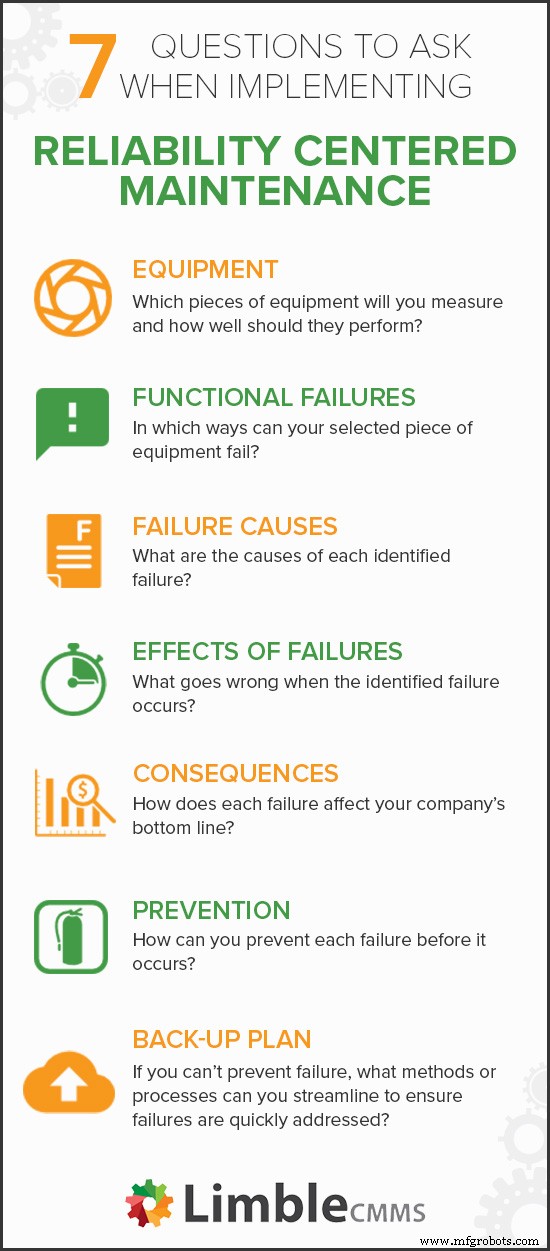
Question 1: What are the functions and desired performance standards of the asset in its current operating context?
Identify the equipment that has the highest value and causes the most disruption when it fails. Gather performance data from your production crew and maintenance logs (or CMMS). Example:
Forklift #3 moves 18 pallets per hour at peak capacity. Current MTBR is 800 hrs with 6 hrs of average downtime. Running 40 hrs per week, this translates to a critical breakdown every 20 weeks, costing the loss of 108 pallets. Industry benchmarks suggest an MTBR of 1,200 hrs for similar forklifts; a 50% MTBR improvement would recover an additional 54 pallets every 20 weeks.
Question 2: In what ways can the asset fail to fulfill its functions (functional failures)?
Compile a list of possible failure modes based on historical data and expert insight. Example for the forklift:
- Human error
- Fork malfunction
- Engine malfunction
Question 3: What causes each functional failure (failure modes)?
- Human error – poor training
- Fork malfunction – inadequate maintenance or operator misuse
- Engine malfunction – neglected oil changes and other routine care
Question 4: What happens when each failure occurs (failure effects)?
- Human error – accidents, spillage, injuries, productivity loss
- Fork malfunction – equipment damage, increased labor, higher repair costs, productivity loss
- Engine malfunction – similar impact as fork failure
Question 5: What are the financial consequences of each failure (failure consequences)?
- Labor & repair – $25/hr labor, $500 average parts
- Equipment damage – $800 per incident (shortened lifecycle)
- Productivity loss – $300/hr during downtime
- Accidents – safety violations, injuries, potential thousands in damages
For example, an engine failure causing 6 hrs of downtime would cost roughly $3,250 (labor, parts, lifecycle loss, and productivity). Knowing these figures enables precise cost forecasting.
Question 6: What proactive tasks and intervals can prevent each failure?
Design preventive or predictive interventions that address the root causes. In our example, replacing filters quarterly and performing oil changes can prevent engine failures that cost $3,250 per incident. If preventive measures are not viable, consider a run‑to‑failure strategy and plan for rapid replacement or rental solutions.
Question 7: What actions can be taken if a suitable proactive task is unavailable (default actions)?
When preventive options are limited, develop contingency plans. For an aging forklift, schedule spare units or establish a rental agreement to mitigate downtime during inevitable breakdowns.
Implementing RCM‑Driven Maintenance Strategies
After completing the RCM analysis, translate insights into a concrete maintenance plan. The most common approaches include:
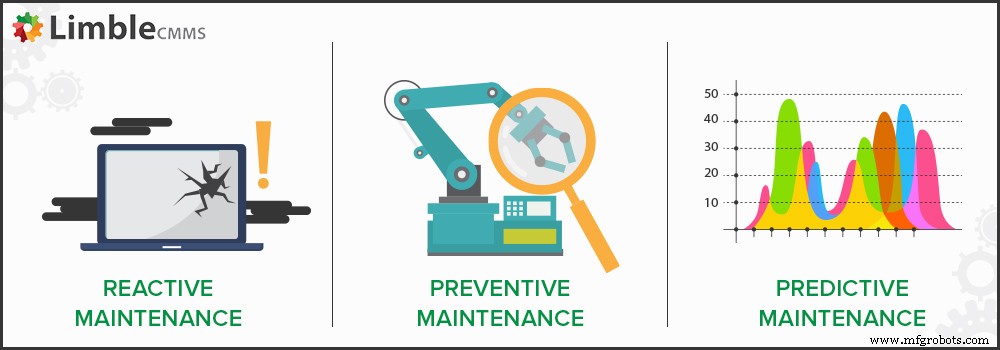
Run‑to‑Failure / Reactive Maintenance
Fix equipment only after a failure occurs. This approach can be cost‑intensive but is sometimes unavoidable. RCM helps you decide when reactive maintenance is acceptable.
Preventive Maintenance
Schedule routine service while equipment is operational to reduce the likelihood of breakdowns. Studies show preventive maintenance can yield returns up to 545%.
Implementation Steps:
- Select high‑value assets with significant repair costs.
- Determine the maintenance schedule from manufacturer guidelines or online resources.
- Collaborate with production and maintenance staff to align service windows.
- Deploy the plan—manually or via a CMMS—and gradually expand coverage.
Predictive Maintenance
Use real‑time condition monitoring to service equipment only when needed, based on actual wear and performance indicators.
Research shows predictive maintenance can reduce preventive tasks by 15% and overall downtime by 1–2%.
Implementation Steps:
- Identify high‑risk equipment for predictive upgrades.
- Invest in appropriate sensors and analytics software.
- Integrate data streams with your CMMS for automated alerts.
- Train technicians to interpret sensor outputs and schedule interventions.
Conclusion
Reliability‑Centered Maintenance equips maintenance managers with a data‑driven framework to prioritize actions, reduce unexpected downtime, and protect profitability. If you’re ready to elevate your maintenance operations, explore Limble CMMS for tools that support RCM implementation.
Equipment Maintenance and Repair
- Reliability: The Comprehensive Guide to Asset Management
- From Maintenance to Reliability: Building a Culture of Predictive Excellence
- Building a Reliability Culture: Ownership, Collaboration, and KPI Success
- Condition‑Based Maintenance: The Definitive Guide to Predictive Asset Care
- Enhancing Plant Reliability Through Collaborative Operations and Maintenance
- Mastering FMEA: A Maintenance Manager’s Step‑by‑Step Guide to Building and Using Failure Mode and Effects Analysis
- Your Comprehensive Guide to Expert Property Maintenance
- Mastering Reliability Centered Maintenance: 5 Essential Principles for Peak Equipment Performance
- Three Proven RCM Strategies to Boost Reliability for Oil & Gas Operations
- Implementing Reliability Centered Maintenance (RCM): A Proven Guide