



Maximizing Drive Chain Longevity: Expert Maintenance Tips
By Tim Morrison
In the field of drive‑chain upkeep, several factors can drastically shorten a roller chain’s useful life. Premature failures not only disrupt production but also erode a manufacturer’s profitability through costly downtime.
When selecting chains, businesses should look beyond the sticker price and focus on total cost of ownership. A premium brand that offers long‑term savings and fewer replacements ultimately protects the bottom line.
Among the most damaging conditions are inadequate lubrication, misaligned sprockets, and improper chain selection.
Lubrication
Like any metal pair in contact, a chain’s pin and bushing slide against one another. Continuous engagement wears the pin’s outside diameter and enlarges the bushing’s inside diameter, gradually increasing the pitch between links. This phenomenon, known as chain stretch, is illustrated in Fig. 1 below.
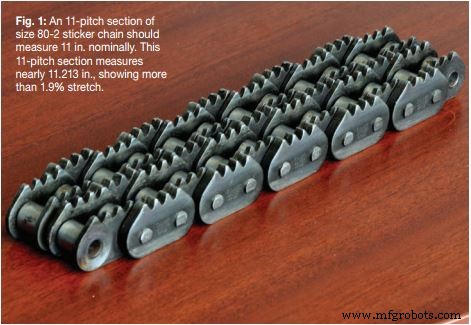
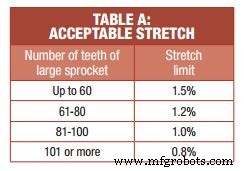
As stretch progresses, the pitch grows so that rollers crawl up the sprocket tooth face, eventually causing a tooth jump. The permissible stretch varies with the sprocket tooth count (see Table A) and is capped at 2% for conveyor applications.
The most reliable ways to curb chain stretch are: 1) proper lubrication and 2) using a self‑lubricating chain.
Proper Lubrication
Select a lubricant whose viscosity allows it to reach the critical pin‑bushing interface. Effective lubrication can dramatically extend chain life. Depending on drive speed, oil may be applied manually, via an oil bath, or by forced injection.
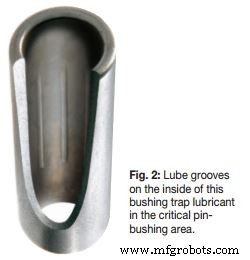
Regular cleaning is essential—debris can block lubricant flow and accelerate wear. Chains featuring retention grooves or other design aids trap oil in the pin‑bushing area. Tsubaki’s exclusive lube grooves, for example, are shown in Fig. 2.
Self‑Lubricating Chain
When conventional lubrication is impractical, a self‑lubricating chain such as Tsubaki’s Lambda series is ideal. Lambda employs an oil‑impregnated sintered metal bushing that releases a protective film as the pin engages the bushing, effectively preventing wear. In comparison to a non‑lubricated chain, Lambda can extend service life by up to 14×.
Lambda offers equivalent performance to a well‑lubricated chain without the ongoing maintenance cost, making it suitable for contaminant‑heavy environments, strict sanitary conditions, or where accidental product contact must be avoided.
Sprocket Considerations
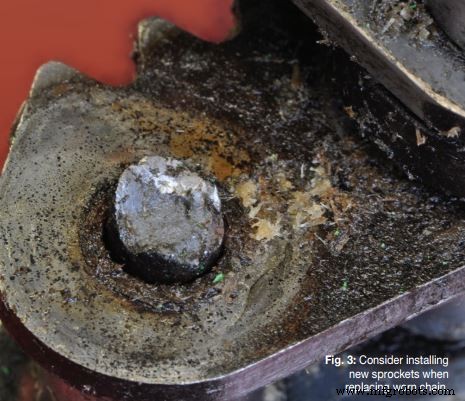
Operating a chain on misaligned sprockets introduces a lateral load that forces the pin to contact the bushing off‑center. This concentrates bearing pressure and often results in pin shear at the bushing edge, as illustrated in Fig. 3.
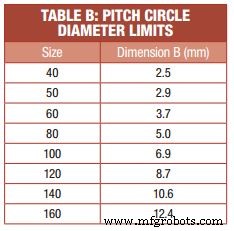
When replacing chains, also inspect sprockets. Worn sprocket teeth reduce the effective pitch circle diameter (PCD), lowering the load capacity. Replacing only the chain on a worn sprocket yields diminishing returns; repeated chain swaps can drastically reduce overall life. Verify that the tooth thickness at the PCD remains above the minimum specified in Table B.
Chain Selection
Failure often begins at the selection stage. Evaluate the chain’s historical performance: does it wear out or break? If it stretches, is proper lubrication feasible? Is the chain sized to handle the required horsepower or pull load? Consider tensile strength, maximum allowable load, and the nature of the operational environment.
For chains that break, determine whether tensile or fatigue failure is at play. Super chains, engineered for shock loads, may be preferable, though they trade off wear resistance. A thoughtful, data‑driven selection process—ideally in partnership with a specialist manufacturer—ensures the right chain is chosen from the outset.
Tim Morrison is the Technical Support Manager for Tsubaki of Canada Ltd., Mississauga, ON. For more information, visit www.tsubaki.ca.
Find the original article on the MRO Website
Equipment Maintenance and Repair
- 6 Expert Tips to Maximize Your Preventive Maintenance Program
- Extending Bearing Life with Expert Grease Lubrication Strategies
- Choosing the Optimal Drive System: Chain, V‑Belt, or Synchronous Belt
- Maximizing Roller Chain Longevity: Expert Strategies for Extended Wear Life
- Choosing the Optimal Drive System: Cost and Performance Insights
- Do Drive Chains Truly Need Lubrication? Inside Modern Lube‑Free Technologies
- Expert Repair Insights: Resolving Gettys DC Drive Controller Failures
- Resolving the 'C Axis Drive Not OK' Error on Osai-Prima Electro Servo Drive 97942050N
- Chain Drive vs Gear Drive: A Comprehensive Comparison
- Belt vs Chain Drives: Key Differences Explained