



Extending Bearing Life with Expert Grease Lubrication Strategies
SKF’s research and development team focuses on mastering grease lubrication to prevent the most common bearing failures—improper lubrication. By blending in‑house analytical capability with industry‑leading testing rigs, SKF delivers solutions that enhance reliability, reduce energy consumption, and support sustainable operations.
Grease Lubrication for Bearing Applications
While an ideal bearing would be free of lubricant, a grease layer is essential to separate rolling elements from raceways, preventing micro‑slip damage. Grease offers a self‑healing film, corrosion protection, and lower friction compared with oil, provided it is of high quality and applied correctly.
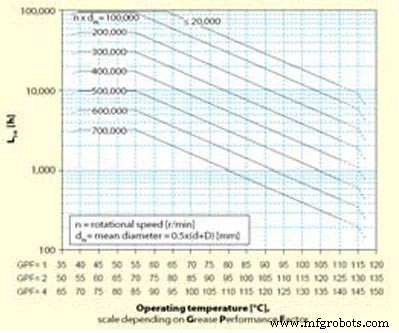
Unlike bearings, grease has a finite life. SKF’s empirical model calculates the relubrication interval for a “good‑quality grease” and, through the Grease Performance Factor (GPF), predicts life for a wide range of greases. A GPF of 1 represents the baseline quality; greases with GPF > 1 outperform the standard. See Figure 1 for life versus temperature, speed, and quality.
Temperature Performance and Relubrication
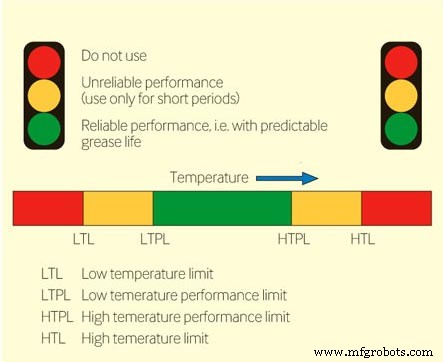
SKF recommends operating greases within a “green zone” defined by a traffic‑light concept. Temperatures beyond this zone are acceptable only for brief periods. Extended exposure to high or low temperatures, mechanical loading, aging, or contaminants accelerates grease degradation. Relubrication decisions hinge on grease type, quantity, and frequency—factors governed by the operating environment and delivery method (manual, automatic, or centralized).
Grease Lubrication Physics
Predicting grease performance requires an understanding of both chemistry and fluid dynamics. Grease behaves as a non‑Newtonian fluid; its rheology, thermal aging, and oxidation of base oil and thickener determine film formation and longevity. Elasto‑hydrodynamic lubrication (EHL) concepts, adapted to grease, explain how contact deformation facilitates film build‑up, while “starved EHL” highlights the role of thickener particles. Figure 3 shows a greased contact via interferometry, illustrating the non‑smooth film profile.

Statistical analysis, particularly Weibull distributions, is employed to assess bearing and grease life data, accounting for the inherent variability of failure events.
Grease Testing Infrastructure
SKF’s R0F and R2F test rigs, upgraded to R0F+, replicate realistic operating conditions—load, speed, and temperature—across a large fleet of tests. These rigs, alongside functional tests (start‑up torque, friction, corrosion, vibration, and noise), provide comprehensive data. A state‑of‑the‑art chemical laboratory supports rigorous analysis.
Product Development Leveraging Grease Knowledge
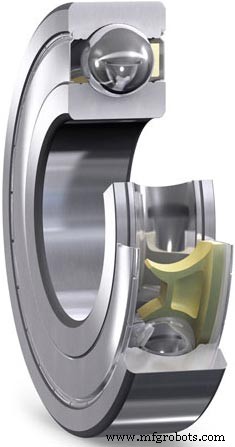
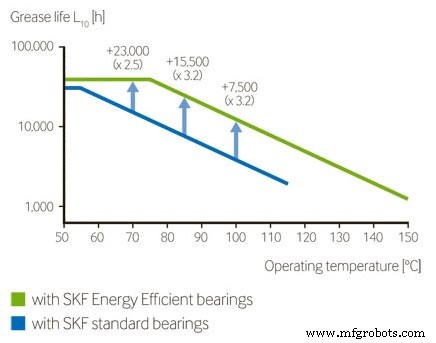
Advanced grease insights feed directly into bearing design. SKF’s Energy Efficient (E2) deep groove ball bearings, shown in Figure 5, achieve at least 30 % lower friction and consume less lubricant. Figure 6 demonstrates that greasing life—and thus bearing service life—is doubled compared to standard bearings, thanks to improved grease, geometry, and cage design.
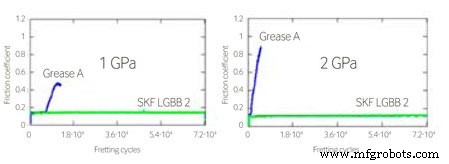
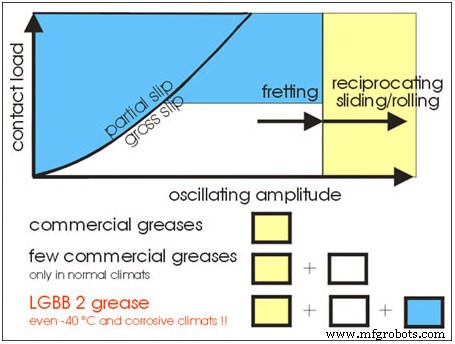
Wind‑turbine blade and yaw bearings benefited from a new grease (SKF LGBB 2) with anti‑false brinelling properties. Figure 7 shows friction monitoring over oscillations, revealing the superior tribo‑layer of the new grease. Figure 8 maps operational windows for greases under blade‑bearing conditions, highlighting the anti‑fretting performance of SKF LGBB 2 at low temperatures.
For paper‑mill bearings, SKF introduced a polymer‑thickened grease that replaces traditional soap thickeners with a non‑polar polypropylene network. This design yields extended relubrication intervals, lower energy consumption in production, and excellent low‑temperature performance.
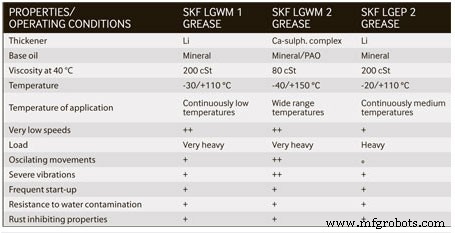
Wind‑turbine main‑shaft bearings face extreme loads, low speeds, and oscillatory motion. SKF offers three greases tailored for offshore and cold climates, each vetted by major OEMs. Table 1 summarizes their key properties.
Conclusion
By integrating rigorous R&D, predictive modelling, and product innovation, SKF extends bearing life, reduces friction, and lowers energy consumption. The resulting longer service intervals translate into less maintenance and diminished waste—key drivers of sustainable industrial practice.
References
- E. Ioannides, G. Bergling, and A. Gabelli. An analytical formulation for the life of rolling bearings. Acta Polytechnica Scandinavia, Mechanical Engineering Series, Finnish Academy of Technology, (137), 1999.
- P.M. Lugt. A review on grease lubrication in rolling bearings. Tribology Transactions, 52(4):470-480, 2009.
- B. Huiskamp. Grease life in lubricated-for-life deep groove ball bearings. Evolution, 2:26–28, 2004.
- A. van den Kommer and J. Ameye. Prediction of remaining grease life— a new approach and method by linear sweep voltammetry. Proceedings Esslingen Conference, pages 891–896, 2001.
- M.T. van Zoelen, C.H. Venner, and P.M. Lugt. Prediction of film thickness decay in starved elasto-hydrodynamically lubricated contacts using a thin-film layer model. Proceedings of the Institution of Mechanical Engineers. Part J, Journal of engineering tribology, 223(3):541-552, 2009.
- T. Andersson. Endurance testing in theory. Ball Bearing Journal, 217:14–23, 1983.
- D. Meijer, D. Polymer thickened lubricating grease. European Patent Application (EP 0 700 986 A3), 1996.
- SKF General Catalog, 6000/I (2008)
Equipment Maintenance and Repair
- Launching a Successful Lubrication Program: Expert Guidance for Reliability
- How Incorrect Greasing Can Trigger Bearing Failure
- Optimizing Machinery Lubrication for Maximum Uptime and Cost Savings
- To Grease or Not to Grease: Best Practices for Electric Motor Bearing Lubrication
- Maximizing Bearing Longevity in Food Processing Operations
- The Three‑Barrier Solution: Enhancing Bearing Longevity in Harsh Environments
- Grease vs. Oil: Selecting the Optimal Lubricant for Linear Bearings
- Maximizing Drive Chain Longevity: Expert Maintenance Tips
- How to Extend Bearing Life: Proven Repair Strategies and Savings
- 11 Expert‑Verified Bearing Myths Debunked: How to Avoid Common Failures