



Essential Electric Motor Maintenance: Preventing Failures and Extending Lifespan
In modern manufacturing, electric motors are ubiquitous, powering everything from conveyor belts to CNC machines. Their simplicity and reliability make them easy to overlook, yet neglect can lead to costly downtime. By adopting a few proven maintenance practices, you can dramatically reduce rebuilds and replacements.
Ensure New and Rebuilt Motors Are in Prime Condition
Before deployment, perform these checks:
- Vibration Analysis: Verify no more than 0.05 in.-per-second (0–120,000 cpm) overall. Excess vibration often signals imbalance or bearing wear.
- Mechanically Balanced Rotors: Request balanced motors, especially for high‑efficiency, high‑speed units. ISO 9001 specifies tolerance limits: G‑6.3 for ≤ 100 hp or less critical motors, and G‑2.5 for high‑hp, vertical or critical applications.
- Proper Storage: Store with bearings fully greased or lubricated, keeping the motor in a dry, temperature‑controlled area. This prevents moisture ingress and corrosion.
Monthly Shaft Rotation
Turning the rotor by hand once a month keeps the bearings from developing fretting corrosion—a wear process that can create misleading brinelling marks.
Careful Bearing Handling
When a bearing needs replacement:
- Store in Original Packaging: Keep bearings horizontally in a dry location, never on a dirty surface.
- Rotate During Storage: For greased units, periodically turn sealed bearings to distribute the grease evenly.
- Use Identical Bearings: Match OEM specifications. Contact your authorized distributor for interchange data.
- Do Not Wash New Bearings: Bearings arrive clean and pre‑lubricated; washing removes the protective coating.
Installation Best Practices
Handle bearings gently—avoid dropping or hammering. If a vise is required, shield the shaft with a soft metal sheet. Inspect shafts and housings for nicks or burrs; remove them with emery paper. Replace any components that show visible wear.
Prevent Overheating: Do not expose bearings to direct flame, and keep temperatures below 446 °C (230 °F). During heat‑mounted operations, clamp the bearing to the shaft shoulder until it cools and locks in place.
Ensure Proper Press Fit: For bearings 100 mm (4 in.) in outer diameter, use a press to apply even pressure to the outer race. Uneven force can damage raceways.
Use Correct Tools: Selecting the right installation tools reduces the risk of damage and speeds the process. Consult your bearing supplier for guidance.
Lubrication & Condition Monitoring
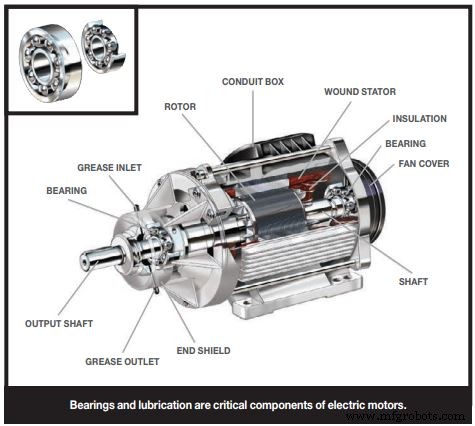
Grease‑lubricated bearings protect against wear, corrosion, and contamination. However, overgreasing is a leading cause of failure—over 90 % of bearing faults arise from excessive grease, which can also rupture seals and allow grease to enter windings.
Adopt stringent alignment limits; misalignment accelerates wear, especially in large, high‑speed motors. Keep the motor clean—dust or process materials can act as insulation, generating heat that shortens bearing life.
Monitor the three key indicators of improper lubrication: excessive noise, abnormal vibration, and elevated temperature. Regular checks help catch problems early. If failures recur, investigate installation or lubrication practices with your supplier’s experts and your lubrication engineer.
By following these proven steps, you’ll extend motor life, reduce downtime, and maintain a safe, efficient operation.
Equipment Maintenance and Repair
- Ball Bearings: Evolution, Manufacturing, and Quality Assurance
- Preventing and Managing Unplanned Downtime to Maximize Plant Efficiency
- To Grease or Not to Grease: Best Practices for Electric Motor Bearing Lubrication
- AEGIS iPRO Rings Cut Bearing Failures, Boosting Uptime at Monarch Cement Plant
- Preloading Ball Bearings: Boost Precision, Reduce Noise, and Enhance Performance
- How to Extend Bearing Life: Proven Repair Strategies and Savings
- Understanding Bush Bearings: Types, Functions, and Applications
- Radial Bearings Explained: Types, Applications, and Performance
- Mechanical Bearings Explained: Function, Types, and Applications
- A Comprehensive Guide to Mechanical Bearings: Function, Types, and Applications