



Understanding Tack Hammers: A Guide for Precision Nailing
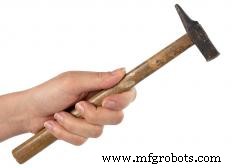
Nailing in tacks and small nails with a regular size hammer can be difficult. To avoid breaking tacks or small frames, a tack hammer allows greater precision. Also known as an upholstery hammer, a tack hammer is a lightweight tool, ideal for small or delicate projects.
Tack hammers are usually composed of a ten-inch wooden handle and a small head. The head usually weighs five to eight ounces, which is much lighter than a regular hammer. In order to secure the tacks safely and precisely, one face of the hammer may be slotted and magnetized to start nails, as well as to pick up fallen tacks. If not magnetized, a tack hammer may have a small nail-removing claw attached. The flat "head," on other side of the hammer's face, is used to drive the tacks into the project.

During tack hammer selection, it can be beneficial to try out different sizes in person for a correct and comfortable fit. Many tack hammers come with a lifetime warranty. Handles are often lacquered with a clear finish to avoid splinters or chipping in the wood. With frequent use over time, the handle may still break or crack.
A forged head is also common in tack hammers. Heads made of cast steel may break more easily than other designs, which can pose a potential hazard should chips break off and hit the bearer during use. Should the head of a tack hammer become loose, it is possible to fix it by driving wedges into the top. This can also be remedied by replacing the handle. If the head itself chips, for safety purposes it should not be used, and replaced instead.
There are also small plastic fastening devices available for purchase to use in conjunction with tack hammers. These hold nails with a friction grip to help create a straight, clean drive into the wall. They also help protect fingers from accidental injuries during hammering.
Fastening fabric to furniture frames is a common use for tack hammers. They can also be used in the carpentry profession for molding, trim work, and cabinet work, as well. A tack hammer may also be used in any project requiring small nails or tacks, from framing to picture-hanging.
When an upholstery tack hammer is not available for use, staple guns and cross-peen hammers make useful substitutes. Cross-peen hammers are a similar size and shape to tack hammers. They have a double-striking head with two faces. One face is flat while the other is round.
Industrial equipment
- Diamond Turning: Precision Machining for Advanced Optics and Beyond
- What Is a Hammer‑Head Screw? Function, Features, and Key Applications
- Understanding the Oxygen (O2) Sensor: Role, Placement, and Failure Signs
- Understanding AS9100: The Aerospace Quality Management Standard
- What Is A2 Steel? A Versatile, Cost‑Effective Tool‑Steel Grade for Industrial and Woodworking Applications
- Understanding Metal Casting: Process, Benefits, and Applications
- Demystifying 3D Printing: A Clear Guide for Innovators
- Pneumatic Hammers: Powerful Air-Driven Tools for Concrete, Asphalt, and Tile Work
- Electric Hammer: How It Works & Why You Need It
- Decoding 'N' in Pump Calculations: Its Role and Significance