



5 Essential Types of T‑Handles: What Every Operator Should Know
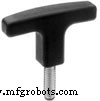
T‑handles deliver a natural, ergonomic control experience for a wide range of machinery. Their iconic T‑shaped design lets operators grip the top and twist the handle to engage or disengage the connected equipment. While the basic geometry remains constant, T‑handles come in several specialized variants to meet different application needs.
#1) Studded
Studded T‑handles feature a threaded rod (stud) that protrudes from the handle’s base. This stud allows the handle to bolt directly onto equipment or workpieces that have matching threaded holes. The photo above illustrates a typical studded T‑handle.
#2) Tapped
Tapped T‑handles forego a stud and instead incorporate a threaded hole at the base. They are designed for mounting onto bolts or other threaded fasteners present on machines or fixtures. By simply twisting the handle onto a threaded fastener, operators secure the device quickly and securely.
#3) Locking
Locking T‑handles integrate a built‑in lock—usually a key‑actuated mechanism—within the handle’s core. After the handle is positioned, the key is inserted and turned, locking the handle in place and preventing unintended movement during operation.
#4) Extra‑Clearance
Extra‑clearance T‑handles are engineered for tight spaces. They maintain the standard T‑shape but are shortened in overall length, reducing the handle’s footprint while still offering full functionality.
#5) Through‑Hole
Through‑hole T‑handles possess a threaded bore that runs the entire length of the handle. Unlike tapped T‑handles, which have a partially threaded hole, through‑hole models allow for a full‑length thread, enabling secure attachment in situations where a longer engagement is necessary.
Understanding these five common T‑handle types—studded, tapped, locking, extra‑clearance, and through‑hole—helps operators choose the right tool for safety, precision, and efficiency in their work environment.
Industrial equipment
- Shearing: A Fast, Clean, and Versatile Metal Cutting Solution
- Bolt Snap Fasteners Explained: Types, Functionality, and Applications
- Why Gas Springs Are the Smart Choice for Modern Applications
- Tap Wrenches Explained: How They Work, Types, and Practical Uses
- Toe Clamps Explained: Features, Benefits, and How to Pick the Right One
- Centrifugal Casting Explained: Process, Advantages, and Applications
- Flat vs. Lock Washers: Key Differences and When to Use Each
- Unlock Efficiency: Key Advantages of Lean Manufacturing
- Scan-Pac Friction Solutions: Expert Insights for Optimal Performance
- Essential Guide to Tower Crane Types for Your Construction Project