



Industrial vs Collaborative Robots: Choosing the Right Automation for Your Factory
As manufacturing technologies evolve, companies seek innovative solutions to boost production and efficiency. Robotic automation—whether industrial or collaborative—offers powerful options for integrating into factory floors. Both categories deliver distinct advantages, but the best choice depends on the specific tasks and work environment.
Industrial Robots
Advantages
- Highly programmable for repetitive, high‑volume tasks, freeing human workers for more complex or creative roles.
- Exceptional speed, precision, and consistency—outperforming human operators on demanding assembly, welding, and cutting jobs.
- Designed for heavy‑weight and hazardous operations, making them ideal for automotive, aerospace, and large‑scale manufacturing.
Limitations
- Typically fixed to a specific workcell; reprogramming or relocation requires onsite expertise and can be time‑consuming.
- High operating speeds and heavy loads create safety risks, necessitating safety cages or dedicated work cells.
- Integration often involves complex programming and substantial upfront investment.
Collaborative Robots (Cobots)
Advantages
- Built to work safely alongside human operators, enabling flexible use in tight or shared workspaces.
- Rapid deployment—operators can teach tasks by hand or via intuitive software, and re‑program for new roles in minutes.
- Ideal for light to medium‑weight tasks such as pick‑and‑place, packing, palletizing, and surface finishing.
Limitations
- Speed is throttled (≈250 mm/s) near humans; higher speeds require isolation or additional safety measures.
- Not suited for heavy‑load or high‑force operations typical of large‑scale manufacturing.
- Safety protocols (scanners, work cells) are essential to prevent injury when operating close to staff.
The Right Balance
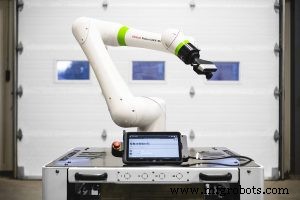
At DIY Robotics, we offer modular robotic cells that combine the precision of industrial robots with the flexibility of cobots. These mobile cells can be relocated and reprogrammed to any workstation, supported by user‑friendly teach pendants and built‑in software. Features such as external displays, scrolling menus, and real‑time status indicators make programming intuitive, while our free support and tutorials accelerate deployment and reduce downtime.
Summary
Choosing between industrial robots and collaborative robots hinges on task complexity, load requirements, and workspace constraints. Industrial robots excel in high‑volume, heavy‑weight environments, whereas cobots shine in flexible, human‑centric settings. Hybrid solutions—like our mobile robotic cells—offer the best of both worlds, delivering speed, safety, and adaptability to modern production floors.
Industrial equipment
- Expert Guide to Selecting the Ideal Laser Coding Machine for Your Production Line
- Electric vs. Diesel Construction Equipment: Power & Performance Showdown
- Atlas Copco Drives Water & Cost Savings at Widmer Brothers Brewery with Waterless Vacuum Pump
- Explore the Variety of Irrigation Systems: From Residential Sprinklers to Large-Scale Pivot Irrigators
- HDS Earns ISO 9001 Certification, Reinforcing Commitment to Premium Rotating Equipment Repairs
- Key Factors in Choosing the Right Compressed Air Filter
- Why a Vertical Machining Center Is a Smart Investment for Your Manufacturing Shop
- Carburetor Explained: How It Works, Its History, and Why It’s Been Replaced by Fuel Injection
- Why Hydraulic Motors Outperform Electric Motors: Efficiency, Durability, and Power
- Why Your Business Depends on Quality Clutch Friction Material